CCI ProChem® NEXUS R-Plus Photopolymer Screen Printing Emulsion – Ultra-Durable, Water-Resistant Emulsion for Water-Based, Discharge & Plastisol Inks

CCI
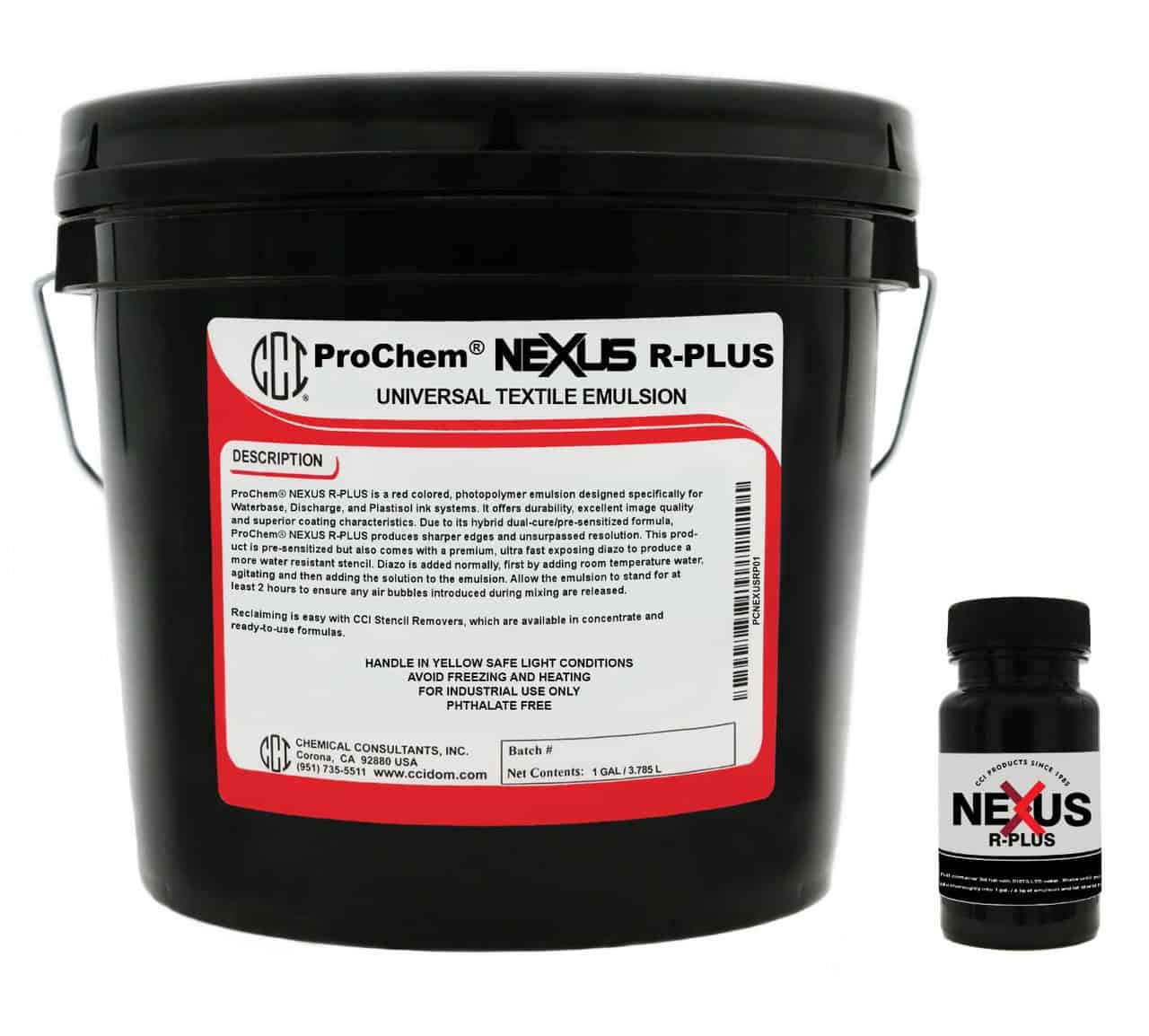
CCI ProChem® NEXUS R-Plus is a premium red photopolymer screen printing emulsion engineered for printers who demand maximum water resistance, long on-press durability, and reliable stencil performance across water-based, discharge, and plastisol ink systems. Pre-sensitized and ready to use straight from the container — no diazo mixing required for standard applications. An optional ultra-fast diazo sensitizer is included for jobs requiring enhanced water resistance against aggressive discharge chemistry. Ultra-high viscosity (12,000 CPS) builds thick, durable stencils with outstanding edge definition. Compatible with DTS (Direct-to-Screen) systems and traditional film-positive exposure.

Water-Based, Discharge & Plastisol Compatible
Pre-Sensitized — Ready to Use
Optional Diazo Included for Max Water Resistance
12,000 CPS Ultra-High Viscosity
48% Solids — Thick, Durable Stencils
Ultra-Fast Exposure Speeds
DTS Compatible
Excellent Edge Definition
Outstanding Humidity Resistance
Red Color for Easy Inspection
🚚 FREE Shipping on orders over $200|📦 In-Stock: Usually ships same or next business day|🏪 Free In-Store Pickup · San Antonio, TX

Price range: $82.56 through $3,893.00

Description

NEXUS R-Plus — The Discharge & Water-Based Specialist

Most photopolymer emulsions can handle plastisol just fine. Discharge printing is where stencils fail. The zinc formaldehyde sulfoxylate in discharge inks aggressively attacks emulsion binders — breaking down stencils, causing edge erosion, and ending runs early. NEXUS R-Plus was engineered specifically to resist that attack. Its 12,000 CPS ultra-high viscosity builds a thick, dense stencil wall that holds up under repeated discharge passes. The included optional ultra-fast diazo sensitizer crosslinks the emulsion further, delivering maximum chemical resistance for the most aggressive discharge applications. Water-based, discharge, or plastisol — NEXUS R-Plus handles them all without compromising run length or stencil integrity.

Key Features

🧪
Purpose-Built for Discharge Inks
Discharge inks chemically attack most emulsions — breaking down stencil edges and shortening runs. NEXUS R-Plus is specifically engineered to resist discharge chemistry, maintaining stencil integrity through long production runs.
💧
Maximum Water Resistance
Excellent water and humidity resistance prevents stencil swelling, edge bleed, and breakdown during water-based printing. The included diazo option pushes resistance even further for the most demanding discharge applications.
🏗️
12,000 CPS Ultra-High Viscosity
Higher viscosity means more emulsion deposited per coat, thicker stencil walls, and better ink hold-out. 48% solids content builds strong, dense stencils with excellent bridging across mesh threads.
🎯
Outstanding Edge Definition
Sharp, clean stencil edges with minimal sawtoothing — critical for halftones, fine type, and detailed artwork. Excellent bridging performance for clean openings at high mesh counts.
Ultra-Fast Exposure Speed
Shorter exposure times increase throughput in the screen room. Compatible with DTS (Direct-to-Screen) systems and traditional film positives with metal halide or LED exposure units.
🔴
Red Color for Easy Inspection
Red emulsion color provides strong contrast against the screen mesh, making it easy to visually inspect coating consistency, identify pinholes, and confirm complete image washout before sending screens to press.

Two Modes: Pre-Sensitized vs. Diazo-Enhanced

Mode 1 — Pre-Sensitized (Standard)
NEXUS R-Plus comes pre-sensitized. Open the container and coat. No diazo mixing required. Delivers excellent water and humidity resistance for most water-based and plastisol applications. Simpler workflow, longer emulsion shelf life.
Mode 2 — Ultra-Fast Diazo Added (Maximum Resistance)
For discharge printing or aggressive water-based chemistry, add the included ultra-fast diazo sensitizer. Mix diazo with room temperature water, pour into emulsion, stir thoroughly, let stand 2 hours to degas, then coat. Produces a more chemically crosslinked stencil with significantly enhanced water resistance and run length.

Step-by-Step Coating Procedure

1
Clean & Degrease the Screen
Use a quality screen degreaser — any ink oils, dirt, or residue will cause adhesion failure and pinholes. Rinse thoroughly and allow the screen to dry completely before coating. Degrease even new mesh before first use.
2
Optional — Mix Diazo for Enhanced Resistance
For discharge or aggressive water-based applications: add room temperature water to the diazo bottle, shake until fully dissolved, pour into the NEXUS R-Plus emulsion container, mix thoroughly. Allow emulsion to stand for 2 hours to release air bubbles before coating.
3
Coat the Screen
Work in a light-safe environment (yellow safelight OK) at 65% humidity. Use a clean coating trough with a smooth, nick-free edge. Apply 1–2 coats to the print side first. Reverse the screen and apply 1–2 coats to the squeegee side. Add extra coats for thicker EOM (Emulsion Over Mesh) if your application requires it.
4
Dry the Coated Screen
Dry horizontally, print side down, in a clean, dust-free room. Target 30–50% relative humidity. Use a dehumidifier if your shop runs humid. Good air circulation speeds drying. Do not expose until fully dry — wet or damp emulsion will not expose correctly.
5
Expose the Screen
Use an exposure calculator to determine correct time for your specific setup. Exposure time varies based on: emulsion thickness, mesh color (white vs. yellow), mesh count, and exposure unit type (metal halide vs. LED). See the exposure time reference table in the Technical Specifications tab.
6
Washout
Gently spray both sides with water. Allow 30–60 seconds for the emulsion to soften. Wash the print side until the image is fully open. Rinse both sides thoroughly. Dry the screen — a vacuum or compressed air accelerates drying. Inspect against a light source for pinholes.

Exposure Time Reference — Metal Halide Lamp

Times shown are for 2-over-2 coating on screens coated with NEXUS R-Plus. These are starting points — always use an exposure calculator to confirm for your specific setup, emulsion thickness, and artwork.

Mesh CountMesh Color8K Metal Halide (sec)5K Metal Halide (sec)
86 meshWhite20s30s
110 meshWhite16s27s
200 meshYellow16s27s
305 meshYellow14s20s
350 meshYellow12s19s

⚠️ These are starting-point reference times only. Always verify with an exposure calculator on your specific setup.

💡 Drying & Storage Conditions

Coated Screen Drying
  • 30–50% relative humidity
  • Good air circulation
  • Print side down, horizontal
  • Dust-free environment
Emulsion Storage
  • 59–77°F (15–25°C) without diazo
  • Coated screens: up to 30 days
  • Store at 40–60% humidity
  • Unopened: 1 year shelf life
With Diazo Added
  • Sensitized: 86–104°F (30–40°C)
  • Refrigerate for longer shelf life
  • Reduced shelf life once sensitized
  • Do not freeze

CCI ProChem Emulsion Comparison — Which Is Right for You?

ProductInk SystemsTypeViscositySolidsExposureColorBest For
NEXUS R-PlusWater-Based, Discharge, PlastisolPhotopolymer + Optional Diazo12,00048%Ultra-FastRedMax water/discharge resistance + discharge-specific jobs
TX-Discharge RedPlastisol, Water-Based, DischargeDiazo-Sensitized PhotopolymerHigh47%StandardRedDiazo-sensitized; wide exposure latitude for discharge
GTX RedPlastisol, UV, Solvent (some WB)Hybrid PhotopolymerStd40%FastRedPlastisol/UV/solvent specialty; limited water-based
GTX BluePlastisol, UV, Solvent (some WB)Hybrid PhotopolymerStd40%FastBlueSame as GTX Red, blue color
NEXUS BlueGraphic + Textile (general purpose)Photopolymer (no diazo needed)Std48%Ultra-FastBlueGeneral-purpose; no diazo; graphic + light textile
Questions? We’re here to help.
Call us at (512) 454-0505 Mon–Fri 9am–5pm CT

Contact Us →

Technical Specifications

SpecificationDetail
Product NameCCI ProChem® NEXUS R-Plus Photopolymer Screen Printing Emulsion
BrandCCI (Chemical Consultants, Inc.) — ProChem® line
SKUNEXUSRPLUS
TypePhotopolymer emulsion + optional ultra-fast diazo sensitizer (included)
ColorRed
Ink System CompatibilityWater-Based, Discharge, and Plastisol ink systems
ApplicationTextile screen printing
Viscosity12,000 CPS (Ultra-High)
Solids Content48%
SensitizationPre-sensitized — ready to use without diazo. Optional ultra-fast diazo included for enhanced water resistance.
DTS CompatibleYes — compatible with Direct-to-Screen (DTS) systems
Exposure SpeedUltra-Fast
Water ResistanceExcellent — outstanding humidity resistance; maximum resistance when diazo is added
Edge DefinitionExcellent — clean stencil edges with minimal sawtoothing
Coating MethodCoating trough — smooth, nick-free edge required. 1–2 coats print side, 1–2 coats squeegee side.
Coating EnvironmentLight-safe area (yellow safelight OK). 65% humidity target.
Drying — Humidity30–50% relative humidity. Dehumidifier recommended for humid shops.
Drying — PositionHorizontal, print side down. Dust-free environment.
Storage — Temp (no diazo)59–77°F (15–25°C)
Storage — Temp (sensitized)86–104°F (30–40°C). Refrigerate to extend sensitized shelf life.
Shelf Life (unopened)1 year when stored correctly
Coated Screen Shelf LifeUp to 30 days at 40–60% humidity
Diazo Mixing ProcedureAdd room temperature water to diazo bottle, shake to dissolve. Pour into emulsion, mix thoroughly. Rest 2 hours to degas before coating.
WashoutGentle water spray both sides. Allow emulsion to soften. Wash print side until image is open. Rinse thoroughly.
ReclaimingUse CCI emulsion removers (ready-to-use or concentrated). Standard reclaiming procedure.
HazardousNo
Exposure Times — 86 mesh White8K Metal Halide: 20 sec | 5K Metal Halide: 30 sec
Exposure Times — 110 mesh White8K Metal Halide: 16 sec | 5K Metal Halide: 27 sec
Exposure Times — 200 mesh Yellow8K Metal Halide: 16 sec | 5K Metal Halide: 27 sec
Exposure Times — 305 mesh Yellow8K Metal Halide: 14 sec | 5K Metal Halide: 20 sec
Exposure Times — 350 mesh Yellow8K Metal Halide: 12 sec | 5K Metal Halide: 19 sec
Technical Data SheetNEXUS R-Plus Technical Data Sheet (PDF)
Safety Data SheetNEXUS R-Plus Safety Data Sheet (PDF)

FREQUENTLY ASKED QUESTIONS

What makes NEXUS R-Plus different from a standard photopolymer emulsion?
NEXUS R-Plus is specifically engineered for water-based and discharge ink systems — which chemically attack most standard emulsions. Its 12,000 CPS ultra-high viscosity builds a thicker, denser stencil wall, and its included diazo option produces a more chemically crosslinked stencil with significantly enhanced resistance to discharge chemistry. Standard photopolymers will often break down prematurely under repeated discharge printing.
Do I have to add the diazo, or can I use it pre-sensitized?
NEXUS R-Plus comes pre-sensitized and works without adding the diazo — this is the standard mode for most applications. The included ultra-fast diazo is optional and is used specifically when maximum water resistance is required, such as for discharge printing or aggressive water-based chemistry. Pre-sensitized mode offers a simpler workflow and longer shelf life. Add the diazo only when you need that extra level of stencil resistance.
How do I mix the diazo?
Add room temperature water to the diazo bottle, cap and shake until fully dissolved. Pour the diazo solution into the NEXUS R-Plus container and mix thoroughly. Allow the sensitized emulsion to stand for 2 hours before coating — this lets air bubbles release and ensures even mixing. Once the diazo is added, the sensitized emulsion should be refrigerated to extend its shelf life.
What mesh counts does NEXUS R-Plus work with?
NEXUS R-Plus works across the full range of textile mesh counts — from 86 mesh for heavy ink deposit and specialty effects to 350 mesh for fine halftones and detail work. The TDS includes specific exposure time references for 86, 110, 200, 305, and 350 mesh. Always use an exposure calculator to verify for your specific setup.
Is NEXUS R-Plus compatible with DTS (Direct-to-Screen) systems?
Yes — NEXUS R-Plus is explicitly rated as compatible with DTS systems. Its ultra-fast exposure speed makes it well-suited to DTS workflows where exposure times need to be short for production efficiency.
What’s the difference between white and yellow mesh for exposure?
White mesh allows more light scatter within the mesh threads, which can slightly reduce resolution but doesn’t require as long an exposure. Yellow-dyed mesh blocks scattered UV light, improving edge definition and resolution — particularly important at high mesh counts (200+) for fine detail work. The exposure time reference table in the Specs tab shows yellow mesh requires similar or slightly less time than white at the same count due to better light efficiency.
How do I reclaim screens coated with NEXUS R-Plus?
Use CCI emulsion removers, available in ready-to-use or concentrated formulas. Apply emulsion remover, allow appropriate dwell time per the remover’s instructions, then pressure wash. Standard screen reclaiming procedure applies. If a haze remains after reclaiming, a haze remover may be needed — CCI offers compatible haze removal products.
How long can I store coated screens?
Coated screens can be stored for up to 30 days under proper conditions: 40–60% relative humidity in a dark, dust-free environment. Exposure to humidity above this range can cause premature emulsion breakdown or reduced resolution. Store in a screen drying cabinet or dark cabinet with controlled humidity for best results.
Can I use NEXUS R-Plus with LED exposure units?
The published exposure times in the TDS are based on metal halide lamps. LED exposure units typically require different (often shorter) times due to different UV output characteristics. If using an LED unit, start with the exposure calculator and test strips rather than using the metal halide times directly.
What emulsion removers work with NEXUS R-Plus?
CCI’s own emulsion removers are specifically compatible and recommended. CCI offers both ready-to-use and concentrated formulas. River City Supply carries CCI chemistry products — contact us for recommendations on compatible reclaiming products.
Download Technical Documents
Full technical data and safety information from CCI
Questions? We’re here to help.
Call us at (512) 454-0505 Mon–Fri 9am–5pm CT

Contact Us →

Reviews

Reviews

    Only logged in customers who have purchased this product may leave a review.

    You May Also Like

    Additional Options