Matsui Fixer V | Wash & Crock Fastness Crosslinker for Polyurethane Water-Based Screen Printing Inks
Matsui
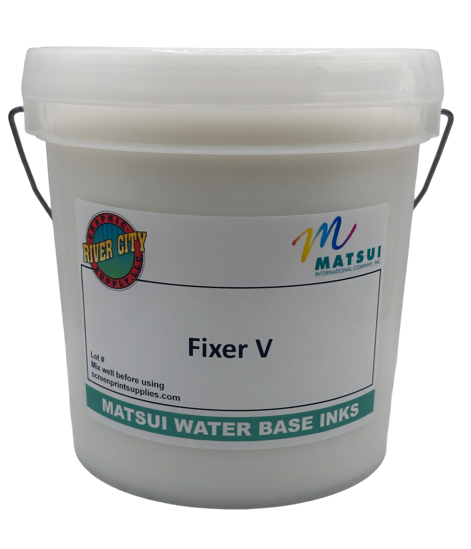
Matsui Fixer V (RM0491) is a crosslinking agent specifically formulated to improve wash fastness and crocking fastness in Matsui’s polyurethane-based water-based screen printing inks. Add 2-3% by weight to Matsui SWR Series, Soft-Tex 350 Series, and other polyurethane-binder ink systems to dramatically increase print durability on nylon, polyester, and water-repellent performance fabrics. Unlike Fixer WF-N — which is the standard crosslinker for Matsui’s acrylic-based inks (301 RC, Alpha, Infinity, EasyPrint, Stretch, Kombat) — Fixer V is chemically matched to polyurethane resin systems, creating stronger crosslinks in PU binders than Fixer WF-N or Fixer L can achieve. Free of APEO, formaldehyde, and organotin compounds. Meets all major brand RSL (Restricted Substance List) requirements. PVC-free.
Price range: $99.99 through $1,799.99
Description
Matsui Fixer V — The Crosslinker Built for Polyurethane Ink Systems
Matsui makes three fixers for improving wash fastness in water-based screen printing inks. Each one is formulated for a specific type of ink resin chemistry. Use the wrong fixer in the wrong ink and you will either get weak crosslinking, no crosslinking, or — worst case — compromise the ink’s performance entirely.
Fixer V exists because polyurethane-based inks are chemically different from acrylic-based inks, and they need a crosslinker that is matched to their specific resin structure. You cannot simply use Fixer WF-N in a polyurethane ink and expect the same wash durability you get in an acrylic ink. The crosslinking chemistry does not work that way.
Here is the full picture of the Matsui fixer lineup — and exactly where each one belongs.
The Three Matsui Fixers — Which One Goes in Which Ink
| Fixer | Designed For | Dosage | Crosslinking Mechanism | Pot Life | Cure Temp Effect | RSL Compliant |
|---|---|---|---|---|---|---|
| Fixer V (RM0491) | Polyurethane-based inks — SWR Series, Soft-Tex 350 Series, and other PU binder systems | 2-3% | Crosslinker matched to polyurethane resin chemistry. Improves both wash fastness and crocking fastness. | No limit stated | None — cure at ink’s standard temperature | Yes — free of APEO, formaldehyde, organotin compounds |
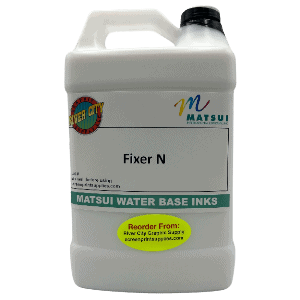
| Fixer WF-N (RM0480) | Acrylic-based inks — 301 RC, 301C Clear, 301M Matte, Alpha, Infinity, EasyPrint, Stretch, Kombat, Discharge, Simple | 1-4% | Crosslinker matched to acrylic resin chemistry. Improves wash fastness. | No limit | Lowers cure temp to 300°F (150°C) | Yes — meets all major brand RSL requirements |
| Fixer L (Drying Agent) | Any Matsui ink where air drying, lower cure temps, or faster belt speeds are needed | 2-3% | Air-dry crosslinker. Bonds chemically with ink for wash durability even without full heat cure. | ~24 hours once mixed | Lowers cure temp to 250°F (120°C). Enables air drying. | Yes — meets all major brand RSL requirements |
The critical point: Fixer WF-N is the default fixer for the vast majority of Matsui inks because most Matsui inks are acrylic-based. It is included in Quick Additive. It is listed on every standard ink TDS. But when you are printing with Matsui’s polyurethane-based ink systems — specifically the SWR Series and Soft-Tex 350 Series — the designated fixer is Fixer V, not Fixer WF-N.
Why Polyurethane Inks Need a Different Fixer
Water-based screen printing inks consist of three core components: pigment (color), binder/resin (the polymer that forms the film and bonds to the fabric), and water (the carrier that evaporates during curing). The binder is the critical component that determines the ink’s adhesion, flexibility, and wash durability.
Matsui’s standard ink lines (301 RC, Alpha, Infinity, EasyPrint, Stretch, Kombat, Discharge) use acrylic-based binder systems. Acrylic resins are versatile, cost-effective, and well-suited for cotton and cotton-blend garments. They form a durable film when heat-cured and respond well to Fixer WF-N’s crosslinking chemistry.
But acrylic binders have limitations on certain substrates. Water-repellent fabrics (DWR-treated nylon and polyester), slick performance fabrics, and synthetic technical textiles have surface energy characteristics that make it difficult for acrylic inks to achieve strong adhesion. Polyurethane-based binders solve this problem — PU resins have inherently better adhesion to these challenging surfaces, along with superior flexibility and elasticity.
The tradeoff is that polyurethane resins have different reactive sites and different polymer chain structures than acrylic resins. A crosslinker that works efficiently with acrylic hydroxyl and carboxyl groups may not form effective crosslinks with polyurethane urethane bonds and isocyanate-derived segments. Fixer V is formulated specifically to match the reactive chemistry of PU binders, forming stronger, more durable crosslinks within the polyurethane film.
This is why the SWR Series TDS specifies Fixer V at 2-3% — not Fixer WF-N. And this is why the Soft-Tex 350 Series TDS specifies Fixer V at 2-3% — not Fixer WF-N.
Which Matsui Inks Require Fixer V
| Matsui Ink System | Binder Type | Target Substrates | Designated Fixer |
|---|---|---|---|
| SWR Clear (WS0574) | Polyurethane | Water-repellent nylon, polyester, DWR-treated fabrics | Fixer V 2-3% |
| SWR White (WS0575) | Polyurethane | Water-repellent nylon, polyester, DWR-treated fabrics | Fixer V 2-3% |
| SWR Blocker | Polyurethane | Dye sublimation blocking on water-repellent polyester | Fixer V 2-3% |
| Soft-Tex White 350 (WS0542) | Polyurethane (rubber binder) | Performance fabrics requiring rubber-like elasticity | Fixer V 2-3% |
| Soft-Tex Clear 350G | Polyurethane (rubber binder) | Clear undercoat for Soft-Tex system | Fixer V 2-3% |
| Matsui Ink System | Binder Type | Designated Fixer | Use Fixer V? |
|---|---|---|---|
| 301 RC White / Clear / Matte | Acrylic | Fixer WF-N 1-4% | No — use Fixer WF-N |
| Alpha Series | Acrylic | Fixer WF-N 1-3% | No — use Fixer WF-N |
| Infinity Series | Acrylic | Fixer WF-N 1-3% | No — use Fixer WF-N |
| EasyPrint Series | Acrylic | Fixer WF-N 1-5% | No — use Fixer WF-N |
| Stretch Series | Acrylic | Fixer WF-N 1-5% | No — use Fixer WF-N |
| Kombat White / Black / Blocker | Acrylic | Fixer WF-N 1-5% | No — use Fixer WF-N |
| Discharge Inks | Acrylic | Fixer WF-N 1-5% | No — use Fixer WF-N |
| Simple Series | Acrylic | Fixer WF-N | No — use Fixer WF-N |
What “Wash Fastness” and “Crocking Fastness” Mean — And Why Both Matter
Fixer V improves two distinct types of print durability:
Wash fastness measures how well a print survives repeated laundry cycles without fading, cracking, peeling, or washing off. In garment decoration, this is the primary durability metric — a print that fades or cracks after 10 washes is a failed product. Fixer V strengthens the crosslinked network within the polyurethane film, making the cured ink more resistant to the combination of water, detergent, mechanical agitation, and heat that occurs during laundering.
Crocking fastness measures how resistant a print is to color transfer when rubbed. If you rub a printed garment against a white fabric and color transfers, the print has poor crock fastness. This is particularly important for performance and activewear fabrics where the print is under constant friction from body movement, equipment straps, or contact with other garments. Fixer V improves the cohesion of the cured polyurethane film so that surface pigment does not release under friction.
Most fixers improve wash fastness only. Fixer V explicitly improves both wash fastness and crocking fastness — a significant advantage for performance fabric applications where friction is constant.
Matsui Fixer V Key Features:
- Designed Specifically for Polyurethane Binder Systems: Fixer V is chemically matched to polyurethane resin chemistry — it is the designated crosslinker for Matsui’s SWR Series and Soft-Tex 350 Series inks. Do not substitute with Fixer WF-N in these ink systems.
- Greatly Improves Both Wash Fastness and Crocking Fastness: Fixer V strengthens the crosslinked polyurethane film for superior resistance to laundering and superior resistance to color transfer under friction. Most fixers address wash fastness only — Fixer V addresses both.
- Free of Banned Substances: Contains no APEO (alkylphenol ethoxylates), no formaldehyde, and no organotin compounds. Meets the Restricted Substance Lists (RSL) of all major apparel brands.
- Low Dosage — 2-3% by Weight: A small addition produces a significant improvement in durability without altering the ink’s printability, hand feel, or cure behavior.
- Essential for Water-Repellent and Technical Fabrics: The SWR and Soft-Tex systems are used on nylon, polyester, DWR-treated jackets, performance athletic fabrics, and other challenging synthetics where adhesion and durability are paramount. Fixer V ensures these prints survive real-world wear and washing.
- Does Not Alter Cure Temperature: Unlike Fixer WF-N (which lowers cure to 300°F) and Fixer L (which lowers cure to 250°F), Fixer V does not change the cure temperature of your ink. Cure at the standard temperature specified by your base ink.
- Compatible with Other Matsui Additives: Use alongside Retarder MG (open time), Thickener B (viscosity), and RV Additive (viscosity reducer) in the same batch.
- PVC-Free: Consistent with the Matsui PVC-free, eco-friendly product line.
Why Screen Printers Use Matsui Fixer V
“I’m printing on DWR-treated nylon jackets with SWR ink and my prints are washing off.” This is the #1 scenario Fixer V was made for. SWR inks are polyurethane-based because PU binders adhere better to water-repellent surfaces than acrylic binders. But even PU ink needs crosslinking to achieve lasting wash durability on these challenging fabrics. Adding 2-3% Fixer V creates the chemical crosslinks that lock the ink film to the fabric through repeated laundering cycles.
“I added Fixer WF-N to my SWR ink and my wash test results are still poor.” Fixer WF-N is formulated for acrylic resin systems. When added to polyurethane-based SWR ink, the crosslinking efficiency is low because the reactive chemistry is not matched to PU binder structures. Switching to Fixer V — the designated fixer for PU inks — will produce dramatically better wash fastness results.
“My prints on performance polyester are rubbing off during wear.” Color transfer under friction (poor crocking fastness) is a common issue on performance fabrics because the garment is under constant physical stress during athletic activity. Fixer V explicitly improves crocking resistance by strengthening the cohesion of the cured PU film so pigment does not release under rubbing.
“I’m printing athletic wear and my brand partner requires RSL compliance.” Major sportswear brands (Nike, Adidas, Under Armour, etc.) maintain strict Restricted Substance Lists. Fixer V is free of APEO, formaldehyde, and organotin compounds — three categories that are commonly restricted. It meets all major brand RSL requirements, keeping your production in compliance.
“I’m printing Soft-Tex 350 rubber binder ink and need maximum wash durability.” The Soft-Tex 350 Series uses a polyurethane rubber binder for exceptional flexibility and a silicone-like feel. Like SWR, it specifies Fixer V at 2-3% — not Fixer WF-N. The PU rubber binder requires a PU-matched crosslinker to achieve its full wash durability potential.
“I’m not sure which Matsui fixer to use — I have Fixer WF-N, Fixer L, and Fixer V in my shop.” The rule is simple: check what ink system you are using. If it is a standard acrylic-based ink (301, Alpha, Infinity, EasyPrint, Stretch, Kombat, Discharge), use Fixer WF-N. If it is a polyurethane-based ink (SWR, Soft-Tex 350), use Fixer V. If you need air-drying capability or the lowest possible cure temperature regardless of ink type, use Fixer L (and note its 24-hour pot life). The Matsui TDS for each ink system specifies the correct fixer — follow it.
How to Use Matsui Fixer V
Step 1 — Confirm Your Ink Is Polyurethane-Based. Fixer V is designed for PU binder systems. Check the product name and TDS of your Matsui ink. If it is SWR Series or Soft-Tex 350 Series, use Fixer V. If it is any other Matsui ink, use Fixer WF-N instead.
Step 2 — Weigh Your Ink. Place your Matsui PU-based ink on a scale and record the weight.
Step 3 — Calculate the Dosage. Add 2-3% Fixer V by weight.
| Ink Amount | 2% Fixer V | 2.5% Fixer V | 3% Fixer V |
|---|---|---|---|
| 1 Pint (approx. 454g) | 9g | 11.4g | 13.6g |
| 1 Quart (approx. 908g) | 18g | 22.7g | 27g |
| 1 Gallon (approx. 3,632g) | 73g | 91g | 109g |
Step 4 — Mix Thoroughly. Add the calculated amount to your ink and mix with clean utensils until fully integrated.
Step 5 — Print and Cure Normally. Fixer V does not change your cure temperature. Cure at the standard temperature specified by your base ink system (SWR cures per its TDS; Soft-Tex 350 cures at 320°F / 160°C).
Step 6 — Conduct a Wash Test. Before production, print a sample, cure it fully, and run it through 3-5 home laundering cycles to verify wash fastness meets your quality standard.
Pro Tips for Best Results
- Always use the correct fixer for your ink chemistry. Fixer V for polyurethane inks (SWR, Soft-Tex 350). Fixer WF-N for acrylic inks (301 RC, Alpha, Infinity, EasyPrint, Stretch, Kombat, Discharge). Fixer L when you need air-drying or the lowest possible cure temperature. Using the wrong fixer in the wrong ink system will result in poor wash performance.
- Full cure is still critical. Fixer V improves the crosslinked network within the cured ink film, but the ink must still reach full cure temperature. Under-cured PU ink will have poor wash fastness regardless of fixer usage. Use a temperature probe or heat strips to verify your dryer is delivering the required temperature at the garment surface.
- If wash fastness is still marginal, try 3% instead of 2%. The 2-3% range gives you room to adjust. For extreme durability requirements (branded sportswear, outerwear, uniforms), go to the high end at 3%.
- Test on the actual production fabric. Water-repellent fabrics vary widely in their surface treatment and chemistry. The specific DWR treatment, fabric weave, and fiber type all affect ink adhesion and durability. Always conduct a wash test on the actual garment before committing to a production run.
- Fixer V works alongside the other SWR-compatible additives. The SWR TDS also lists Retarder MG (1-5% for open time) and Thickener B (0.25-1% for viscosity). All three additives — Fixer V, Retarder MG, and Thickener B — can be used together in the same SWR ink batch.
- Use clean mixing vessels. As with all Matsui products, contamination from other ink sources or non-approved additives can compromise PVC-free certification and may affect the crosslinking chemistry.
- Note: Quick Additive is NOT a substitute for Fixer V on PU inks. Quick Additive contains Fixer WF-N (the acrylic fixer), not Fixer V. Do not use Quick Additive as your fixer when printing with SWR or Soft-Tex 350 — it contains the wrong crosslinker for PU inks. If you want open time and softness along with the correct fixer, add Retarder MG + Softener MG + Fixer V individually.
Technical Specifications
| Specification | Detail |
|---|---|
| Product Name | Matsui Fixer V |
| Product Code | RM0491 |
| Type | Crosslinking agent / wash fastness enhancer for polyurethane water-based printing binders |
| Primary Function | Improve wash fastness and crocking fastness in polyurethane-based Matsui water-based inks |
| Recommended Dosage | 2-3% by weight |
| Designed for Ink Chemistry | Polyurethane-based water-based printing binders |
| Designated Ink Systems | Matsui SWR Series (Clear, White, Blocker), Soft-Tex 350 Series (Clear 350G, White 350W) |
| NOT Designed For | Acrylic-based Matsui inks (301 RC, Alpha, Infinity, EasyPrint, Stretch, Kombat, Discharge, Simple) — use Fixer WF-N for these |
| Durability Improvement | Both wash fastness AND crocking fastness |
| Effect on Cure Temperature | None — does not change the cure temperature of the base ink |
| Mixing Requirement | Standard hand mixing — mix thoroughly until fully integrated |
| Banned Substances | Free of APEO, formaldehyde, and organotin compounds |
| RSL Compliance | Meets Restricted Substance List requirements of all major apparel brands |
| Target Substrates | Nylon, polyester, water-repellent (DWR-treated) fabrics, performance technical textiles, synthetic athletic fabrics |
| Formulation | PVC-free, environmentally safe |
| Storage | 65°F to 95°F (18°C to 35°C). Avoid direct sunlight. Store in a cool, dry place. |
| Cleanup | Water and mild soap or detergent |
| Available Sizes | Quart, Gallon |
Benefits at a Glance
- The designated crosslinker for Matsui’s polyurethane-based ink systems — SWR Series and Soft-Tex 350 Series
- Greatly improves both wash fastness and crocking fastness — not just one
- Chemically matched to polyurethane resin chemistry for stronger, more durable crosslinks than Fixer WF-N or Fixer L can achieve in PU inks
- Essential for printing on water-repellent nylon, polyester, DWR-treated fabrics, and other challenging technical textiles where adhesion is critical
- Free of APEO, formaldehyde, and organotin compounds — meets all major brand RSL requirements for safety and compliance
- Low dosage (2-3%) with major impact on print durability
- Does not alter cure temperature — no process adjustments required
- Compatible with Retarder MG and Thickener B for complete SWR and Soft-Tex 350 ink optimization
- PVC-free formulation consistent with the Matsui eco-friendly product line
- Critical for branded sportswear, outerwear, and performance apparel production where both wash durability and regulatory compliance are mandatory
Technical Sheets / Safety Data Sheets / Documents
FREQUENTLY ASKED QUESTIONS
What does Matsui Fixer V do?
Matsui Fixer V is a crosslinking agent designed for polyurethane-based water-based inks.
It improves:
- Wash fastness
- Crocking fastness
- Ink film durability
- Resistance to laundering and friction
Fixer V strengthens the crosslinked network within the cured polyurethane ink film for long-term performance.
How much Fixer V should I add?
Recommended usage: 2–3% by weight
- 2% – Standard wash durability
- 3% – Maximum durability for challenging fabrics or brand-spec production
Always measure by weight for consistency.
Which Matsui inks should I use Fixer V with?
Fixer V is specifically designed for polyurethane-based Matsui inks, including:
- SWR Series (Clear SWR, White SWR, SWR Blocker)
- Soft-Tex 350 Series (Clear 350G, White 350W)
Do not use Fixer V with acrylic-based Matsui inks. For those systems, use Fixer WF-N.
What is the difference between Fixer V, Fixer WF-N, and Fixer L?
Each fixer is designed for a specific chemistry or use case:
Fixer V:
- For polyurethane-based inks (SWR, Soft-Tex 350)
- Does not change cure temperature
Fixer WF-N:
- For acrylic-based inks (301, Alpha, Infinity, EasyPrint, Stretch, Kombat, Discharge)
- Lowers cure temperature to 300°F
Fixer L:
- Air-dry crosslinker
- Lowers cure temperature to 250°F
- 24-hour pot life
Using the correct fixer for your ink chemistry is essential for maximum durability.
Can I use Fixer WF-N instead of Fixer V in SWR inks?
No.
Fixer WF-N is formulated for acrylic resin systems and will not properly crosslink polyurethane binders. The SWR Technical Data Sheet specifies Fixer V at 2–3%.
Can I use Quick Additive instead of Fixer V?
No.
Quick Additive contains Fixer WF-N (for acrylic systems), not Fixer V. It is not a substitute for polyurethane-based ink systems.
For SWR or Soft-Tex 350, use Fixer V along with any additional desired additives.
What does “crocking fastness” mean?
Crocking fastness measures resistance to color transfer when a print is rubbed against another surface.
Poor crocking fastness results in color transfer onto white fabric or other materials. This is especially important for:
- Performance apparel
- Athletic garments
- High-friction applications
Does Fixer V contain formaldehyde or APEO?
No.
Fixer V is:
- APEO-free
- Formaldehyde-free
- Free of organotin compounds
- Compliant with all major brand RSLs
Does Fixer V change cure temperature?
No.
Unlike Fixer WF-N (300°F) and Fixer L (250°F), Fixer V does not alter cure requirements.
Cure according to the base ink system specifications.
What fabrics is Fixer V most important for?
Fixer V is especially important when printing on:
- Water-repellent (DWR-treated) nylon
- Polyester
- Technical performance fabrics
- Synthetic athletic wear
These substrates are difficult for ink adhesion, making crosslinking essential for durability.
Does Fixer V have a pot life?
Matsui does not specify a strict pot life.
However, as with all crosslinking agents, it is best practice to:
- Use mixed ink within a reasonable production window
- Conduct wash tests if ink has been stored for extended periods
Reviews
Only logged in customers who have purchased this product may leave a review.


Reviews