Matsui Emacol R-600-E | Long-Bodied Viscosity Thickener for Halftone Dot Retention in Water-Based Screen Printing Ink
Matsui
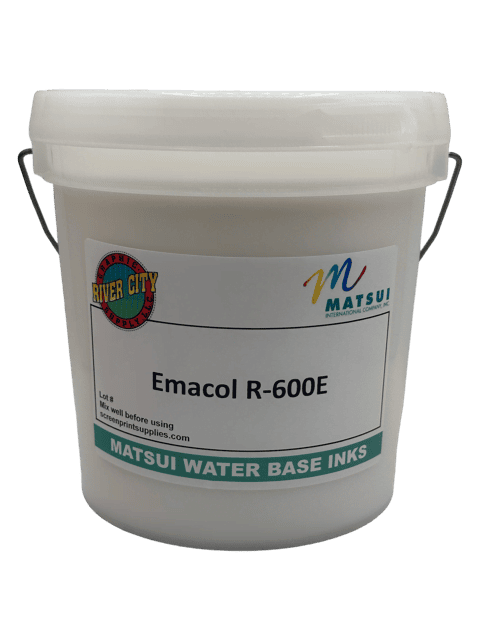
Matsui Emacol R-600-E (RM0471) is a long-bodied viscosity thickener designed to raise the viscosity of Matsui water-based screen printing inks and improve halftone dot retention. Add 0.25-1% by weight to increase ink body, hold halftone dots, reduce dot gain, and maintain print sharpness across tonal gradients. Unlike Matsui Thickener B (Carrier B), which creates a short-bodied ink that snaps and breaks cleanly, Emacol R-600-E produces a long-bodied ink with a smoother, more elastic flow profile — the ink stretches and pulls rather than snapping, providing excellent dot holding characteristics while maintaining a smooth, continuous flow through the mesh. Requires a high-speed mixer for proper dispersion. No pot life limitation. Compatible with all Matsui water-based ink systems. PVC-free.
Price range: $99.99 through $349.99
Description
Matsui Emacol R-600-E — The Long-Bodied Viscosity Thickener for Halftone Printing
Matsui makes two thickeners that raise ink viscosity and improve halftone dot retention. Both use the same dosage (0.25-1%), both require a high-speed mixer, and both are designed to help halftone dots hold their shape after printing. But they produce fundamentally different types of ink body — and that difference matters.
Thickener B (Carrier B) creates a short-bodied ink. Short-bodied ink snaps and breaks cleanly when pulled. It has fast thixotropic recovery — the ink shears thin under the squeegee, then snaps back to its resting viscosity almost instantly. It is designed for printers who want each dot to lock in place immediately.
Emacol R-600-E creates a long-bodied ink. Long-bodied ink stretches and flows smoothly when pulled. It has a more elastic, continuous flow profile — the ink moves through the mesh in a smooth, connected stream rather than breaking into discrete segments. It still holds halftone dots after deposit, but it gets there through a different rheological pathway — higher yield stress and cohesive flow rather than sharp snap-back.
These are not interchangeable products that do the same thing differently. They are two distinct rheological tools for printers who are tuning their ink to specific printing conditions, mesh counts, designs, and press setups.
What “Long-Bodied” Ink Means — and When It’s the Right Choice
Ink “body” describes how the ink behaves when it is pulled, stretched, or separated. It sits on a spectrum:
Short-bodied ink (created by Thickener B) breaks cleanly and quickly. When the squeegee lifts the mesh off the garment, the ink separates abruptly. There is very little stringing or stretching — the ink snaps. This is ideal when you want each halftone dot deposited as a discrete, sharp-edged point with no trailing ink.
Long-bodied ink (created by Emacol R-600-E) stretches and pulls when separated. When the squeegee lifts the mesh, the ink forms smooth, controlled filaments between the mesh and the garment before eventually separating. This elastic behavior creates a more continuous ink film with excellent cohesion — the ink holds together as a unified deposit rather than breaking into separate pieces.
Why would you want a long-bodied ink for halftone printing? Several reasons:
Smoother tonal transitions. In halftone and simulated process work, the visual effect depends on smooth gradients between light and dark areas. Long-bodied ink’s cohesive flow produces deposits with smoother edges and more even ink coverage within each dot, which translates to smoother tonal gradients across the printed image.
Better performance on automatic presses. On high-speed automatic presses, the mesh separates from the garment very quickly. Short-bodied ink’s snap-back can sometimes cause ink deposit inconsistencies at high press speeds because the ink breaks before it has fully transferred. Long-bodied ink’s elastic behavior maintains contact with the garment for slightly longer during mesh separation, promoting more complete and consistent ink transfer at speed.
Reduced mesh marking. Short-bodied ink’s abrupt break can sometimes leave mesh-pattern artifacts in the printed surface — visible grid lines where the ink snapped off at each mesh thread. Long-bodied ink’s smooth separation tends to level out more evenly, reducing visible mesh marking.
Higher yield stress. Long-bodied ink resists flowing under gravity more effectively than short-bodied ink at the same measured viscosity. This means a long-bodied ink can hold a halftone dot’s shape on the garment through a different mechanism — not snap-back speed, but resistance to deformation under its own weight.
Emacol R-600-E vs. Thickener B — The Two Matsui Halftone Thickeners Compared
| Specification | Emacol R-600-E (RM0471) | Thickener B / Carrier B (RM0680) |
|---|---|---|
| Primary Function | Raise viscosity + hold halftone dots | Raise viscosity + hold halftone dots |
| Ink Body Created | Long-bodied — elastic, smooth, cohesive flow | Short-bodied — snappy, clean break, fast recovery |
| Dosage | 0.25-1% | 0.25-1% |
| Mixing Requirement | High-speed mixer required | High-speed mixer required |
| How It Holds Dots | Higher yield stress and cohesive flow — the ink resists deformation under its own weight | Fast thixotropic recovery — the ink snaps back to high viscosity almost instantly after deposit |
| Mesh Separation Behavior | Smooth, elastic separation with controlled filament formation | Abrupt, clean separation with minimal filament formation |
| Tonal Gradient Quality | Smoother gradients — cohesive deposits with even edges | Sharp dots — each deposit is a discrete, hard-edged point |
| Mesh Marking | Less visible — elastic flow levels out after separation | More visible at lower mesh counts — abrupt break can leave grid pattern |
| Best for High-Speed Auto Press | Yes — elastic behavior maintains ink transfer at speed | May need press speed optimization to ensure complete transfer |
| Best for Manual Press | Yes — smooth flow is forgiving at variable squeegee speeds | Yes — snap-back locks dots immediately regardless of technique |
| Ideal Printing Scenario | Smooth gradients, simulated process, photorealistic images, high-speed automatic presses, lower mesh counts where mesh marking is a concern | Sharp discrete dots, high-contrast halftones, spot color halftones, index printing, high mesh counts where snap-back is critical |
| Pot Life | No limit | No limit |
| Can They Be Combined? | Yes — blending both creates a hybrid rheology between short-bodied and long-bodied. This allows printers to fine-tune the exact ink behavior they want for a specific job. | |
The decision tree: If your halftone work prioritizes sharp, discrete dots with hard edges (index printing, spot color halftones, high-contrast graphic separations), start with Thickener B. If your halftone work prioritizes smooth tonal gradients and photorealistic imagery (simulated process, CMYK process, continuous tone reproductions), start with Emacol R-600-E. If you want something in between, blend both.
When to Use Emacol R-600-E vs. Thickener B vs. Both
| Printing Scenario | Recommended Thickener | Why |
|---|---|---|
| Simulated process printing (6-10+ colors, photorealistic images on darks) | Emacol R-600-E | Smooth tonal gradients and even ink coverage across complex color separations |
| CMYK 4-color process on lights | Emacol R-600-E | Even dot formation across all four process colors for clean color blending |
| High-speed automatic press running halftone jobs | Emacol R-600-E | Elastic flow maintains consistent ink transfer at fast mesh separation speeds |
| Lower mesh counts (110-160) with halftone work | Emacol R-600-E | Elastic leveling reduces visible mesh marking that is more common on lower mesh |
| Index color separation printing | Thickener B | Index printing uses square dots that need hard, sharp edges — snap-back is ideal |
| Spot color halftone fades (single color vignettes, 1-2 color designs with gradients) | Thickener B | Clean, discrete dots with fast recovery for simple, high-contrast tonal work |
| High mesh (230-305) with fine halftone detail | Thickener B | Tight mesh openings benefit from snap-back that locks very small dots immediately |
| Mixed job — photorealistic imagery with sharp text or graphic elements in the same design | Both — blended | Blending 50/50 creates a hybrid rheology that balances smooth gradients with sharp detail |
| Testing and dialing in — not sure which is best for your setup | Try each separately, then blend | Print the same halftone test image with each thickener independently, compare results, then fine-tune with a blend |
Matsui Emacol R-600-E Key Features:
- Raises Ink Viscosity for Halftone Dot Retention: Add 0.25-1% by weight to increase the viscosity of any Matsui water-based ink and improve halftone dot retention, reducing dot gain and preserving tonal detail.
- Creates Long-Bodied Ink Rheology: Unlike Thickener B which creates short-bodied (snappy, abrupt break) ink, Emacol R-600-E creates long-bodied ink with an elastic, smooth, cohesive flow profile that stretches and levels rather than snapping.
- Smoother Tonal Gradients in Halftone Prints: The long-bodied flow produces dots with smoother edges and more even ink coverage, which translates to smoother visual gradients across photorealistic and simulated process images.
- Reduced Mesh Marking: The elastic flow characteristic promotes post-separation leveling, reducing visible mesh-pattern artifacts in the printed surface — especially beneficial on lower mesh counts.
- Excellent Performance at High Press Speeds: Long-bodied ink maintains contact during rapid mesh separation on automatic presses, promoting more complete and consistent ink transfer at production speeds.
- Higher Yield Stress for Dot Stability: Dots hold their shape through resistance to deformation under their own weight, not just snap-back speed — a different and complementary mechanism to Thickener B.
- Combinable with Thickener B: Blend Emacol R-600-E and Thickener B together to create a hybrid rheology tuned to your specific printing conditions. This is the ultimate precision tool for halftone optimization.
- Compatible with All Matsui Water-Based Inks: Works across 301 RC, Alpha, Infinity, Stretch, Simple, EasyPrint, Discharge, and all Matsui specialty inks and binders.
- Low Dosage, High Impact: Just 0.25-1% by weight is sufficient to produce a measurable change in viscosity and dot retention.
- No Pot Life Limitation: Emacol R-600-E does not expire once mixed into ink. Your batch remains usable indefinitely.
- Requires High-Speed Mixer: Like Thickener B, proper dispersion requires a high-speed mixer (drill-mounted mixing blade, lab mixer, or equivalent). Hand stirring is not sufficient.
- PVC-Free: Consistent with the Matsui PVC-free product line.
Why Screen Printers Use Matsui Emacol R-600-E
“I’m printing simulated process and my gradients look rough and choppy.” Simulated process printing depends on smooth, seamless tonal transitions across 6-10+ color separations. If each halftone dot deposits as a hard-edged discrete point (the Thickener B profile), the transitions between tonal values can look choppy under close inspection. Emacol R-600-E’s long-bodied flow produces dots with softer edges and more even coverage, resulting in smoother, more photorealistic gradients.
“I’m running CMYK process and my color blends look grainy.” CMYK process printing creates the illusion of full color through four overlapping halftone dot patterns at specific angles. When dots deposit unevenly or with inconsistent edges, the color blending appears grainy instead of smooth. Emacol R-600-E’s cohesive flow produces more uniform dot deposits across all four process colors, improving color blend quality.
“I’m seeing mesh marks in my halftone prints, especially on lower mesh counts.” Mesh marking — visible grid-pattern artifacts from the screen mesh — is more common on lower mesh counts (110-160 mesh) and with short-bodied inks that break abruptly at each mesh thread. Emacol R-600-E’s elastic flow promotes leveling after mesh separation, reducing the visibility of these artifacts.
“My halftone ink transfer is inconsistent on my automatic press at production speed.” At high press speeds, the mesh separates from the garment very quickly. Short-bodied ink can sometimes break before fully transferring, leaving inconsistent deposits from print to print. Emacol R-600-E’s elastic behavior maintains the ink bridge between mesh and garment for slightly longer during fast separation, promoting more complete transfer.
“I’ve been using Thickener B but I want to experiment with a different dot quality.” Thickener B gives you sharp, hard-edged dots. Emacol R-600-E gives you smooth, even-edged dots. They are different tools that produce different visual results. If your current halftone work looks good but you want to explore a different aesthetic — or if you’re struggling with mesh marking or gradient smoothness — Emacol R-600-E opens up new possibilities.
“I want to fine-tune my halftone ink to the exact rheology I need.” Advanced printers use Emacol R-600-E and Thickener B in combination, blending the two to create a custom hybrid rheology that falls anywhere on the spectrum between pure long-body and pure short-body. This is precision ink tuning at its finest — you have two independent variables to dial in exactly the flow behavior your specific job, mesh, press, and garment require.
How to Use Matsui Emacol R-600-E
Step 1 — Weigh Your Ink. Place your Matsui ink on a scale and record the weight.
Step 2 — Calculate the Dosage. Add 0.25-1% Emacol R-600-E by weight. Start at the low end (0.25%) and increase after testing.
| Ink Amount | 0.25% Emacol R-600-E | 0.5% Emacol R-600-E | 1% Emacol R-600-E |
|---|---|---|---|
| 1 Pint (approx. 454g) | 1.1g | 2.3g | 4.5g |
| 1 Quart (approx. 908g) | 2.3g | 4.5g | 9g |
| 1 Gallon (approx. 3,632g) | 9g | 18g | 36g |
Step 3 — Mix with a High-Speed Mixer. This is critical. Emacol R-600-E requires a high-speed mixer for proper dispersion — the same requirement as Thickener B. Hand stirring will not incorporate the thickener fully, leaving inconsistent viscosity and clumps in the batch. Run the high-speed mixer until the additive is completely and uniformly dispersed.
Step 4 — Allow Viscosity to Develop. After mixing, let the ink rest for 5-10 minutes. Check the viscosity and body after resting — the thickening effect may continue to develop slightly after mixing stops.
Step 5 — Test Print. Run a halftone test image to evaluate dot retention, gradient smoothness, mesh marking, and flow through the screen. If the dots are still gaining too much, add another 0.1-0.25% and remix. If the ink is too thick to pass through the mesh, add a small amount of RV Additive (0.5-1%) to restore flow.
Step 6 — Print and Cure Normally. No changes to your print process or cure settings. Emacol R-600-E does not alter cure temperature requirements. Cure at your standard 320°F (160°C) for the recommended dwell time of your base ink.
Pro Tips for Best Results
- Always use a high-speed mixer. This is non-negotiable for both Emacol R-600-E and Thickener B. A drill-mounted paint mixing paddle works if a dedicated lab mixer is not available. The goal is complete, clump-free dispersion.
- Start at 0.25% and work up. The 0.25-1% range is wide. Start low, test, and increase in 0.1-0.25% increments. It is easier to add more than to correct over-thickening.
- Compare Emacol R-600-E and Thickener B side-by-side. Print the same halftone test image with each thickener (at the same dosage) and compare. You will see the difference in dot quality, gradient smoothness, and mesh marking. This comparison is the best way to determine which thickener suits your work.
- Blend both for hybrid rheology. You are not limited to one or the other. Use 0.25% Emacol R-600-E + 0.25% Thickener B for a balanced hybrid. Adjust the ratio to shift the rheology toward long-body or short-body as needed.
- Pair with RV Additive for the complete viscosity toolkit. If your thickened ink is too heavy to pass through the mesh, add 0.5-1% RV Additive to restore flow. The full Matsui viscosity toolkit is: Emacol R-600-E (long-body thickener) + Thickener B (short-body thickener) + RV Additive (viscosity reducer). Together, these three additives give you complete control over ink viscosity and rheological profile.
- Emacol R-600-E is especially useful for photorealistic work. If your shop specializes in simulated process, CMYK process, or any photographic reproduction, Emacol R-600-E’s smooth gradient characteristics may outperform Thickener B for these specific applications.
- Can be used alongside the full Matsui additive lineup. Emacol R-600-E works with Retarder MG (open time), Softener MG (hand feel), Fixer WF-N or Fixer L (wash fastness), Quick Additive (all-in-one), and RV Additive (viscosity reducer) in the same batch.
- Use with clean mixing vessels and utensils. As with all Matsui products, contamination from other ink sources or non-approved additives can compromise the PVC-free certification.
Technical Specifications
| Specification | Detail |
|---|---|
| Product Name | Matsui Emacol R-600-E |
| Product Code | RM0471 |
| Type | Long-bodied viscosity thickener / rheology modifier / halftone dot retention agent |
| Primary Function | Raise ink viscosity and improve halftone dot retention with a long-bodied, elastic flow profile |
| Secondary Functions | Reduce dot gain, smooth tonal gradients, reduce mesh marking, improve ink transfer at high press speeds |
| Recommended Dosage | 0.25-1% by weight |
| Mixing Requirement | High-speed mixer required for proper dispersion |
| Ink Body Profile | Long-bodied — elastic, smooth, cohesive flow (vs. Thickener B which creates short-bodied ink) |
| Pot Life Once Mixed | No limit — mixed ink remains usable indefinitely |
| Effect on Color / Opacity | None at recommended dosage |
| Effect on Cure Temperature | None — follow base ink specifications (typically 320°F / 160°C) |
| Companion Thickener | Thickener B (Carrier B, RM0680) — short-bodied thickener. Can be blended with Emacol R-600-E for hybrid rheology. |
| Counterpart Reducer | RV Additive (Catalyst 3000, RM0459) — viscosity reducer for all Matsui inks |
| Compatible Ink Types | All Matsui water-based inks |
| Compatible Ink Systems | All Matsui 301 RC, 301C Clear, 301M Matte, Alpha, Infinity, Stretch, Simple, EasyPrint, Dye Blocker, Kombat, Discharge, Specialty Inks, Special Effect Binders |
| Compatible Substrates | Cotton, cotton-poly blends, polyester, performance fabrics |
| Formulation | PVC-free, environmentally safe |
| Storage | 65°F to 95°F (18°C to 35°C). Avoid direct sunlight. |
| Cleanup | Water and mild soap or detergent |
| Available Sizes | Quart, Gallon |
Benefits at a Glance
- Raise the viscosity of any Matsui water-based ink at just 0.25-1% by weight for improved halftone dot retention
- Create long-bodied ink rheology — elastic, smooth, and cohesive flow that complements Thickener B’s short-bodied snap-back
- Achieve smoother tonal gradients in simulated process, CMYK process, and photorealistic halftone printing
- Reduce visible mesh marking, especially on lower mesh counts where grid-pattern artifacts are most common
- Improve ink transfer consistency on high-speed automatic presses where fast mesh separation can disrupt short-bodied deposits
- Hold halftone dots through higher yield stress — the ink resists deformation under its own weight after deposit
- Blend with Thickener B for a custom hybrid rheology tuned to your exact printing conditions, mesh count, and design
- Compatible with all Matsui water-based ink systems — one additive covers your entire ink inventory
- No pot life limitation — mixed ink stays usable indefinitely
- Does not alter ink color, opacity, or cure temperature at the recommended dosage
- Works alongside the full Matsui additive lineup — use with Retarder MG, Softener MG, Fixer WF-N, RV Additive, and more
- PVC-free formulation consistent with the Matsui eco-friendly product line
Technical Sheets / Safety Data Sheets / Documents
FREQUENTLY ASKED QUESTIONS
What does Matsui Emacol R-600-E do?
Emacol R-600-E raises the viscosity of Matsui water-based screen printing inks and improves halftone dot retention.
It creates a long-bodied ink with an elastic, smooth flow profile that holds dots through cohesive resistance to deformation rather than snap-back.
How much Emacol R-600-E should I add?
Recommended usage: 0.25–1% by weight
- 0.25% – Mild viscosity increase
- 0.5% – Moderate thickening
- 1% – Strong thickening effect
Increase in small increments and test before production.
What is the difference between Emacol R-600-E and Thickener B?
Both increase viscosity and improve dot retention at 0.25–1%.
The difference is ink body:
Emacol R-600-E:
- Long-bodied
- Elastic, smooth flow
- Stretches and levels
- Ideal for smoother gradients
Thickener B:
- Short-bodied
- Snappy break
- Fast recovery
- Ideal for sharper, discrete dots
Choose based on the visual effect required.
Do I need a high-speed mixer?
Yes.
Emacol R-600-E requires high-speed mixing for proper dispersion. Hand stirring can cause clumping and uneven viscosity.
A drill-mounted mixing paddle works if a lab mixer is not available.
Can I use Emacol R-600-E and Thickener B together?
Yes.
Blending both creates a hybrid rheology between long-bodied and short-bodied flow.
Example:
- 0.25% Emacol R-600-E
- 0.25% Thickener B
This produces balanced flow and dot control.
What Matsui inks is Emacol R-600-E compatible with?
Compatible with all Matsui water-based systems, including:
- 301 RC Series
- Alpha Series
- Infinity Series
- Stretch
- Simple
- EasyPrint
- Dye Blocker
- Kombat Blocker
- Discharge inks
- All Special Effect binders
Is Emacol R-600-E better for simulated process printing?
Many printers prefer Emacol R-600-E for:
- Simulated process
- Photorealistic halftones
- Smooth tonal gradients
Its long-bodied flow produces more even dot coverage.
Thickener B may be preferred for:
- High-contrast spot color halftones
- Index printing
- Sharper, more discrete dots
Does Emacol R-600-E change ink color?
No.
At 0.25–1%, it does not affect:
- Color
- Opacity
- Surface appearance
It modifies rheology only.
Does Emacol R-600-E reduce mesh marking?
Yes.
Mesh marking — visible grid artifacts from screen threads — is more common with short-bodied inks.
Emacol R-600-E promotes leveling after mesh separation, reducing visible mesh marks, especially on lower mesh counts (110–160).
Does Emacol R-600-E have a pot life?
No.
It does not expire once mixed into ink. Your batch remains usable indefinitely.
Can I use Emacol R-600-E on an automatic press?
Yes.
It is especially effective on automatic presses where mesh separation occurs rapidly.
Its elastic flow maintains the ink bridge slightly longer during separation, promoting more complete ink transfer at high production speeds.
Reviews
Only logged in customers who have purchased this product may leave a review.


Reviews