Matsui Thickener B | Viscosity Thickener for Halftone Dot Retention in Water-Based Screen Printing Ink
Matsui
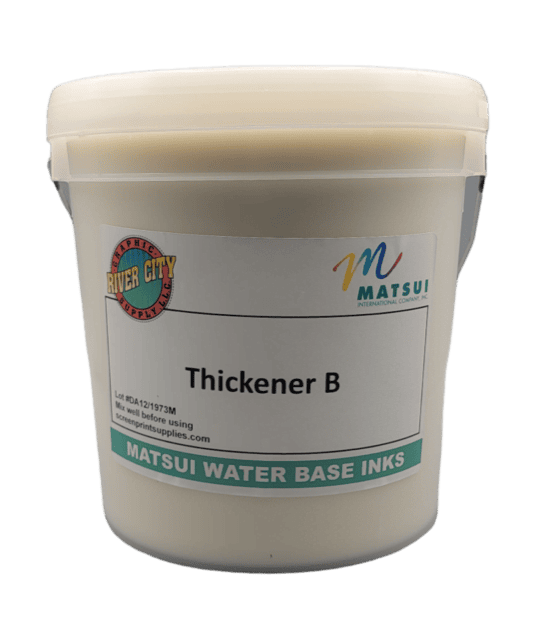
Matsui Thickener B (Carrier B, RM-0195) is the designated viscosity thickener for the entire Matsui water-based screen printing ink product line. Add 0.25-1% by weight to increase ink viscosity, improve halftone dot retention, reduce dot gain, and prevent ink bleeding and spreading on the garment. Thickener B creates a “short-bodied” ink — a rheological profile where the ink shears cleanly through the mesh under squeegee pressure, then snaps back to a thicker resting state immediately after printing, locking each halftone dot in place before it can spread. Requires a high-speed mixer for proper dispersion. Thickener B is the counterpart to RV Additive (the designated thinner) — together they give you full bidirectional viscosity control across all Matsui ink systems. No pot life limitation. PVC-free.
Price range: $29.99 through $349.99
Description
Matsui Thickener B — The Designated Ink Thickener for Every Matsui Water-Based Ink System
Every viscosity problem in screen printing has two directions: too thick or too thin. In the Matsui water-based product line, the designated thinner is RV Additive (Catalyst 3000) and the designated thickener is Thickener B (Carrier B). They are the matched pair for full viscosity control across every Matsui ink product.
If your ink is too thin and running, bleeding, or losing halftone dot integrity, Thickener B is the solution. If you look at the technical data sheet for any Matsui ink — 301 RC, Alpha, Infinity, Stretch, Simple, EasyPrint, Discharge, every special effect binder — every single one lists “Thickener B” as the designated thickener. It is the universal viscosity-up additive for the entire Matsui ecosystem.
But Thickener B does more than just make your ink thicker. It changes the rheological behavior of the ink to create what Matsui calls a “short-bodied” ink — a specific flow characteristic that is essential for high-quality halftone printing and fine detail work. Understanding what “short-bodied” means and why it matters is the key to getting the most out of this additive.
What “Short-Bodied” Ink Means — and Why It Matters for Halftones
Screen printing inks have a rheological property called “body” that describes how the ink behaves when it is sheared (forced through the mesh by the squeegee) and then left at rest (sitting on the garment after printing). Ink body falls on a spectrum between two extremes:
Long-bodied ink stretches and strings when pulled. When the squeegee lifts the mesh off the garment, long-bodied ink forms threads and filaments between the mesh and the substrate. These threads create uneven deposits, fuzzy edges, and messy mesh marks. Long-bodied inks are slow to “snap” — they take time to break cleanly from the mesh, and during that time the ink deposit spreads.
Short-bodied ink breaks cleanly. When the squeegee lifts the mesh, short-bodied ink snaps and separates immediately. The deposit stays exactly where it was placed, with sharp edges and no stringing. The ink shears thin under pressure (flows through the mesh easily) but recovers its thickness almost instantly once the pressure is removed.
This is exactly what halftone printing demands. Each halftone dot is a tiny, isolated ink deposit. If the ink is too thin or too long-bodied, those dots spread after they are printed — this is dot gain. The dots merge together, shadows fill in, highlights disappear, and your photo-realistic image turns into a muddy blob.
Thickener B creates short-bodied ink. It modifies the rheological profile so the ink has:
- High resting viscosity: The ink is thicker when sitting still, which means each halftone dot holds its shape after being deposited on the garment.
- Shear-thinning behavior: The ink still flows easily when the squeegee applies pressure, so it passes through the mesh cleanly.
- Fast thixotropic recovery: The ink snaps back to its thicker resting state almost instantly after the squeegee passes, locking each dot in place before it can spread.
This combination — thick at rest, thin under shear, fast recovery — is the definition of a short-bodied ink, and it is the rheological profile that produces the sharpest halftone prints.
What Happens When Ink Is Too Thin — The Problems Thickener B Solves
| Problem | What You See on the Print | Root Cause | How Thickener B Fixes It |
|---|---|---|---|
| Dot gain (halftone dots spreading) | Shadows filling in, highlights disappearing, muddy midtones, loss of detail | Ink is too thin at rest — each dot spreads after deposit before the ink can stabilize | Increases resting viscosity so dots hold their shape immediately after printing |
| Ink bleeding / spreading beyond the design edge | Fuzzy edges, soft borders, ink creeping outside the stencil area | Ink viscosity too low — flows laterally across the garment surface after deposit | Raises viscosity to prevent lateral flow after printing |
| Over-penetration into the garment | Ink soaking through to the back of the shirt, reduced opacity on front | Ink is too thin and absorbs too deeply into the fiber structure | Thicker ink sits higher on the garment surface with controlled, not excessive, penetration |
| Fine line detail loss | Thin lines widening, small text filling in, delicate features blurring | Low viscosity ink spreads after deposit, expanding each printed element | Short-bodied rheology locks fine line deposits in place with no post-print spreading |
| Ink too thin after adding too much RV Additive | Any combination of the above problems | Over-thinned ink from too much viscosity reducer | Thickener B brings the viscosity back up — it is the direct counterpart to RV Additive |
| Inconsistent ink deposit (wet-on-wet issues) | Uneven coverage, colors mixing where they shouldn’t, smearing between stations | Ink doesn’t hold its deposit firmly enough between print stations on an automatic press | Higher resting viscosity keeps the deposit stable until the next color is applied or the shirt is flashed |
Matsui Thickener B Key Features:
- Increases Ink Viscosity: Raises the viscosity of Matsui water-based inks at an effective dosage of just 0.25-1% by weight. A small amount produces a significant, measurable change in ink consistency.
- Improves Halftone Dot Retention: The primary purpose of Thickener B. It prevents halftone dots from spreading after they are deposited on the garment, preserving detail, tonal range, and sharpness in halftone and simulated process prints.
- Creates Short-Bodied Ink Rheology: Modifies the ink’s flow behavior to be shear-thinning with fast thixotropic recovery. The ink flows freely through the mesh under squeegee pressure, then snaps back to a thicker resting state immediately, locking each printed element in place.
- Reduces Dot Gain: By keeping halftone dots at their intended size after printing, Thickener B directly reduces dot gain — the #1 quality problem in halftone screen printing.
- Prevents Ink Bleeding and Spreading: Stops thin ink from flowing beyond the stencil edges, preserving sharp design borders and clean fine lines.
- Universal Matsui Compatibility: Designated as the official thickener in the technical data sheets of every Matsui water-based ink product. Works across 301 RC, Alpha, Infinity, Stretch, Simple, EasyPrint, Discharge, and all Matsui special effect binders.
- The Counterpart to RV Additive: Thickener B (viscosity up) and RV Additive (viscosity down) are the matched pair for full bidirectional viscosity control across all Matsui inks. If you over-thin with RV Additive, Thickener B brings the viscosity back.
- No Pot Life Limitation: Thickener B does not expire once mixed into your ink. Your mixed batch remains usable indefinitely.
- Does Not Alter Color or Cure Properties: At the recommended 0.25-1% dosage, Thickener B does not change ink color, opacity, or cure temperature requirements.
- PVC-Free: Consistent with the Matsui PVC-free product line.
Why Screen Printers Use Matsui Thickener B
“My halftone dots are spreading and my detail is filling in.” This is the #1 reason printers reach for Thickener B. Halftone printing with water-based inks is demanding because water-based inks are naturally thinner than plastisol. If the ink viscosity is too low, each printed dot spreads before it can stabilize on the garment. Adding 0.25-0.5% Thickener B raises the resting viscosity just enough to lock each dot in place, preserving highlights, shadows, and tonal transitions.
“I’m printing CMYK / simulated process and my colors are muddy.” CMYK and simulated process printing rely on precise halftone dots at specific angles to create the illusion of full-color imagery. If any color’s dots are gaining too much, the color separation breaks down — skin tones shift, gradients band, and the image looks over-saturated. Thickener B at 0.25-0.5% per color gives each dot the viscosity it needs to stay put.
“I over-thinned my ink with RV Additive.” This is common. A printer adds RV Additive to improve flow through a high mesh screen, then realizes the ink is now too thin and bleeding. Thickener B is the direct fix — add 0.25-0.5% to bring the viscosity back up to a printable range. RV Additive and Thickener B are designed to work as a matched pair for exactly this kind of fine-tuning.
“My ink is soaking through the shirt.” Thin inks penetrate deeply into the garment, sometimes all the way through to the back. While some penetration is desirable for a soft hand feel, too much penetration reduces opacity on the front surface and wastes ink. Thickener B increases viscosity so the ink deposits sit higher on the garment with controlled, not excessive, penetration.
“My fine line text and small details are filling in.” Thin ink spreads laterally after printing, which causes thin lines to widen and small text to close up. Thickener B’s short-bodied rheology locks each printed element exactly where the mesh placed it, preserving crisp edges on fine detail work.
“I’m printing wet-on-wet on an automatic press and the first colors are smearing.” On high-speed automatic presses running wet-on-wet (no flash between colors), the first colors must hold their deposit firmly while subsequent colors are printed on top. If the first color is too thin, the next squeegee stroke will disturb it. Thickener B at 0.25-0.5% firms up the deposit enough to survive the next print stroke without smearing.
Thickener B vs. RV Additive — The Matsui Viscosity Control Pair
Thickener B and RV Additive are the opposite ends of the Matsui viscosity spectrum. Every Matsui ink TDS lists both products as the designated viscosity adjustment tools:
| Specification | Thickener B (Carrier B) | RV Additive (Catalyst 3000) |
|---|---|---|
| Direction | Viscosity UP (thickens ink) | Viscosity DOWN (thins ink) |
| Dosage | 0.25-1% | 1-3% |
| Mixing Requirement | High-speed mixer required | Standard hand mixing is sufficient |
| Primary Use Case | Halftone printing, fine detail, dot retention, controlling ink spread | Improve flow through high mesh, enhance fabric penetration, thin ink for printability |
| Rheological Effect | Creates short-bodied ink (shear-thinning with fast recovery) | Reduces overall viscosity and improves flow at all shear rates |
| Pot Life | No limit | No limit |
| Can They Be Used Together? | Yes — use RV Additive first if needed for flow, then add Thickener B to fine-tune dot retention. Or use Thickener B to correct over-thinning from RV Additive. | |
The fine-tuning workflow: Many experienced printers use both in the same batch. For example, when printing halftones through 230 mesh: add 1-2% RV Additive to ensure the ink flows cleanly through the fine mesh openings, then add 0.25-0.5% Thickener B to restore just enough body to hold the halftone dots. The result is an ink that flows easily through the mesh but locks into place the instant it hits the garment.
How to Use Matsui Thickener B
Step 1 — Weigh Your Ink: Place your mixed Matsui ink on a scale and record the weight.
Step 2 — Calculate the Dosage: Add 0.25-1% Thickener B by weight. Start at the low end (0.25%) and increase in small increments after testing. A little goes a long way.
| Ink Amount | 0.25% Thickener B | 0.5% Thickener B | 1% Thickener B |
|---|---|---|---|
| 1 Pint (approx. 454g) | 1.1g | 2.3g | 4.5g |
| 1 Quart (approx. 908g) | 2.3g | 4.5g | 9g |
| 1 Gallon (approx. 3,632g) | 9g | 18g | 36g |
Step 3 — Mix with a High-Speed Mixer: This is critical. Thickener B requires a high-speed mixer (drill-mounted mixing blade, lab mixer, or equivalent) for proper dispersion. Hand stirring will not fully incorporate the thickener into the ink, leaving clumps and uneven viscosity throughout the batch. Run the high-speed mixer until the thickener is completely and uniformly dispersed with no visible clumps or streaks.
Step 4 — Allow Viscosity to Develop: After mixing, let the ink rest for 5-10 minutes. The thickening effect continues to build slightly after mixing stops. Check the viscosity again before printing.
Step 5 — Test Print: Run a test print to evaluate dot retention, edge sharpness, and flow through the mesh. If the dots are still gaining too much, add another 0.1-0.25% and remix. If the ink is now too thick to pass through the mesh cleanly, add a small amount of RV Additive (0.5-1%) to bring the flow back.
Step 6 — Print and Cure Normally: No changes to your print process or cure settings. Thickener B does not alter cure temperature requirements. Cure at your standard 320°F (160°C) for the recommended dwell time of your base ink.
Pro Tips for Best Results
- Always use a high-speed mixer. This is non-negotiable. Thickener B will not disperse properly with hand stirring. If you do not have a high-speed mixer, a drill-mounted paint mixing paddle works. The goal is uniform dispersion with no clumps.
- Start at 0.25% and work up. The effective dosage range is 0.25-1%, but the difference between 0.25% and 1% is substantial. Start low, test, and increase in small increments. It is much easier to add more thickener than to correct over-thickening.
- If you over-thicken, add RV Additive to bring it back. Thickener B and RV Additive are the designated pair. Over-thickened ink can be rescued by adding 0.5-1% RV Additive and remixing. You are not wasting ink — you are fine-tuning it.
- Use Thickener B for halftone and simulated process work as a standard practice. Many production shops add 0.25-0.5% Thickener B to every batch used for halftone printing as a default. It is inexpensive insurance against dot gain.
- Combine with RV Additive for the best halftone flow. The optimal halftone ink often uses both additives: RV Additive (1-2%) to ensure clean flow through high mesh, and Thickener B (0.25-0.5%) to lock the dots after printing. This gives you the best of both worlds — smooth mesh release and tight dot retention.
- Thickener B is especially useful on absorbent or rough-textured garments. Heavyweight cotton, ring-spun tees, and garments with a rougher surface texture tend to cause more dot gain because the ink spreads as it hits the uneven surface. Thickener B helps the dots hold their shape even on challenging substrates.
- Pair with other Matsui additives as needed. Thickener B works alongside the full Matsui additive lineup. A typical halftone production recipe might include: Retarder MG (1-3%) for open time + Softener MG (2-3%) for hand feel + Fixer WF-N (1-3%) for wash fastness + RV Additive (1-2%) for mesh flow + Thickener B (0.25-0.5%) for dot retention. All five can be used together in the same batch.
- Use with clean mixing vessels and utensils. As with all Matsui products, contamination from other ink sources or non-approved additives can compromise the PVC-free certification. Always use clean, dedicated equipment.
Technical Specifications
| Specification | Detail |
|---|---|
| Product Name | Matsui Thickener B (Carrier B) |
| Product Code | RM-0195 |
| Type | Viscosity thickener / rheology modifier / dot retention agent |
| Primary Function | Increase ink viscosity and improve halftone dot retention |
| Secondary Functions | Create short-bodied ink rheology, reduce dot gain, prevent ink bleeding and spreading, control ink penetration depth |
| Recommended Dosage | 0.25-1% by weight (0.1-0.5% for Flock Binder 301) |
| Mixing Requirement | High-speed mixer required for proper dispersion |
| Pot Life Once Mixed | No limit — mixed ink remains usable indefinitely |
| Effect on Color / Opacity | None at recommended dosage |
| Effect on Cure Temperature | None — follow base ink specifications (typically 320°F / 160°C) |
| Ink System Role | Designated thickener for all Matsui water-based ink products |
| Counterpart Additive | RV Additive (Catalyst 3000) — the designated thinner for all Matsui inks |
| Compatible Ink Types | All Matsui water-based inks |
| Compatible Ink Systems | All Matsui 301 RC, 301C Clear, 301M Matte, Alpha, Infinity, Stretch, Simple, EasyPrint, Dye Blocker, Kombat Blocker, Discharge, Specialty Inks, Special Effect Binders |
| Compatible Substrates | Cotton, cotton-poly blends, polyester, performance fabrics |
| Formulation | PVC-free, environmentally safe |
| Storage | 65°F to 95°F (18°C to 35°C). Avoid direct sunlight. |
| Cleanup | Water and mild soap or detergent |
| Available Sizes | Quart, Gallon |
Benefits at a Glance
- Increase the viscosity of any Matsui water-based ink at just 0.25-1% by weight — a small amount with a significant impact
- Improve halftone dot retention to preserve detail, tonal range, and sharpness in halftone and simulated process prints
- Create short-bodied ink rheology that flows through the mesh under pressure but snaps back to a thicker state immediately after printing
- Reduce dot gain — the #1 quality problem in halftone screen printing — by locking each dot at its intended size
- Prevent ink bleeding and spreading beyond the stencil edges for sharp design borders and clean fine lines
- Control ink penetration depth to prevent over-saturation and strike-through on absorbent garments
- Correct over-thinning from too much RV Additive without wasting the ink batch
- The designated thickener for every Matsui water-based ink product — one additive covers your entire ink inventory
- No pot life limitation — mixed ink stays usable indefinitely for pre-mixed batch inventory
- Does not alter ink color, opacity, or cure temperature at the recommended dosage
- Works alongside the full Matsui additive lineup — use with Retarder MG, Softener MG, Fixer WF-N, and RV Additive in the same batch
- PVC-free formulation consistent with the Matsui eco-friendly product line
Technical Sheets / Safety Data Sheets / Documents
FREQUENTLY ASKED QUESTIONS
What does Matsui Thickener B do?
Matsui Thickener B increases the viscosity of Matsui water-based screen printing inks.
It:
- Improves halftone dot retention
- Reduces dot gain
- Creates short-bodied ink rheology
- Locks printed elements in place immediately after deposit
It is the designated thickener for the entire Matsui water-based ink product line.
How much Thickener B should I add?
Recommended usage: 0.25–1% by weight
- 0.25% – Mild viscosity increase and improved dot holding
- 0.5–1% – More aggressive thickening for demanding halftone work or absorbent garments
For Flock Binder 301: 0.1–0.5%
Always measure by weight for consistent results.
Do I need a high-speed mixer?
Yes.
Thickener B requires high-speed mixing for proper dispersion. Hand stirring can leave undissolved clumps and uneven viscosity.
If you do not have a lab mixer, a drill-mounted paint mixing paddle is recommended.
What does “short-bodied ink” mean?
Short-bodied ink:
- Flows easily through the mesh under squeegee pressure
- Breaks cleanly without stringing
- Snaps back to a thicker resting state immediately after printing
This prevents halftone dots and fine lines from spreading. Thickener B creates this fast thixotropic recovery.
Can I use Thickener B and RV Additive together?
Yes.
They are the designated viscosity control pair for Matsui inks:
- RV Additive – Thins ink for mesh flow
- Thickener B – Thickens ink for dot retention
Many printers use both in halftone printing to balance flow and edge sharpness.
What Matsui inks is Thickener B compatible with?
Thickener B works with all Matsui water-based systems, including:
- 301 RC Series
- Alpha Series
- Infinity Series
- Stretch
- Simple
- EasyPrint
- Dye Blocker
- Kombat Blocker
- Discharge inks
- All Special Effect binders
Does Thickener B change ink color?
No.
At 0.25–1%, Thickener B does not affect:
-
Color
-
Opacity
-
Surface appearance
It modifies viscosity only.
What is the difference between Thickener B and RV Additive?
They are opposites.
Thickener B – Increases viscosity
RV Additive – Decreases viscosity
Together they provide full bidirectional viscosity control. If you over-thin with RV Additive, add Thickener B to restore body.
Will Thickener B help with dot gain?
Yes.
Dot gain occurs when halftone dots spread after printing. Thickener B increases resting viscosity and creates fast recovery, locking each dot at its intended size before spreading can occur.
This is its primary function.
Does Thickener B have a pot life?
No.
Thickener B does not expire once mixed into ink. Your batch remains usable indefinitely, allowing pre-mixing and storage without waste.
Can Thickener B fix bleeding or spreading ink?
Yes.
Bleeding and spreading are caused by low viscosity. Thickener B raises resting viscosity so ink stays within the stencil area, preserving sharp edges and clean borders.
Reviews
Only logged in customers who have purchased this product may leave a review.


Reviews