Matsui Catalyst 3000/RV Additive | Viscosity Reducer and Fabric Penetration Enhancer for Water-Based Screen Printing Ink
Matsui
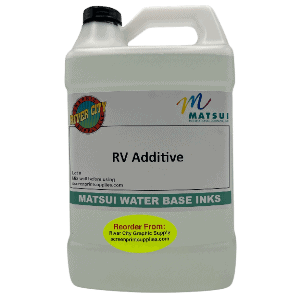
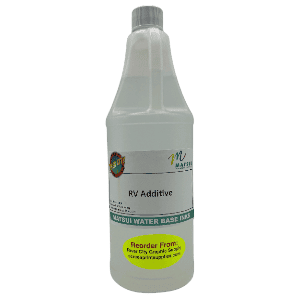
Matsui Catalyst 3000/RV Additive (RM0459) is a professional viscosity reducer and fabric penetration enhancer for Matsui water-based and discharge screen printing inks. Add 1-3% by weight to reduce ink viscosity, improve flow through the mesh, drive deeper ink penetration into fabric fibers, and promote cross-linking during the curing process for improved wash fastness and adhesion. RV Additive is the designated thinner across the entire Matsui water-based ink product line — it is listed as the recommended thinner in the technical data sheets for every Matsui ink system including 301 RC, Alpha, Infinity, Stretch, Simple, EasyPrint, Discharge, Specialty Inks, and all Matsui special effect binders. Particularly effective when printing through high mesh counts, on thick or heavyweight garments, on polyester and blended fabrics, or in any situation where the ink needs to flow more freely and absorb more deeply into the substrate. No pot life limitation. PVC-free.
Price range: $19.99 through $229.99
Description
Matsui Catalyst 3000/RV Additive — The Official Ink Thinner for Every Matsui Water-Based Ink System
Every ink system needs a viscosity reducer. In the Matsui water-based product line, that product is Catalyst 3000/RV Additive.
If you look at the technical data sheet for any Matsui ink — 301 RC bases, Alpha Series, Infinity Series, Stretch Clear, Simple Clear, EasyPrint White, Dye Blocker, Kombat Blocker, Discharge bases, Puff Foaming Base, Glitter Base, Pearl Binder, Crack Base, Suede Base, Flock Binder, Foil Adhesive, Foil Blocker, Phantom Clear, Hydrochromic White, Soft-Tex Overprint — every single one lists “RV Additive” as the designated thinner. It is the universal viscosity control additive for the entire Matsui ecosystem.
But Catalyst 3000/RV Additive is not just a thinner. Unlike simply adding water to thin your ink (which dilutes the resin system and weakens the print), RV Additive reduces viscosity while simultaneously improving three other critical print properties: fabric penetration, cross-linking during cure, and ink-to-fiber adhesion. This is why Matsui calls it “Catalyst 3000” — it catalyzes a better bond between ink and garment, not just a thinner ink.
What RV Additive Actually Does — Viscosity Reduction vs. Adding Water
This is the most important distinction to understand about RV Additive, and it is the question that brings most printers to this product: Why can’t I just add water to thin my ink?
You can add small amounts of water to Matsui inks to rehydrate ink that has started to dry. But using water as a viscosity reducer creates problems:
| Method | Thinning with Water | Thinning with RV Additive (1-3%) |
|---|---|---|
| Viscosity reduction | Yes — thins the ink | Yes — thins the ink |
| Effect on resin concentration | Dilutes the resin system — weakens the ink film | Does not dilute the resin system — maintains ink film integrity |
| Fabric penetration | Marginally improved (thinner ink flows slightly better) | Actively improved — RV Additive promotes ink absorption into fibers |
| Cross-linking during cure | No improvement — may reduce cure quality due to excess moisture | Enhanced — RV Additive promotes cross-linking for stronger ink-to-fiber bond |
| Wash fastness | May decrease (weaker resin concentration = weaker adhesion) | Maintained or improved (cross-linking strengthens adhesion) |
| Color intensity | Decreases (diluted pigment concentration) | Maintained (no pigment dilution at 1-3%) |
| Risk of over-thinning | High — easy to add too much water | Low — controlled at 1-3% with measurable results |
| Effect on cure | Excess water must evaporate — can slow cure or cause incomplete cure | No excess moisture — does not impede the curing process |
Bottom line: Water rehydrates. RV Additive reduces viscosity while simultaneously making the ink penetrate better, bond stronger, and cure more effectively. They are not interchangeable.
Matsui Catalyst 3000/RV Additive Key Features:
- Reduces Ink Viscosity: Thins out water-based ink to improve flow through the mesh without diluting the resin system or weakening the ink film. The recommended 1-3% dosage provides measurable, controlled viscosity reduction.
- Enhances Fabric Penetration: Drives the ink deeper into fabric fibers, creating prints that are more integrated with the garment. This results in a softer hand feel, better adhesion, and improved durability because the ink is mechanically locked into the fiber structure rather than sitting on the surface.
- Promotes Cross-Linking During Cure: RV Additive actively improves the chemical cross-linking that occurs during the heat cure process. Cross-linking creates stronger molecular bonds between the ink resin and garment fibers, which directly improves wash fastness and crock resistance.
- Improves Adhesion on Difficult Substrates: Particularly effective on polyester, cotton-poly blends, thick or heavyweight garments, and tightly-woven fabrics where standard ink may struggle to penetrate or adhere properly.
- Universal Matsui Compatibility: Designated as the official thinner/viscosity reducer in the technical data sheets of every Matsui water-based ink product. Works across 301 RC, Alpha, Infinity, Stretch, Simple, EasyPrint, Discharge, all special effect inks, and all Matsui mixing bases.
- Works with Both Water-Based and Discharge Inks: Compatible with standard water-based printing and with activated discharge inks, expanding its usefulness across your entire production workflow.
- No Pot Life Limitation: RV Additive does not expire once mixed into your ink. Your mixed batch remains usable indefinitely, allowing for pre-mixed inventory.
- Does Not Alter Color or Appearance: At the recommended 1-3% dosage, RV Additive does not change ink color, opacity, or surface appearance.
- Compatible with Photopolymer Emulsions: Safe for use with photopolymer-based stencils — does not attack or degrade the emulsion.
- PVC-Free: Environmentally safe formulation consistent with the Matsui PVC-free product line.
Why Screen Printers Use Matsui RV Additive:
RV Additive solves a specific set of production problems that water-based screen printers encounter regularly. Understanding when to reach for it — and when another additive is the better choice — is key to getting the most out of it.
The Real-World Problems RV Additive Solves:
- “My ink is too thick and won’t flow through the mesh cleanly.” This is the #1 reason printers use RV Additive. Inks that are too viscous produce inconsistent deposits, leave mesh marks, require excessive squeegee pressure, and create fatigue on manual presses. Adding 1-2% RV Additive reduces viscosity to improve flow without compromising print quality.
- “I’m printing through high mesh (230+) and the ink is struggling to pass through.” High mesh counts restrict ink flow because the openings are smaller. Thicker inks that print fine through 110 or 156 mesh may struggle at 230 or 305 mesh. RV Additive at 1-2% brings the viscosity down to a range that passes smoothly through fine mesh without losing opacity or sharpness.
- “My prints aren’t penetrating the fabric — they feel like they’re sitting on top.” If the ink is not absorbing into the garment fibers, it sits on the surface, feels stiffer, and is more vulnerable to cracking and washing off. RV Additive promotes deeper fabric penetration, which improves both hand feel and print durability. This is especially useful on heavyweight garments (6+ oz), tightly woven fabrics, and polyester blends.
- “I’m having adhesion issues on polyester or blended fabrics.” Polyester and synthetic-blend garments can be difficult for water-based inks because the synthetic fibers resist absorption. RV Additive’s penetration and cross-linking properties improve the ink-to-fiber bond on these substrates, reducing adhesion failure.
- “My prints are losing vibrancy or cracking after a few washes.” If the ink isn’t properly bonded to the garment fibers, wash fastness suffers. RV Additive promotes cross-linking during the cure, which strengthens the molecular bond between the ink resin and the fabric. This is especially valuable on garments that will see frequent, aggressive washing.
- “I need to thin my ink but don’t want to weaken it with water.” This is the fundamental value proposition. Adding water dilutes the resin, weakens adhesion, and can cause incomplete curing. RV Additive thins the ink while actually improving the properties that water would weaken.
RV Additive vs. Other Matsui Additives — When to Use Which
Printers sometimes confuse RV Additive with Softener MG because both improve ink flow and fabric penetration. They are different products with different mechanisms and different primary purposes:
| Additive | Primary Function | Dosage | When to Reach for It |
|---|---|---|---|
| RV Additive (Catalyst 3000) | Reduce viscosity, enhance fabric penetration, promote cross-linking | 1-3% | Ink is too thick for your mesh count. You need better flow through high mesh. You need deeper penetration on thick or synthetic fabrics. You need to thin ink without weakening it. |
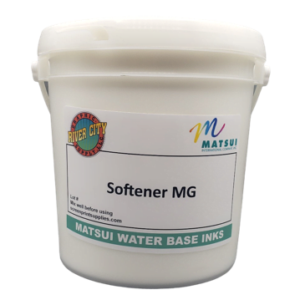
| Softener MG | Ultra-soft hand feel, silicone surface lubrication, improved shear rate | 1-4% | The print hand feel needs to be softer. You want a silicone-smooth finish. You also need a foil release agent, screen cleaner, or mesh lubricant. |
| Retarder MG | Extend open time, prevent drying and clogging in the screen | 1-5% | Ink is drying in the screen during runs. You are in a low-humidity environment. Multi-color jobs with delays between prints. |
| Fixer WF-N | Cross-link ink to fibers, improve wash fastness, lower cure temperature | 1-4% | Prints are fading or cracking in the wash. You need to lower cure temp to 300°F. You want formaldehyde-free wash fastness improvement. |
| Thickener B | Increase viscosity, improve dot retention for halftones | 0.25-1% | Ink is too thin and bleeding. You need better halftone dot sharpness. You want higher ink deposit per stroke. |
Key distinction — RV Additive vs. Softener MG for penetration: Both improve fabric penetration, but through different mechanisms. Softener MG reduces surface tension via silicone, which allows the ink to spread and absorb more easily. RV Additive reduces viscosity directly, making the ink physically thinner so it flows into the fiber structure more readily. Both work. They can be used together. But if your primary need is viscosity reduction and adhesion improvement, RV Additive is the correct choice. If your primary need is a softer hand feel with a silicone-smooth finish, Softener MG is the correct choice.
Can you use both? Yes. Many printers use both RV Additive (1-2% for viscosity) and Softener MG (2-3% for hand feel) in the same batch when they need both thinner ink and a softer finish. The two additives complement each other without overlap.
How to Use Matsui Catalyst 3000/RV Additive
Step 1 — Weigh Your Ink: Place your mixed Matsui ink on a scale and record the weight.
Step 2 — Calculate the Dosage: Add 1-3% RV Additive by weight. Start at 1% for a slight viscosity reduction. Go to 2-3% for more significant thinning or when you need maximum penetration improvement on thick or synthetic fabrics.
| Ink Amount | 1% RV Additive | 2% RV Additive | 3% RV Additive |
|---|---|---|---|
| 1 Pint (approx. 454g) | 4.5g | 9g | 13.5g |
| 1 Quart (approx. 908g) | 9g | 18g | 27g |
| 1 Gallon (approx. 3,632g) | 36g | 73g | 109g |
Step 3 — Mix Thoroughly: Add the calculated amount of RV Additive to your ink and stir slowly but consistently using clean utensils. Continue mixing until the additive is completely integrated with no visible clumps or streaks.
Step 4 — Test Print: Run a test print to evaluate the viscosity and penetration. If the ink is still too thick, add another 0.5-1% in small increments. Do not exceed 3% without testing, as over-thinning can affect print quality.
Step 5 — Print and Cure Normally: No changes to your print process or cure settings. RV Additive does not alter cure temperature requirements. Cure at your standard 320°F (160°C) for the recommended dwell time of your base ink.
Pro Tips for Best Results
- Do not exceed 3% without testing. Over-thinning the ink can cause it to flow too freely, resulting in blurry details, excessive bleeding, or insufficient opacity. Stay within the 1-3% range and test before committing to production.
- Use RV Additive — not water — as your primary thinner. Water rehydrates dried ink but dilutes the resin system. RV Additive reduces viscosity while improving penetration and cross-linking. They serve fundamentally different purposes.
- Combine with Thickener B for fine-tuning. RV Additive (thinner) and Thickener B (thickener) are the designated viscosity control pair across all Matsui inks. If you thin too much with RV Additive, you can add Thickener B (0.25-1%) to bring the viscosity back up.
- Essential for high mesh printing. If you are printing through 230+ mesh and experiencing inconsistent ink transfer, mesh marks, or incomplete fills, 1-2% RV Additive is often the solution. The thinner viscosity allows the ink to pass cleanly through the smaller mesh openings.
- Particularly useful on heavyweight garments. Thick, densely-woven fabrics (10+ oz fleece, heavyweight hoodies, canvas) resist ink penetration. RV Additive at 2-3% helps the ink absorb into the fiber structure rather than sitting on top, which improves both hand feel and wash durability.
- Improves adhesion on polyester and blends. If you are printing on 100% polyester or high-poly blends and experiencing adhesion problems (ink peeling or cracking), RV Additive’s cross-linking properties can help. For polyester, also consider pairing with Dye Blocker or Kombat Blocker as your underbase to prevent dye migration.
- Works with both water-based and discharge inks. RV Additive is not limited to standard water-based printing. It can be mixed into activated discharge inks as well.
- Use with clean mixing vessels and utensils. As with all Matsui products, contamination from other ink sources or non-approved additives can compromise the PVC-free certification. Always use clean, dedicated equipment.
- Pair with other Matsui additives as needed. RV Additive works alongside the full Matsui additive lineup. A typical production recipe might include: Retarder MG (1-3%) for open time + Softener MG (2-3%) for hand feel + Fixer WF-N (1-3%) for wash fastness + RV Additive (1-2%) for viscosity and penetration. All four can be used together in the same batch.
Technical Specifications
| Specification | Detail |
|---|---|
| Product Name | Matsui Catalyst 3000/RV Additive |
| Product Code | RM0459 |
| Type | Viscosity reducer / fabric penetration enhancer / cross-linking promoter |
| Primary Function | Reduce ink viscosity and improve fabric penetration |
| Secondary Functions | Promote cross-linking during cure, improve adhesion, improve wash fastness |
| Recommended Dosage | 1-3% by weight (0.1-1% for Flock Binder 301) |
| Pot Life Once Mixed | No limit — mixed ink remains usable indefinitely |
| Effect on Color / Opacity | None at recommended dosage |
| Effect on Cure Temperature | None — follow base ink specifications (typically 320°F / 160°C) |
| Ink System Role | Designated thinner for all Matsui water-based ink products |
| Counterpart Additive | Thickener B (Carrier B) — the designated thickener for all Matsui inks |
| Compatible Ink Types | Water-based inks and discharge inks |
| Compatible Ink Systems | All Matsui 301 RC, 301C Clear, 301M Matte, Alpha, Infinity, Stretch, Simple, EasyPrint, Dye Blocker, Kombat Blocker, Discharge, Specialty Inks, Special Effect Binders |
| Compatible Substrates | Cotton, cotton-poly blends, polyester, performance fabrics, heavyweight garments |
| Emulsion Compatibility | Compatible with photopolymer emulsions |
| Formulation | PVC-free, environmentally safe |
| Storage | 65°F to 95°F (18°C to 35°C). Avoid direct sunlight. |
| Cleanup | Water and mild soap or detergent |
| Available Sizes | Quart, Gallon |
Benefits at a Glance
- Reduce water-based ink viscosity without diluting the resin system or weakening the ink film — the correct way to thin Matsui inks
- Drive ink deeper into fabric fibers for softer prints, better adhesion, and improved wash durability
- Promote cross-linking during the heat cure for stronger molecular bonds between ink and garment
- Improve ink flow through high mesh counts (230+) where standard viscosity inks struggle to pass cleanly
- Enhance adhesion on difficult substrates including polyester, cotton-poly blends, and heavyweight garments
- The designated thinner for every Matsui water-based ink product — one additive covers your entire ink inventory
- No pot life limitation — mixed ink stays usable indefinitely for pre-mixed batch inventory
- Does not alter ink color, opacity, or cure temperature at the recommended 1-3% dosage
- Compatible with both standard water-based and activated discharge inks
- PVC-free formulation — consistent with the Matsui eco-friendly product line
- Works alongside the full Matsui additive lineup — use with Retarder MG, Softener MG, Fixer WF-N, and Thickener B in the same batch
Technical Sheets / Safety Data Sheets / Documents
FREQUENTLY ASKED QUESTIONS
What does Matsui Catalyst 3000 / RV Additive do?
RV Additive is a viscosity reducer and fabric penetration enhancer for Matsui water-based and discharge inks.
It:
- Thins ink for improved mesh flow
- Drives ink deeper into fabric fibers
- Improves adhesion
- Promotes cross-linking during curing
- Enhances wash fastness
It is the designated thinner for Matsui water-based systems.
How much RV Additive should I add?
Standard usage: 1–3% by weight
- 1% – Slight viscosity reduction
- 2–3% – Greater thinning and maximum penetration
For Flock Binder 301 only: 0.1–1%
Do not exceed 3% without production testing.
Why is RV Additive better than adding water?
Water:
- Dilutes the resin system
- Weakens the ink film
- Reduces color intensity
- Can cause incomplete curing
RV Additive:
- Reduces viscosity properly
- Improves penetration
- Enhances cross-linking
- Strengthens adhesion
They are not interchangeable.
What Matsui inks is RV Additive compatible with?
RV Additive is compatible with all Matsui water-based products, including:
- 301 RC Series
- Alpha Series
- Infinity Series
- Stretch
- Simple
- EasyPrint
- Dye Blocker
- Kombat Blocker
- All Discharge inks
- Special Effect binders (Puff, Glitter, Pearl, Crack, Suede, Foil Adhesive, Foil Blocker, Phantom Clear, Hydrochromic White, and more)
Can I use RV Additive with discharge inks?
Yes.
RV Additive is compatible with both standard water-based and activated discharge ink systems.
Does RV Additive change ink color?
No.
At 1–3%, RV Additive does not alter:
- Color
- Opacity
- Surface appearance
What is the difference between RV Additive and Softener MG?
RV Additive:
- Reduces viscosity
- Improves penetration
- Promotes cross-linking
Softener MG:
- Reduces surface tension via silicone
- Improves hand feel
- Enhances mesh lubrication
If you need to thin ink, use RV Additive.
If you want a softer finish, use Softener MG.
Both can be used together.
What is the difference between RV Additive and Thickener B?
They are opposites.
RV Additive – Thinner (reduces viscosity)
Thickener B (Carrier B) – Thickener (increases viscosity)
Together they provide full viscosity control. If you over-thin, add Thickener B to restore body.
Is RV Additive compatible with photopolymer emulsions?
Yes.
RV Additive is safe for photopolymer-based stencils and does not degrade emulsion.
Will RV Additive help with polyester adhesion?
Yes.
RV Additive improves ink-to-fiber bonding on polyester and blends by increasing penetration and cross-linking.
For polyester garments, consider using:
- Matsui Dye Blocker
- Matsui Kombat Blocker
to prevent dye migration.
Does RV Additive have a pot life?
No.
RV Additive does not create a chemical time limit once mixed. Your ink batch remains usable indefinitely, allowing pre-mixing and storage without waste.
Reviews
Only logged in customers who have purchased this product may leave a review.


Reviews