
Matsui Glitter Base 301 | Water-Based Glitter Binder for Screen Printing — Mix with Your Own Glitter Flakes for Dry Sparkle Effect on Cotton & Blends — Tintable with Neo Pigments
Matsui
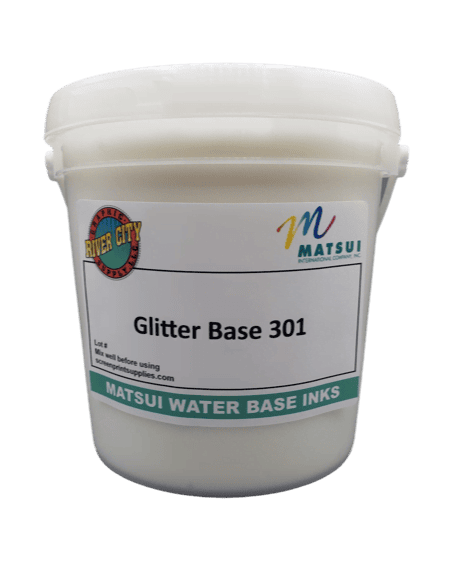
⚠️ Glitter flakes are NOT included. Matsui Glitter Base 301 (WS0504) is a water-based binder specifically formulated to carry and anchor glitter flakes for screen-printed glitter effects. You supply the glitter — Glitter Base 301 supplies the binder system that holds the glitter on the garment. The base is engineered to permeate INTO the fabric during curing, sinking below the surface while leaving the glitter flakes EXPOSED on top — creating a dry, tactile glitter effect where the sparkle sits on the surface and the binder disappears into the fibers. This is not a premixed glitter ink. This is the professional binder system that lets you choose your own glitter type, size, color, and density — then anchor it permanently to the garment through screen printing. Tint with Matsui Neo Pigments or Glow Pigments at minimal levels to color-match the binder to your glitter for seamless edges. Prints through mesh up to 80/inch (32/cm) — low mesh required for glitter flakes to pass through the screen. Thicker stencils and capillary film recommended for heavier glitter deposit. Enhance production with Matsui additives — including Fixer WF-N for wash fastness and Fixer L to help hold glitter during washing. Requires zero viscosity modifications. Cures at 320°F (160°C). PVC-free. Environmentally safe.
Price range: $29.99 through $299.99
Description
Matsui Glitter Base 301 — The Binder, Not the Glitter
First, the most important thing: Glitter Base 301 does not contain glitter. It is the binder system that holds glitter on a garment. You supply the glitter flakes separately — whatever type, color, size, and finish you want — and mix them into Glitter Base 301 before printing. The base does the work of adhering the glitter to the fabric. The glitter does the work of sparkling.
This is actually an advantage. Premixed glitter inks lock you into one glitter type, one size, one color, and one density. Glitter Base 301 gives you total control. Choose your glitter: fine or chunky, holographic or metallic, gold, silver, multicolor, or iridescent. Use polyester glitter for durability or biodegradable glitter for eco-conscious brands. Mix at the density you want — light sparkle or heavy glitter coverage. Glitter Base 301 does not dictate your glitter choices. It anchors whatever glitter you choose.
How the Dry Glitter Effect Works
The magic of Glitter Base 301 is in what happens during curing.
When you print a standard ink, the binder and pigment cure together as a unified film on the garment surface. Glitter Base 301 works differently. During curing at 320°F (160°C), the binder is formulated to permeate into the fabric, sinking below the surface into the fibers. The glitter flakes are too large to follow the binder into the fabric, so they stay on the surface.
The result is that the binder anchors into the fabric, mostly invisible and below the surface, while the glitter flakes stay exposed on top. The glitter feels dry and tactile to the touch, not buried under a shiny wet-looking clear coat and not trapped inside a glossy plastisol layer. The sparkle is exposed, dimensional, and natural-feeling.
This is the critical difference between Glitter Base 301 and a standard clear base with glitter mixed in. A standard clear base cures as a film on top of the fabric, trapping the glitter under or inside a visible binder layer that adds sheen, stiffness, and a plasticky appearance. Glitter Base 301 sinks below the glitter, leaving only the sparkle on display.
Glitter Flakes Are Sold Separately — What to Know Before Mixing
Glitter type
Use polyester (PET) glitter flakes designed for textile screen printing. Metallic, holographic, iridescent, matte, and standard finishes all work. The glitter must be heat-stable at 320°F (160°C), because standard craft glitter may melt or curl during curing. Use screen-printing-grade or heat-stable glitter.
Glitter size
The glitter flakes must pass through your screen mesh. At the maximum mesh of 80/inch (32/cm), the mesh openings are large, but extremely chunky glitter may still clog. Fine to medium glitter in the 0.008″ to 0.025″ range, or about 0.2mm to 0.6mm, works well at 80 mesh. Test your specific glitter with your specific mesh before production.
Mix ratio
Start at approximately 10–20% glitter by weight mixed into Glitter Base 301. More glitter gives denser sparkle coverage. Less glitter gives a lighter, more subtle sparkle. Test to find the density your design requires.
Mixing
Stir the glitter flakes gently into Glitter Base 301 until evenly distributed. Do not use high-speed mixers. Aggressive mixing can break or damage delicate glitter flakes, especially holographic varieties.
Custom Colored Glitter Binder with Neo Pigments and Glow Pigments
Tint Glitter Base 301 with Matsui Neo Pigments or Glow Pigments at minimal levels to color-match the binder to your glitter.
Why does binder color matter? When the binder permeates into the fabric, it leaves a thin residual layer around and between the glitter flakes. If the binder is clear and the garment is a contrasting color, the garment color shows through between the glitter particles. By tinting the binder to match the glitter color, you create a more seamless, saturated glitter field.
- Gold glitter — tint with a trace of Neo Pigment Yellow or Orange for a richer gold appearance
- Red glitter — tint with a trace of Neo Pigment Red to fill gaps between red glitter particles
- Blue glitter — tint with a trace of Neo Pigment Blue for a more seamless blue sparkle field
- Green glitter — tint with a trace of Neo Pigment Green for forest-to-emerald sparkle
- Silver or holographic glitter — leave the binder clear or tint with a trace of Neo Pigment Black for contrast
- Any glitter — tint with Glow Pigments for a UV or blacklight-reactive glitter effect
Keep pigment additions minimal. Glitter Base 301 is a binder system, not a color-mixing base. A trace of pigment shifts the binder tone. Too much pigment changes the binder’s penetration properties.
Explore the full Matsui Neo Pigment and Glow Pigment collection here.
Glitter Base 301 vs. Pearl Binder 301 — Physical Sparkle vs. Optical Shimmer
These are Matsui’s two main sparkle products. Customers often assume they do the same thing. They do not.
| Spec | Glitter Base 301 (WS0504) | Pearl Binder 301 (WS0508) |
|---|---|---|
| What Creates the Sparkle | Physical glitter flakes — real, visible, tactile particles sitting on the fabric surface. You supply the glitter. | Pearlescent particles built into the ink — microscopic translucent structures that refract light |
| Sparkle Character | Bold, dimensional, individual points of light — you can see and feel the particles | Soft, diffused, iridescent glow — subtle light play without visible particles |
| Texture | Tactile — raised glitter flakes with dry, dimensional texture | Smooth — feels like a standard soft print |
| Contains Sparkle Material? | No — binder only. You add your own glitter flakes. | Yes — pearlescent particles are already in the ink |
| Mesh Count | Up to 80/inch (32/cm) — very low mesh for glitter flakes to pass through | Up to 110/inch (43/cm) |
| Print Detail | Low — best for bold shapes, text, fills, and large graphics | Moderate — allows more detail than glitter |
| Customizability | Total — choose your own glitter type, color, size, finish, and density | Limited — tint with up to 2% Neo Pigments for colored pearl tones |
| Unique Additive | Fixer L (1–3%) — helps hold glitter particles during wash cycles | Standard Matsui additives only |
| Analogous To | Glitter nail polish, craft glitter on glue, sequin-like sparkle | Inside of a seashell, mother-of-pearl, opal |
| Best For | Bold sparkle, event apparel, cheer, dance, kids’ designs, novelty, holiday, concert merch | Subtle elegance, fashion, bridal, luxury branding, premium retail |
| Choose This When… | You want real glitter — visible, tactile, dimensional sparkle | You want pearlescent glow — soft, smooth, iridescent light play |
The simple decision: If the customer says “I want glitter,” use Glitter Base 301 with glitter flakes. If the customer says “I want pearl” or “I want a soft shimmer,” use Pearl Binder 301. Both sparkle. They just sparkle differently.
Printing Tips for Maximum Glitter Impact
Mesh selection is critical
Print through mesh up to 80/inch (32/cm) only. This is not a suggestion — it is a requirement. Glitter flakes are physical particles that must pass through the mesh openings. Mesh above 80 will filter out the flakes, clog the screen, and ruin the print. Use the lowest mesh possible for maximum glitter throughput.
Thick stencil equals more glitter
Use capillary film or multiple emulsion coats to build a thick stencil. The thicker the stencil, the more ink and glitter deposits per stroke. More deposit means denser glitter coverage and more sparkle.
Squeegee
Use a square-edge squeegee, 60–80 durometer. A sharper squeegee edge helps push glitter flakes through the mesh cleanly. Use standard pressure and angle.
Flash or direct cure
No special flash requirements are needed. Proceed to cure at 320°F (160°C). The binder will permeate into the fabric during the cure cycle, leaving glitter exposed on the surface.
Test before production
Test your specific glitter type and size with your specific mesh and stencil thickness before running production. Glitter flake size versus mesh opening size is the single most important variable to verify.
How Matsui Additives Improve Your Production with Glitter Base 301
Glitter Base 301 is production-ready from the container once glitter flakes are mixed in. Matsui additives help optimize durability and production flow.
The problem: Glitter flakes fall off or wash out after laundering. The additive solution: use Fixer WF-N at 1–5% to crosslink the binder for improved wash fastness, and use Fixer L at 1–3% to specifically help hold powder and glitter particles during wash cycles. Use both for glitter applications.
The problem: Ink dries in the screen during production pauses, and glitter particles clog mesh when the binder dries. The additive solution: Retarder MG at 1–5% extends open time. This is especially important with glitter because dried glitter and binder in 80 mesh is extremely difficult to reclaim.
The problem: Ink sits on top of fibers instead of penetrating, which defeats the dry-glitter effect. The additive solution: Softener MG at 1–4% enhances binder penetration into the fabric, helping the binder sink below the surface so the glitter stays exposed.
Additional additives include Thickener B at 0.25–1% to increase viscosity and RV Additive at 1–3% to reduce viscosity.
Browse the complete Matsui additive collection here.
Why Screen Printers Choose Glitter Base 301
I want real glitter sparkle on screen-printed garments — not just metallic shimmer.
Glitter Base 301 delivers actual glitter — physical flakes that catch light from individual points across the print surface. The sparkle is bold, visible, and dimensional. This is not the soft glow of Pearl Binder or the metallic sheen of Gold Shimmer. This is glitter.
I want to choose my own glitter — type, color, size, finish.
That is exactly why Glitter Base 301 is a binder without glitter. You are not locked into one glitter option. Gold, silver, holographic, multicolor, iridescent, fine, chunky, and biodegradable options can all be used depending on the project.
I print cheer, dance, kids’ apparel, and event merchandise where glitter is expected.
Cheer uniforms, dance recital tees, kids’ party merchandise, holiday apparel, concert merch, and bachelorette party tees are all natural fits for Glitter Base 301 because bold sparkle is the whole point.
I want the binder to disappear and leave only the glitter visible.
Glitter Base 301 permeates into the fabric during curing. The binder sinks below the surface, while the glitter flakes stay on top, exposed. The result is dry, tactile sparkle rather than glitter trapped under a glossy clear coat.
My screen-printed glitter washes off after a few cycles.
Add Fixer WF-N at 1–5% and Fixer L at 1–3% together. Fixer WF-N crosslinks the binder, while Fixer L specifically helps hold particles during washing. Using both provides the strongest glitter retention.
I want UV or blacklight-reactive glitter.
Tint Glitter Base 301 with Glow Pigments. The binder between glitter particles will glow fluorescent under blacklight while the glitter sparkles under normal light. It creates a dual effect: sparkle plus neon glow.
Key Features
- Glitter flakes not included — binder only, so you supply and choose your own glitter flakes
- Engineered to permeate fabric — binder sinks into the garment during curing, leaving glitter exposed on the surface
- Tintable with Neo Pigments and Glow Pigments — color-match the binder or create UV-reactive glitter effects
- Low mesh required — up to 80/inch (32/cm) so glitter flakes can pass through the screen
- Unique additive support — Fixer L helps retain glitter particles during laundering
- Production-optimized with Matsui additives — Retarder MG, Fixer WF-N, Fixer L, and Softener MG all help improve performance
- Zero viscosity modifications required — prints from the container after adding your glitter
- PVC-free and eco-friendly — environmentally safe
Recommended Additives for Glitter Base 301 Production
| Additive | Dosage | Production Problem It Solves |
|---|---|---|
| Retarder MG | 1–5% | Binder drying in the screen and trapping glitter in clogged mesh — extends open time and is highly recommended |
| Fixer WF-N | 1–5% | Glitter falling off or the print degrading after washing — improves wash fastness and should be used with Fixer L |
| Fixer L | 1–3% | Glitter particles specifically washing off during laundering — specialized for glitter and powder retention |
| Softener MG | 1–4% | Binder sitting on top of fabric instead of penetrating — helps preserve the dry-glitter effect |
| Thickener B | 0.25–1% | Ink too thin — increases viscosity for better deposit control |
| RV Additive | 1–3% | Ink too thick — reduces viscosity for better flow |
Browse the complete Matsui additive collection here.
Technical Specifications
| Specification | Detail |
|---|---|
| Product Name | Matsui Glitter Base 301 |
| Product Code | WS0504 |
| Type | Water-based glitter binder — formulated to carry and anchor glitter flakes. ⚠️ GLITTER FLAKES NOT INCLUDED. |
| How It Works | Binder permeates INTO fabric during cure, leaving glitter flakes EXPOSED on the surface for a dry, tactile sparkle effect |
| Glitter Flakes | NOT included — you supply and mix in your own glitter flakes |
| Recommended Glitter | Polyester (PET) screen-printing-grade or heat-stable glitter flakes. Must be stable at 320°F (160°C). Size: 0.008″–0.025″ (0.2mm–0.6mm) recommended. |
| Neo Pigment Tinting | Minimal levels — Neo Pigments or Glow Pigments to color-match the binder to the glitter |
| Recommended Mesh Count | Up to 80/inch (32/cm). Very low mesh REQUIRED for glitter flakes to pass through. |
| Stencil | Thick stencil recommended — capillary film or multiple emulsion coats for heavier glitter deposit |
| Cure Temperature | 320°F (160°C) |
| Primary Substrates | Cotton and cotton blends |
| Companion Product | Pearl Binder 301 — for smooth, iridescent pearlescent effects (different category — optical shimmer vs. physical sparkle) |
| Unique Additive | Fixer L (1-3%) — specialized additive to hold glitter particles during wash. Use with Fixer WF-N. |
| Other Additives | Retarder MG (1-5%), Fixer WF-N (1-5%), Softener MG (1-4%), Thickener B (0.25-1%), RV Additive (1-3%) |
| Viscosity Modifications | None required — prints from the container after adding glitter |
| Formulation | PVC-free, environmentally safe |
| Storage | 65°F to 95°F (18°C to 35°C). Avoid direct sunlight. |
| Cleanup | Water and mild soap or detergent |
| Available Sizes | Quart, Gallon |
Benefits at a Glance
- ⚠️ Glitter flakes NOT included — binder system only. Total control over glitter type, color, size, finish, and density.
- Engineered to permeate into fabric — binder sinks below the surface, leaving glitter flakes exposed for dry, tactile sparkle
- Not a glossy clear coat trapping glitter — the glitter sits ON TOP, exposed and dimensional
- Tintable with Neo Pigments to color-match binder to glitter for seamless, saturated sparkle fields
- UV/blacklight-reactive glitter with Glow Pigments — neon glow between sparkle points
- Fixer L (1-3%) — specialized additive for holding glitter during wash cycles, unique to this product
- Use Fixer WF-N + Fixer L together for maximum glitter wash retention
- Low mesh at 80/inch (32/cm) — required for glitter flakes to pass through the screen
- Thick stencil recommended for heavier glitter deposit and denser sparkle coverage
- PVC-free and environmentally safe
- Perfect for cheer, dance, kids’ apparel, event merch, holiday prints, concert tees, novelty designs
Technical Sheets / Safety Data Sheets / Documents
FREQUENTLY ASKED QUESTIONS
Does Glitter Base 301 come with glitter in it?
No — Glitter Base 301 is the binder system only. Glitter flakes are not included. You supply your own glitter flakes and mix them into the base before printing. This gives you total control over the glitter type, color, size, finish, and density for every job.
What kind of glitter should I use?
Use polyester (PET) screen-printing-grade or heat-stable glitter flakes. The glitter must be stable at the 320°F (160°C) cure temperature, because standard craft glitter may melt or curl. Sizes around 0.008″ to 0.025″ (0.2mm to 0.6mm) work well at 80 mesh. Metallic, holographic, iridescent, matte, and biodegradable finishes can all work.
How much glitter do I mix in?
Start at approximately 10–20% glitter by weight. More glitter gives denser sparkle. Less glitter gives lighter sparkle. Stir gently until evenly distributed, and avoid high-speed mixers that can break delicate glitter flakes.
Why does the binder permeate into the fabric instead of staying on top?
By design. Glitter Base 301 is formulated to sink into the fabric fibers during curing. This leaves the glitter flakes exposed on the surface, creating a dry, tactile sparkle effect instead of trapping the glitter under a visible glossy binder layer.
What is the difference between Glitter Base 301 and Pearl Binder 301?
They create completely different effects. Glitter Base 301 uses physical glitter flakes that you add yourself for bold, tactile, dimensional sparkle you can see and feel. Pearl Binder 301 uses microscopic pearlescent particles already loaded in the ink for soft, smooth, iridescent light play. Glitter gives bold sparkle. Pearl gives subtle glow.
What mesh count should I use?
Up to 80/inch (32/cm) only. Glitter flakes are physical particles that must pass through the mesh openings. Mesh above 80 will filter out and clog with glitter flakes. Use the lowest mesh available for maximum glitter throughput.
Can I tint the binder to match my glitter color?
Yes — add Neo Pigments at minimal levels to color-match the binder to your glitter. Gold glitter can use a trace of Yellow or Orange pigment. Red glitter can use a trace of Red pigment. This creates a more seamless, saturated sparkle field by matching the binder color visible between the glitter particles.
My glitter washes off after a few cycles. How do I fix this?
Use both Fixer WF-N at 1–5% and Fixer L at 1–3% together. Fixer WF-N crosslinks the binder. Fixer L specifically helps hold particles and powder during wash cycles. Using both gives the strongest glitter retention. Also make sure the print is fully cured at 320°F (160°C).
Can I make UV or blacklight-reactive glitter?
Yes — tint Glitter Base 301 with Glow Pigments. The binder between and around the glitter particles glows fluorescent neon under blacklight while the glitter flakes sparkle under normal light. It gives you a dual effect.
Why can’t I just mix glitter into a standard Matsui clear base?
Standard clear bases such as 301C Clear cure as a film on top of the fabric, trapping glitter inside or underneath a visible binder layer. That creates a glossy, plasticky look. Glitter Base 301 is formulated to permeate into the fabric, leaving the glitter exposed and dry on the surface. The binder disappears while the sparkle stays visible.
Can I print fine detail with glitter?
Only in a limited way. The 80 mesh requirement means fine lines and small text are not ideal. Glitter printing works best for bold shapes, large text, fills, panels, and graphic areas where the low mesh and thick deposit create maximum visual impact.
Is Glitter Base 301 safe?
Yes. It is PVC-free and environmentally safe. For children’s clothing applications, also make sure the glitter flakes themselves comply with the relevant safety standards.
Reviews
Only logged in customers who have purchased this product may leave a review.
You May Also Like
Related products
-

Matsui Soft Stretch Clear | Ultra-Soft Silicone-Like Water-Based Clear Mixing Base for Premium Custom Colors on Performance & Stretch Fabric Screen Printing
Price range: $39.99 through $469.99 -
Matsui Under Base Blocker 301-LG Black | Maximum-Density Water-Based Dye Migration Blocker for Aggressive Polyester, Sublimated Garments & Performance Fabrics — Works Under Water-Based AND Plastisol Inks
Price range: $29.99 through $399.99 -
Matsui Stretch Clear 301 | Silicone-Like Water-Based Clear Mixing Base for Custom Colors on Performance & Stretch Fabric Screen Printing
Price range: $29.99 through $299.99 -
Matsui Gold Shimmer 620 | Water-Based Metallic Gold Shimmer Ink for Soft Luxury Screen Printing on Cotton & Blends — Tintable with Neo Pigments
Price range: $39.99 through $699.99

Reviews