TW 5100 Defoamer – Anti-Foam Additive for TW Graphics Water-Based Poster Inks
TW Graphics
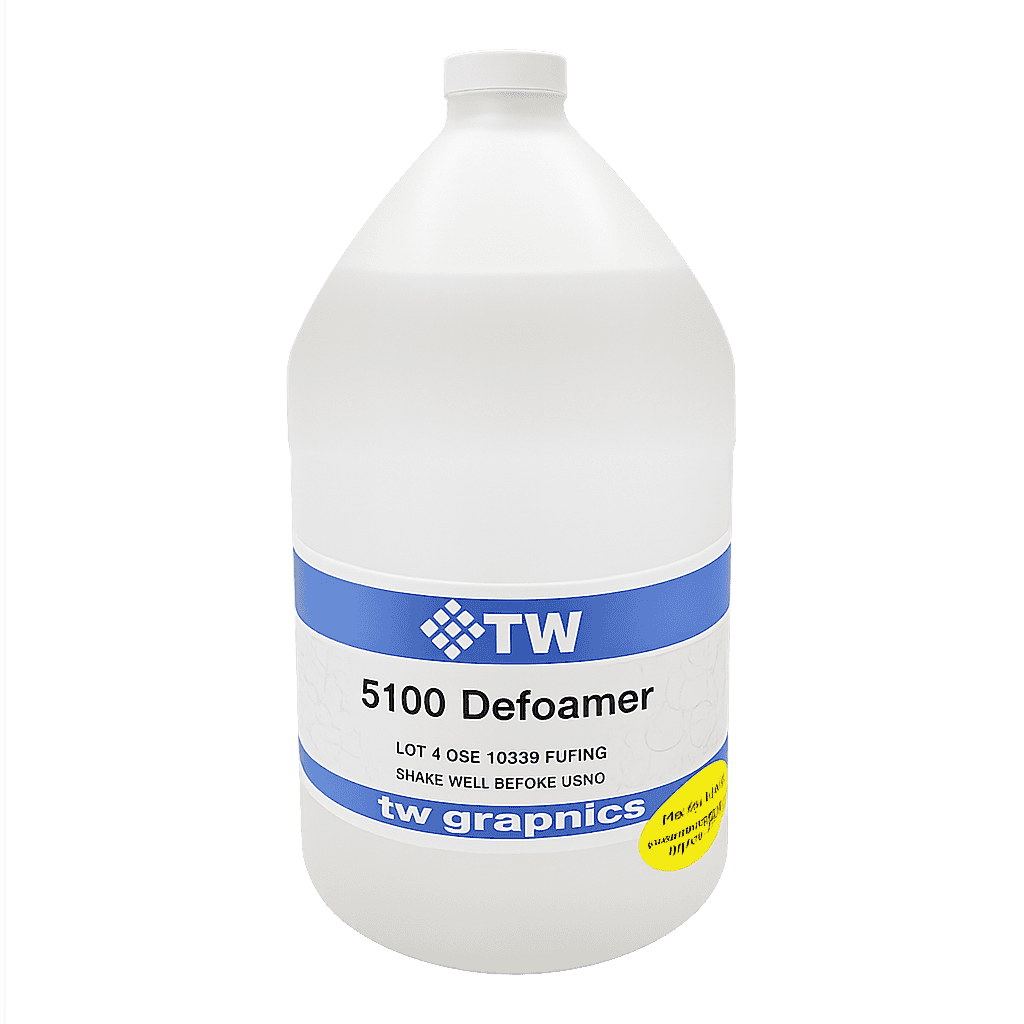
TW 5100 Defoamer eliminates the bubbling and foaming that plagues water-based poster inks at high press speeds. Add just 1–2% by weight to any TW 5500 Flat Series or TW 5000 Gloss Series ink to stabilize the ink film, prevent surface pitting, and keep your prints clean through long automatic runs. A tiny addition with an outsized impact on print quality. Made in the USA by TW Graphics.
✓ Eliminates Bubbling & Foaming
✓ TW 5000 & 5500 Compatible
✓ For High Press Speeds
✓ No Color Impact
✓ Made in USA
🚚 Same-Day Shipping Before 3:30 PM CT | Free Shipping Over $200 | Stocked in San Antonio, TX
$104.99
Description
TW Graphics — Water-Based Additive — 1–2% By Weight
TW 5100 Defoamer
Push a water-based poster ink fast enough and it starts to fight back. The mechanical agitation of a flood bar cycling at speed, combined with the natural surfactant chemistry of water-based ink systems, generates air bubbles in the ink body. Those bubbles survive through the screen and onto the substrate — showing up as pinholes, craters, voids, and a mottled surface texture that ruins an otherwise clean print. TW 5100 Defoamer solves this at the source. Added at just 1–2% by weight, it breaks the surface tension of the bubbles before they have a chance to transfer, giving you a smooth, uniform ink film from the first impression to the last — regardless of how fast your press is running.
Key Features
Eliminates Bubbling & Foaming
Breaks the surface tension of air bubbles before they transfer to the substrate. Prevents pinholes, craters, and surface texture defects caused by foam in the ink body.
Built for High-Speed Printing
Specifically recommended for high-speed automatic press runs where the mechanical action of the flood bar introduces the most air into the ink. The faster your press, the more TW 5100 earns its keep.
Minimal Addition Required
Only 1–2% by weight. A small amount goes a long way — and using more than the recommended rate can actually introduce new surface defects. Precision matters with this additive.
No Color Impact
At recommended usage rates, TW 5100 does not affect hue, opacity, or pigment load. Your color stays exactly as formulated — just without the foam defects.
Why Water-Based Inks Foam — And Why It Gets Worse at Speed
Foaming in water-based inks is a chemistry and mechanics problem. Understanding both helps you use TW 5100 more effectively.
The Chemistry Side
Water-based inks contain surfactants — agents that reduce surface tension to improve substrate wetting and ink flow. These same surfactants make the ink prone to trapping air. Every mix and stir introduces bubbles, and the surfactant chemistry keeps them stable rather than letting them collapse.
The Mechanics Side
Every flood bar stroke beats air into the ink body. At low press speeds, air has time to escape before the squeegee stroke. At high speeds, it does not — bubbles get driven through the screen mesh and land on the substrate, leaving pinholes and craters in the cured film.
Additives Make It Worse
Some TW additives — particularly retarders and thinners — further reduce ink viscosity and surface tension, which increases foam susceptibility. If you are running a highly modified ink at speed, TW 5100 becomes especially important.
How TW 5100 Fixes It
Defoamers work by disrupting the bubble wall — they spread across the surface of foam bubbles and cause them to collapse before they can transfer. TW 5100 does this continuously throughout the press run, keeping the ink body stable even as the flood bar keeps beating in air.
When Do You Need TW 5100 Defoamer?
Not every print job needs a defoamer. But certain situations make it essential. If your job matches any of these, add TW 5100 before you go to press.
⚡ High-Speed Automatic Runs
The faster your press cycles, the more aggressively the flood bar beats air into the ink. Any automatic run at production speed is a candidate for TW 5100, especially with TW water-based inks.
📄 Solid Flood Coverage
Large solid color fields are where foam defects are most visible. A pinhole in a fine-detail halftone is hard to notice. A pinhole in a solid black or flat color field is immediately obvious to the eye.
🏸 Thinned or Modified Inks
Ink modified with TW Z1820 Thinner, retarders, or significant water addition has lower viscosity and more foam potential. If you are running a heavily modified batch at speed, add TW 5100 as standard practice.
🌅 Fresh-Mixed Ink
Freshly stirred or just-opened ink has more entrained air than ink that has rested. If you are going straight from mixing to press, TW 5100 helps neutralize the foam generated during stir-up.
🏆 Premium / High-Value Jobs
Concert poster editions, fine art serigraphs, and premium POP displays have zero tolerance for surface defects. On any job where a reprint is expensive, add TW 5100 as insurance.
How to Use TW 5100 Defoamer
Step 1 — Weigh Your Ink
Place your prepared ink batch on a gram scale and record the weight. This is the base for your defoamer calculation.
Step 2 — Calculate & Weigh Defoamer
Multiply ink weight by 1–2% (e.g., 500g ink × 1.5% = 7.5g defoamer). Weigh separately before adding. Start at 1% — more is not always better with defoamers.
Step 3 — Add & Stir Gently
Add the defoamer and stir slowly and thoroughly into the ink. Avoid vigorous stirring which re-introduces air. You want the defoamer distributed evenly without creating new foam.
Step 4 — Let Rest 2–3 Minutes
Allow the defoamer a brief moment to begin working before going to press. Existing bubbles from mixing will start to collapse within a few minutes of addition.
Step 5 — Print & Evaluate
Run your press at production speed and pull a few test prints before committing to the full run. Inspect under a good light source. If pinhole defects persist, add another 0.5% defoamer and re-test.
The Critical Rule: Do Not Over-Defoam
Defoamers are one of the few ink additives where using too much creates the same problem you were trying to solve — but in reverse. This is the most important thing to understand about TW 5100.
What Happens at 1–2%
Defoamer molecules spread across bubble surfaces, collapse them, and keep the ink body free of entrained air. Prints are smooth, uniform, and defect-free.
What Happens Above 2%
Excess defoamer molecules that have no bubbles to collapse begin to form their own microscopic oil droplets in the ink body. These droplets land on the substrate as fish eyes, craters, and surface repellency defects — visually similar to the foam defects you were trying to prevent.
The Rule
Always start at 1% and add in 0.5% increments if foam persists. Never exceed 2% by weight. If you are still seeing foam defects at 2%, the issue is mechanical or the ink is over-thinned — not a defoamer dosage problem.
Complete TW Graphics Water-Based Additives Guide
TW 5100 works alongside the rest of the TW Graphics additive lineup to give you complete control over every press variable. All stocked in San Antonio, TX — ships same day.
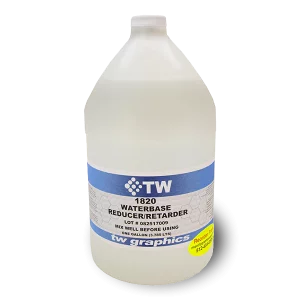
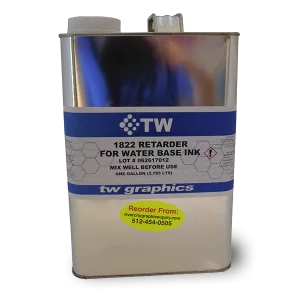
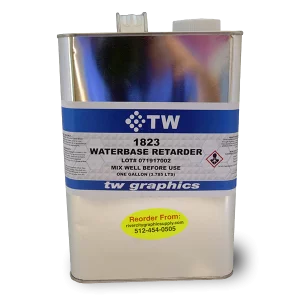
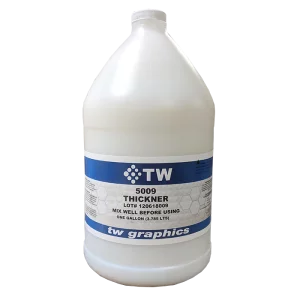
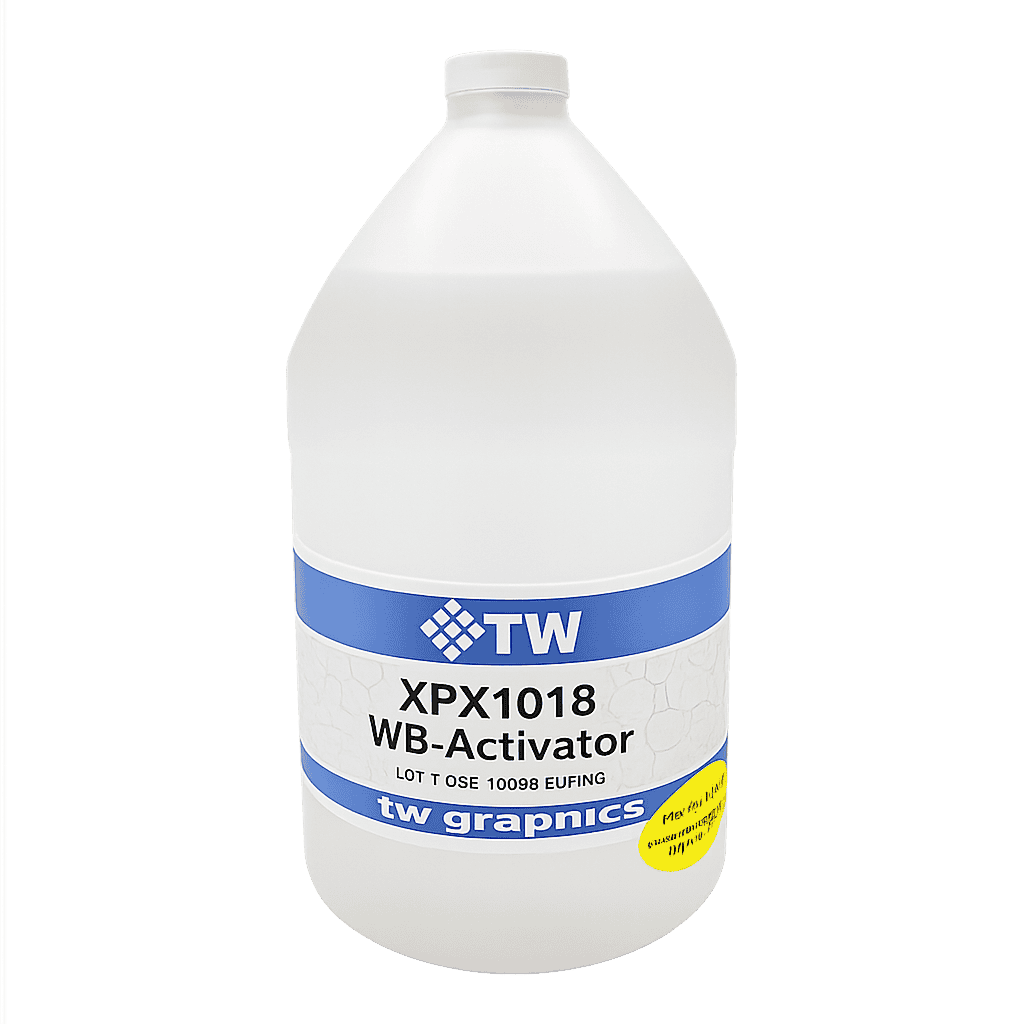
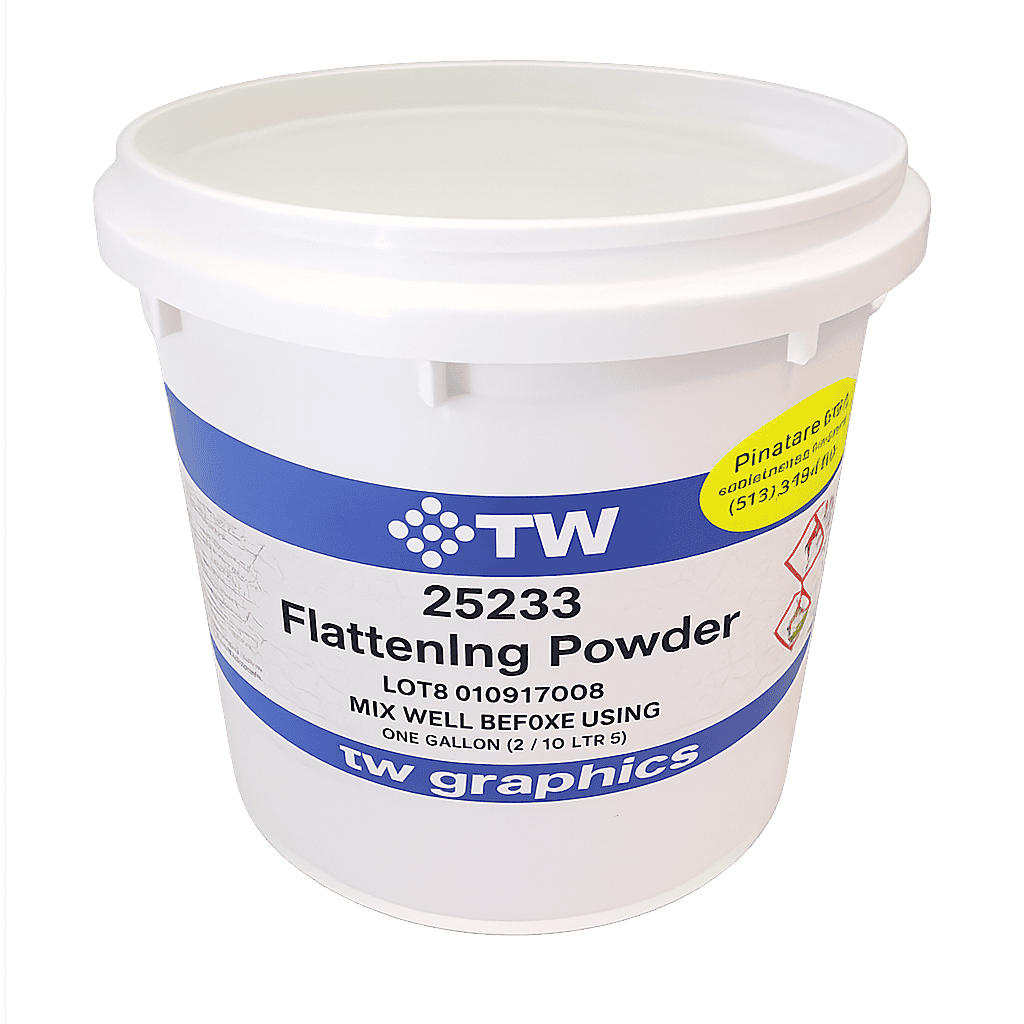
Browse all TW Graphics water-based additives at River City Supply →
Screen Room Recommendation
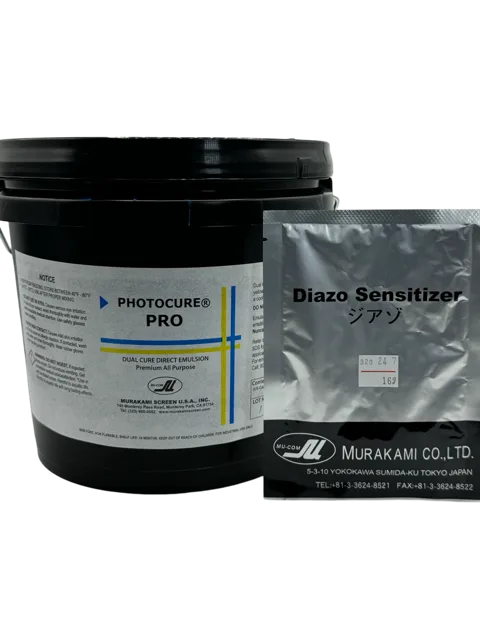
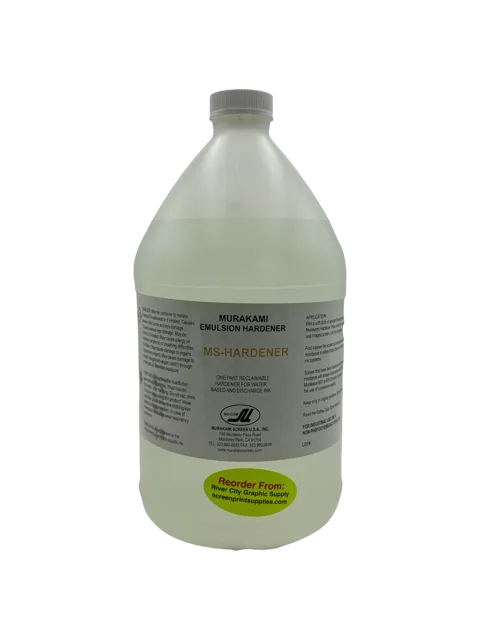
Best Emulsion for TW Graphics Poster Inks: Murakami Photocure Pro
If you are running TW water-based inks fast enough to need a defoamer, you are running production-level print speeds. Your emulsion needs to hold up to match. Murakami Photocure Pro is our recommendation for TW Graphics water-based printing — its dual-cure chemistry and 38% solids content deliver the stencil durability that high-volume poster and flat-stock printing demands.
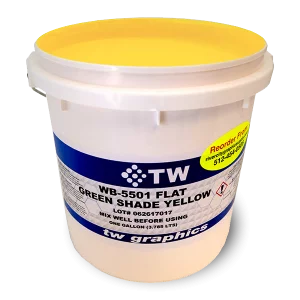
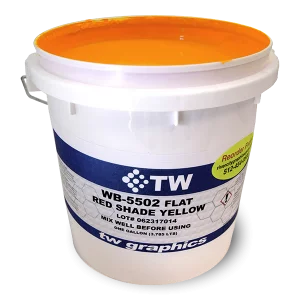
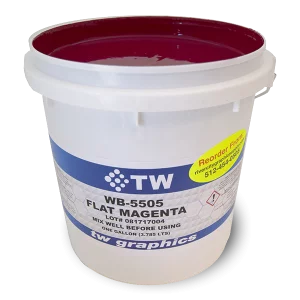
Compatible TW 5500 Flat Series Inks
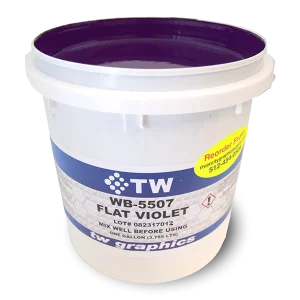
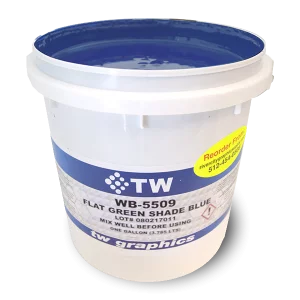
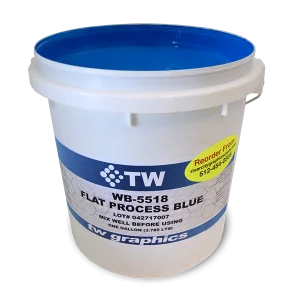
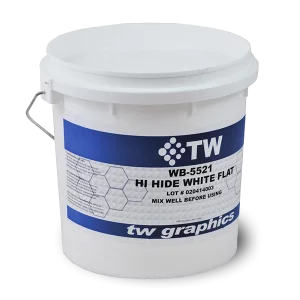
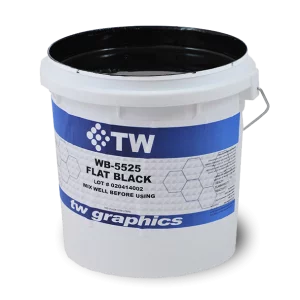
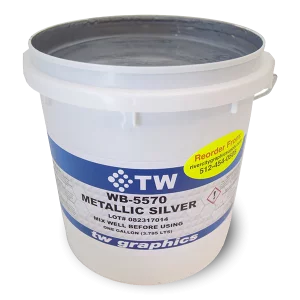
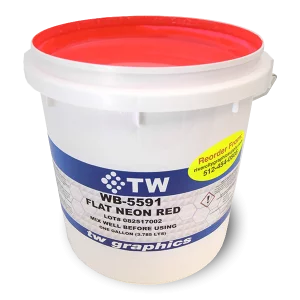
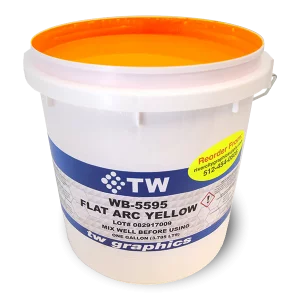
TW 5100 Defoamer works with every color in the TW 5500 Flat Series and the TW 5000 Gloss Series. Click any color to shop.
Why Buy From River City Supply?
We have been supplying screen printers since 2008. TW Graphics stocked, deep in inventory, shipped same day from San Antonio, TX.
🕒 Same-Day Shipping
Orders placed before 3:30 PM CT ship the same business day from San Antonio, TX.
🌎 Faster Than Ordering Direct
TW Graphics is in California. We are in San Antonio — 1–3 day transit to most of the U.S., consistently faster than ordering direct.
🚚 Free Shipping Over $200
Hit $200 and shipping is on us. Stock up on defoamer, inks, emulsion, and all your additives in one order.
🎉 Authorized TW Distributor
River City Supply is an authorized TW Graphics distributor. Genuine product, full lineup in stock.
📞 Real People, Real Help
Call (512) 454-0505 or email [email protected] with questions on usage rates or which additives to combine.
⚠ Do Not Exceed 2%
Over-defoaming causes fish eyes and surface repellency defects — the same visual problem as foam, caused by excess defoamer molecules in the ink body. Start at 1% and increment only if needed.
⚠ Stir Gently After Adding
Vigorous stirring after adding defoamer defeats its purpose by re-introducing air. Stir slowly and steadily until fully incorporated, then allow 2–3 minutes to rest before going to press.
⚠ Check Ink Viscosity First
Persistent foaming despite proper defoamer use is often a sign of over-thinned ink. If foam continues at 2%, evaluate whether the ink has been over-reduced with water or thinner before adding more defoamer.
Running at High Speed?
If your automatic press is running at production speed with TW water-based inks, TW 5100 should be part of your standard ink setup — not a reactive fix when foam problems show up mid-run.
Pair with Other Additives
TW 5100 is compatible with all other TW Graphics additives. Running activated ink? Running thinned ink at speed? Add TW 5100 to stabilize the foam that both scenarios introduce.
Ready to Order?
Call (512) 454-0505 or email [email protected]. Same-day shipping before 3:30 PM CT. Free shipping over $200.
Technical Specifications
| Specification | Detail |
|---|---|
| Product Name | TW 5100 Defoamer |
| Product Type | Water-Based Ink Additive — Defoamer / Anti-Foam Agent |
| Manufacturer | TW Graphics (USA, est. 1923) |
| Usage Rate | 1–2% by weight of ink — do not exceed 2% |
| Primary Function | Eliminates bubbling and foaming effect when printing at high press speeds; prevents pinholes and surface crater defects |
| When to Use | High-speed automatic runs, large solid coverage areas, heavily thinned or modified ink, freshly mixed ink batches, premium high-value jobs |
| Compatible Inks | TW 5500 Flat Series, TW 5000 Gloss Series, TW Custom Pantone Water-Based Inks |
| Compatible Additives | Compatible with all TW additives: TW Z1820 Thinner, TW Z1822/Z1823 Retarders, TW 5008/5009 Thickener, TW 25233 Flattening Powder, TW XPX1018 WB-Activator |
| Effect on Viscosity | Negligible at 1–2% usage rates |
| Effect on Color | None at recommended usage rates |
| Over-Use Warning | Exceeding 2% by weight causes fish eyes and surface repellency defects in the dried ink film |
| Mixing Method | Weigh and stir gently into ink; avoid vigorous stirring which re-introduces air; allow 2–3 minutes rest before press-up |
| Cure / Dry Process | No change to standard TW cure parameters; air dry 20–30 min at room temp, force dry seconds at 90–150°F (32–66°C) |
| Recommended Press Speed | Primarily for high-speed automatic runs; also beneficial at any speed when foam defects are observed |
| Ships From | San Antonio, TX — same-day on orders before 3:30 PM CT |
| Country of Origin | USA |
Technical Sheets / Safety Data Sheets / Documents
FREQUENTLY ASKED QUESTIONS
What does TW 5100 Defoamer actually do?
It eliminates the bubbling and foaming effect that occurs when water-based poster inks are printed at high press speeds. The defoamer works by breaking the surface tension of air bubbles in the ink body before they can transfer through the screen mesh and onto the substrate. This prevents pinholes, craters, and surface texture defects in the dried ink film. It is specifically referenced in TW Graphics’ own technical documentation as the solution for high-speed printing foam issues.
How much defoamer do I add?
Add 1–2% by weight of ink. Weigh your ink on a gram scale, calculate 1–2% of that weight, and weigh the defoamer separately before adding. Always start at 1% and evaluate before adding more. For example, 500g of ink at 1.5% requires 7.5g of defoamer. Never exceed 2% — over-defoaming causes its own set of surface defects.
Why can’t I just add more defoamer if foam is still a problem?
This is the most important rule with any defoamer. At 1–2%, the defoamer molecules target air bubbles and collapse them. Above 2%, there are more defoamer molecules than there are bubbles to collapse. The excess molecules begin forming microscopic oil droplets in the ink body, which transfer to the substrate as fish eyes, craters, and areas of surface repellency — visually similar to foam defects but caused by the defoamer itself. If you are still seeing foam at 2%, the problem is likely over-thinned ink or mechanical — not a defoamer dosage issue.
Do I need defoamer on every print job?
No. At lower press speeds and with press-ready unmodified ink, foam is usually not significant enough to cause visible defects. TW 5100 is primarily recommended for high-speed automatic press runs, large solid coverage areas, heavily thinned or modified ink batches, and high-value jobs where any surface defect is unacceptable. If you are printing slowly on a manual or semi-automatic press with unmodified ink, you likely do not need it.
Why does foam get worse at higher press speeds?
Every flood bar stroke beats air into the ink body. At low press speeds, bubbles have time to rise and escape before the squeegee stroke forces them through the mesh. At high speeds, the cycle time is too short — bubbles get driven through the screen and onto the substrate before they have a chance to dissipate. This is a mechanical reality of high-speed water-based printing, not a sign of a bad ink formulation.
Can I use TW 5100 with other TW Graphics additives in the same ink batch?
Yes. TW 5100 is compatible with the full TW Graphics additive lineup — TW Z1820 Thinner, TW Z1822/Z1823 Retarders, TW 5008/5009 Thickener, TW 25233 Flattening Powder, and TW XPX1018 WB-Activator. In fact, if you are running a heavily modified ink batch with thinner and retarder at high speed, TW 5100 is particularly important because those additives reduce ink viscosity and increase foam potential.
How should I mix the defoamer into the ink?
Stir slowly and steadily. Vigorous or rapid stirring after adding the defoamer counteracts its work by introducing new air into the ink body. Once the defoamer is evenly distributed — which takes about 30–60 seconds of gentle stirring — allow the ink to rest for 2–3 minutes before going to press. Existing bubbles from mixing will begin to collapse during that rest period.
I’m still seeing foam defects even after adding defoamer at 1.5%. What else should I check?
Before adding more defoamer, check these: (1) Is the ink over-thinned? Ink that is too low in viscosity foams more aggressively and is harder to control with defoamer alone. Try a slightly thicker consistency. (2) Did you stir gently after adding? Vigorous post-addition stirring defeats the defoamer. (3) Is the flood bar pressure or angle contributing? Excessive flood bar pressure drives more air into the ink per stroke. (4) Are you running faster than the ink can handle at its current formulation? Sometimes slowing the press slightly is more effective than chemical intervention.
Which TW Graphics inks does TW 5100 work with?
TW 5100 is designed for the full TW Graphics water-based poster ink line — TW 5500 Flat Series, TW 5000 Gloss Series, and TW Custom Pantone Water-Based Inks. It is not intended for plastisol, solvent-based, or UV-curable ink systems.
Why order from River City Supply instead of direct from TW Graphics?
River City Supply is an authorized TW Graphics distributor based in San Antonio, TX. TW Graphics is based in California. Orders placed before 3:30 PM CT ship the same day, and most customers receive orders within 1–3 business days — consistently faster than ordering from TW direct. Orders over $200 ship free. Our team at (512) 454-0505 can help with usage rates, additive combinations, and press troubleshooting specific to your job.
Questions? Call (512) 454-0505 or email [email protected]
Reviews
You May Also Like
Related products
-

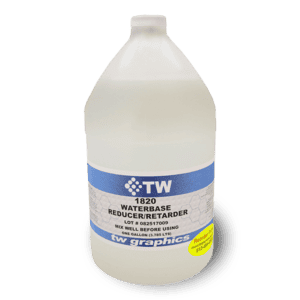
TW Z1820 Thinner – 5 to 10% Water Based Poster Ink
Price range: $26.99 through $72.45 -
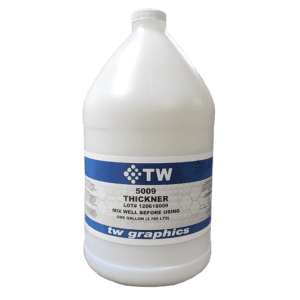
TW 5009 Thickener – 1% Water Based Poster Ink
Price range: $29.99 through $99.67 -
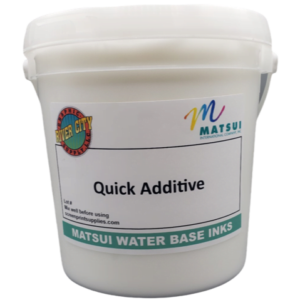
Matsui Quick Additive | All-in-One Softener, Retarder and Fixer for Water-Based Screen Printing Ink
Price range: $32.99 through $449.99 -
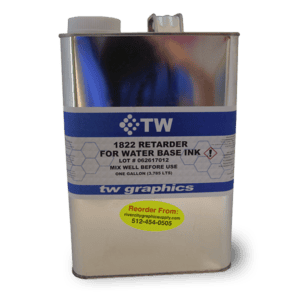
TW Z1822 Retarder – 5 to 10% Water Based Poster Ink
Price range: $24.99 through $74.99