
Chromaline Super PHAT® Capillary Film — 3D & High-Density Screen Printing
Chromaline
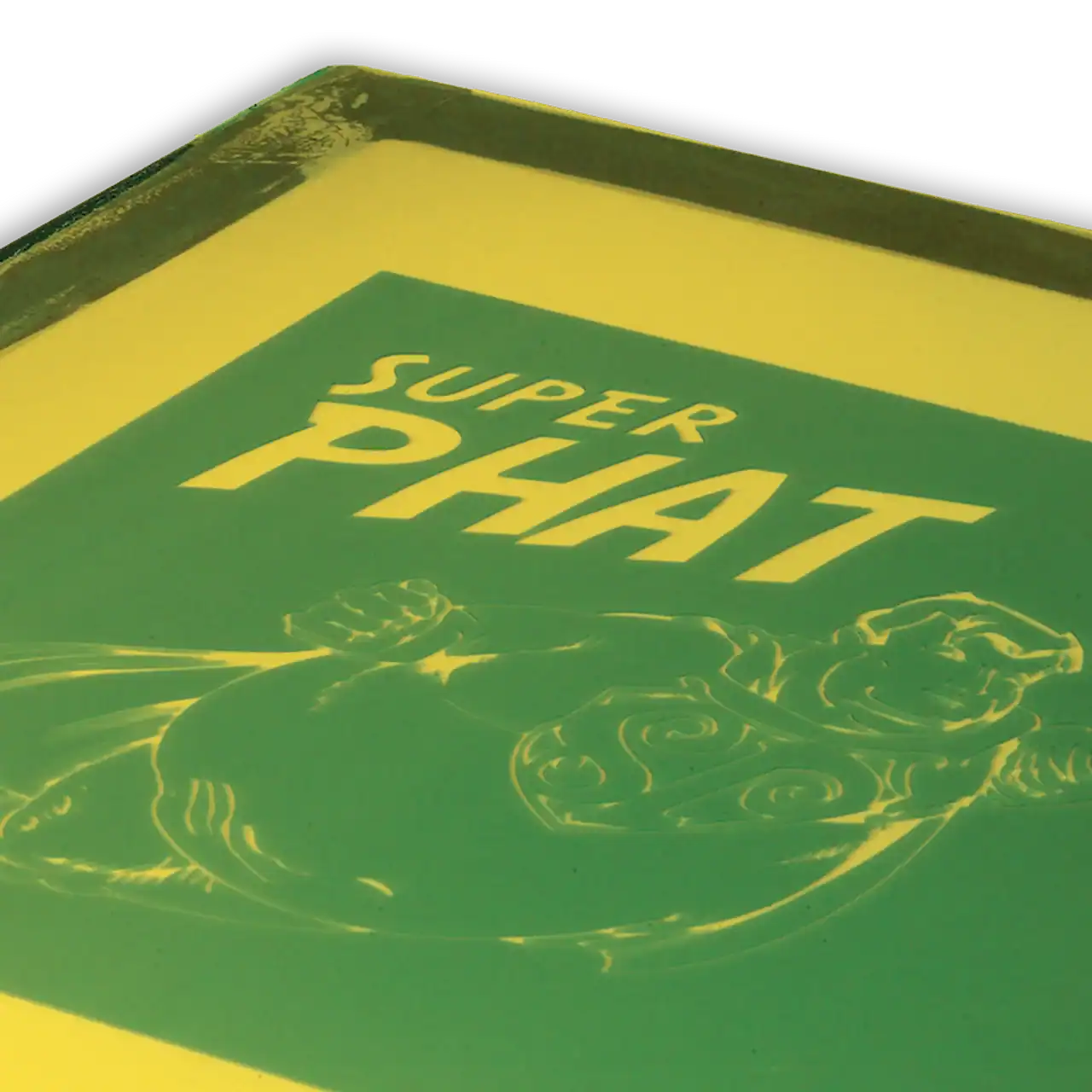
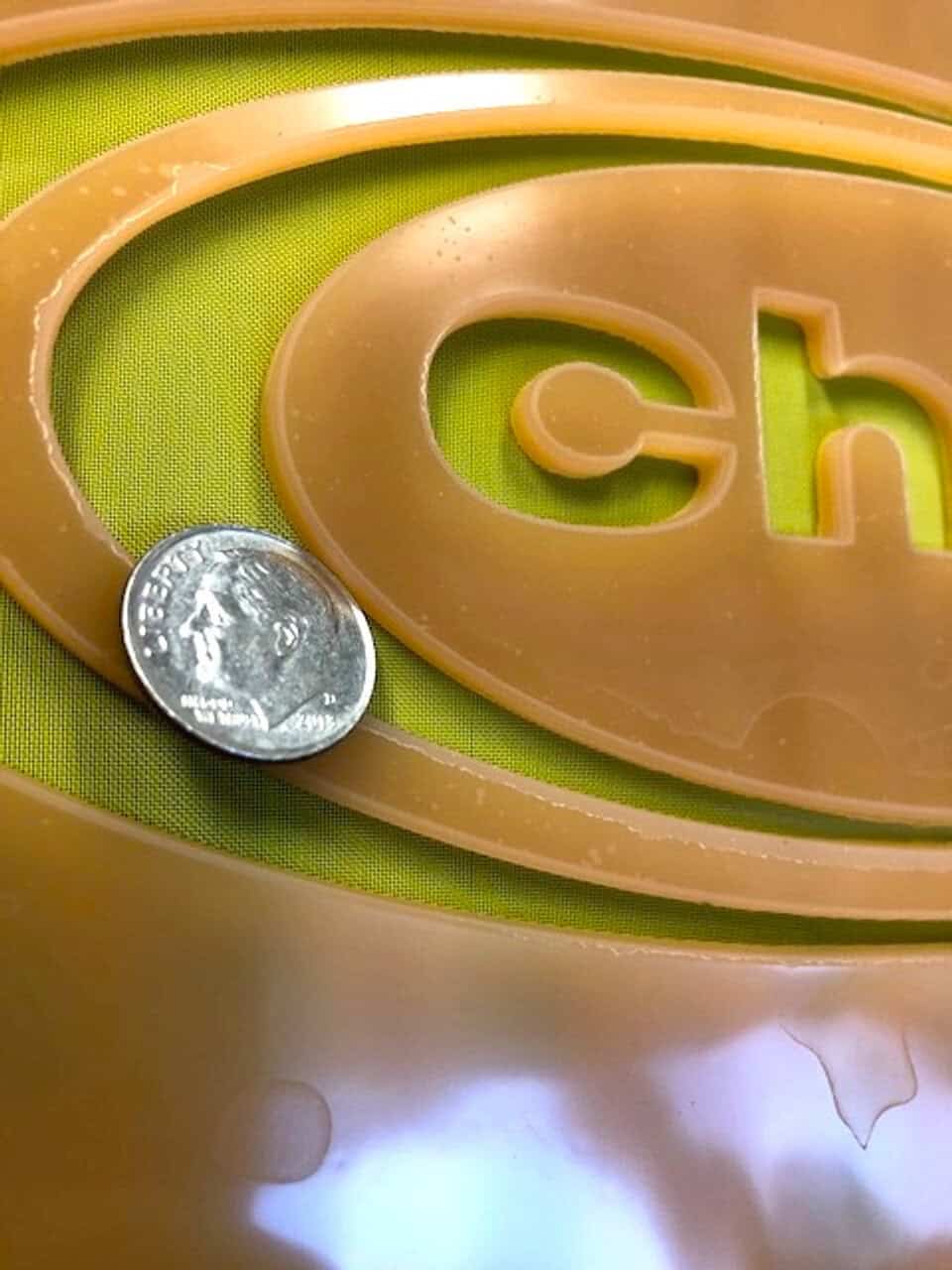


Chromaline Super PHAT® Capillary Film is the industry-standard stencil material for textile screen printers running high-density plastisol, puff, glitter, gel, and foil base inks — anywhere you need a thick stencil deposit that liquid emulsion can’t reliably achieve. Available in seven thickness options from 100 to 700 microns, Super PHAT lets you dial in exactly the ink deposit your design needs. The dry-film format means uniform thickness, fast exposures, no orange-peel surface, and faster screen turnaround than building up multiple liquid emulsion coats. Important: Super PHAT must be bonded to mesh with a liquid emulsion — typically ChromaBlue or UDC-ACE depending on your ink type. Drop ships direct from Chromaline’s South Carolina distribution warehouse.
Price range: $31.83 through $699.73
Description
The Industry Standard for 3D, Puff & High-Density Screen Printing
Pre-sensitized photopolymer capillary film engineered for thick stencil deposits — 100 to 700 microns in a single application. Built for puff plastisol, glitter ink, gel ink, foil base, high-density plastisol, and any decorator workflow where standard liquid emulsion can’t deliver the deposit thickness you need. 7 thickness options, 3 size formats, 24-month shelf life. Drop ships direct from Chromaline’s South Carolina warehouse.
What Is Super PHAT® Capillary Film?
Capillary film is pre-sensitized, dry photopolymer emulsion supplied in sheet form. Instead of coating your screen with liquid emulsion (and waiting hours for multiple coats to dry while fighting orange peel), you apply the film to a wet mesh, squeegee it down, and it bonds capillary-style to the threads. The result: a perfectly uniform stencil thickness in minutes instead of hours.
Super PHAT is Chromaline’s high-density capillary film — engineered specifically for the thick stencil deposits required by special effects screen printing. Where standard capillary films top out around 50-75 microns and liquid emulsions struggle to consistently build past 100 microns, Super PHAT goes from 100µm all the way up to 700µm in a single film application.
In screen printing, stencil thickness controls ink deposit. A 20-micron stencil deposits a thin, flat film of ink. A 200-micron stencil deposits a thick, dimensional layer that rises off the fabric. Puff plastisol expands during cure to amplify that rise — pair it with a 200µm or 300µm Super PHAT stencil and you get a finished print with visible 3D height. Add glitter ink, gel ink, or foil base to a high-density stencil and you get the textured, premium-feel prints customers pay a premium for.
See Super PHAT In Action — Official Chromaline Demo
Chromaline’s product team walks through Super PHAT capillary film — application technique, exposure setup, bonding with liquid emulsion, and the high-density print results. Watch before your first roll-down to see the exact technique used in the demo.
Which Thickness Should You Buy?
The thickness you need depends on your ink type and the visual effect you want. For most textile shops running puff or high-density plastisol, 200µm is the workhorse. Industrial and electronics shops typically need 400-700µm. Here’s the breakdown — call us if you’d like help picking the right thickness for your specific ink and design:
| Thickness | SKU Option | Best For |
|---|---|---|
| 100 µm | Super PHAT 100 | Light dimensional effect — subtle raised line work, small high-density details, mild puff prints |
| 150 µm | Super PHAT 150 | Light-to-medium high-density. Good for athletic numbers with subtle raise, beginner puff prints |
| 200 µm | Super PHAT 200 | Sweet spot for most high-density work — clear dimension, sharp edges, ideal for puff, gel, and glitter inks. Most-used thickness |
| 250 µm | Super PHAT 250 | Strong dimensional build — heavy puff prints, foil base layers, premium athletic apparel logos |
| 300 µm | Super PHAT 300 | Pronounced 3D effect — heavy textured prints, premium streetwear, hand-feel-focused designs |
| 400 µm | Super PHAT 400 | Extreme build — heavy industrial-grade thickness. Use stacked 200µm screens instead for sharper edges on textiles |
| 700 µm | Super PHAT 700 | Maximum build for electronics, industrial, and ceramic printing. Rarely used for textile work |
If you need ~400 microns of total stencil deposit AND sharp edges, don’t use a single 400µm Super PHAT screen — the edges blur as the stencil thickness increases. Instead, build two screens at 200µm each, both with the same image. Print the first screen, flash cure, then print the second screen registered slightly higher than the first. This “stacking” approach produces the total height you want while maintaining the crisp edge definition that single thick stencils lose. Chromaline’s matchstick demo print uses this technique.
What Super PHAT Is Used For
Super PHAT exists because liquid emulsion can’t reliably deliver thick, uniform stencil deposits. Every workflow below either requires Super PHAT (or a competitor capillary film) — or accepts compromised results from triple-coated liquid emulsion. The thickness range from 100-700µm covers everything from subtle dimension to extreme industrial build:
Step-by-Step: Applying Super PHAT to Your Screen
The standard application method is the “roll-down” technique below. Larger shops sometimes use a spray-gun method that applies water more lightly and reduces the risk of denting the film, but the roll-down method is the proven workflow for most operations. The whole process takes 10-15 minutes of active time plus drying.
Start with a properly degreased, fully dry screen on a fresh mesh. Yellow mesh is strongly preferred for Super PHAT — it absorbs scattered UV light during exposure, which is critical for thick stencil resolution. Standard white mesh works but expect softer edges.
Open Super PHAT only under yellow safelight or low-wattage tungsten bulbs. AVOID daylight, fluorescent lamps, quartz/halogen, or cool-white LEDs — any of these will pre-expose the film and ruin the stencil before you start. Cut the film about 1″ larger than your image area.
Spray or wipe the mesh side (the side the squeegee won’t touch during printing) with clean filtered water. The mesh should be uniformly wet — not dripping, not dry. This is the capillary action that bonds the film to the threads.
With the printed Mylar carrier sheet UP (toward you) and the dry film side DOWN (toward the wet mesh), lay the film flat on the mesh. Smooth out any wrinkles or bubbles by hand before squeegeeing — once water wets the film, you can’t move it.
Using a soft squeegee or window-squeegee, work from the center of the screen outward to push water and air bubbles to the edges. Light pressure — you’re not trying to drive the film into the mesh, you’re letting the capillary action pull it in. Several light passes beat one heavy pass.
For small bubbles that remain in the image area, wet your finger and gently touch the bubble. The capillary action will pull the film tight to the mesh, eliminating the bubble. This is normal — don’t panic at a few residual bubbles.
Lay the screen flat to dry — film side up. Drying position doesn’t really matter with capillary film (unlike liquid emulsion), but horizontal dry is most foolproof. Allow several hours minimum; thick film (400µm+) may need overnight.
Once dry, peel the Mylar carrier sheet off the film. Then coat the PRINT SIDE of the screen with one thin coat of liquid emulsion — ChromaBlue for plastisol inks, UDC-ACE for water-based or discharge inks. This bonds the film to the threads and seals the edges. Dry again.
Use LED or metal halide exposure (fluorescent units don’t have enough UV power for thick film). Chromaline’s reference: 5KW unit at 40″ / 1 meter from frame using yellow mesh. Expose, wash out gently with low-pressure water, inspect for clean edges and full image.
Unlike standard capillary films which can be used standalone, Super PHAT is engineered to be laminated with a liquid emulsion on the print side. Without the bonding coat, the film will not adhere reliably to the mesh during long print runs — you’ll see lifting, ghosting, and stencil failure. Chromaline specifies ChromaBlue for plastisol inks and UDC-ACE for water-based or discharge inks. Other Chromaline emulsions work too — check the emulsion’s data sheet for capillary-film compatibility.
8 Pro Tips for Better Super PHAT Results
Distilled from Chromaline’s technical documentation, decorator shop experience, and our own customer feedback. If you’re new to capillary film, read these before your first roll-down:
For total stencil deposits over 200µm where edge sharpness matters: use TWO screens at 200µm each instead of one screen at 400µm. Print the first, flash cure, then print the second slightly higher. Edge definition stays crisp; total ink deposit hits 400µm+. Chromaline’s matchstick demo uses this exact technique.
Yellow mesh absorbs scattered UV during exposure, which is essential for thick stencils. White mesh produces softer edges and undercutting on thick film. The extra cost of yellow mesh is recovered the first time you save a screen from re-burning.
Standard fluorescent exposure units don’t produce enough UV intensity to fully expose thick capillary film. Symptoms of underexposure: soft edges, image washes out, stencil dissolves during printing. If you have a fluorescent exposure unit, borrow time on a friend’s LED or metal halide unit before buying Super PHAT in bulk.
ChromaBlue for plastisol inks (oil-based). UDC-ACE for water-based, discharge, or solvent-based inks. Mixing this up causes stencil breakdown mid-run — the wrong emulsion dissolves in the wrong ink. Check your ink type before ordering bonding emulsion.
Super PHAT sheets curl and crease if stored standing or hanging. Lay them flat in a closed container in a cool, dry, dark area. A simple flat cardboard pizza-style box works well. Creased film produces creased stencils — non-recoverable.
Once you’ve applied Super PHAT and the bonding emulsion to a screen, that coated screen lasts MAXIMUM one month in cool, dry, completely dark storage. Beyond that, the unexposed photopolymer starts breaking down. Don’t pre-coat dozens of screens hoping to use them next quarter.
Super PHAT has improved humidity resistance vs liquid emulsion — but it’s not waterproof. Drying screens in a humid (>70% RH) environment slows drying and risks moisture-related bond failure. Use a dehumidifier or AC in your drying cabinet during summer months.
The 8″×10″ 2-sheet trial pack is the right way to dial in your shop’s specific exposure time, bonding emulsion, and ink combo before buying a 10-sheet production pack. Most shops need 1-3 trial screens to nail down their workflow with a new capillary film.
Exposure Unit Requirements — Read Before Buying
Super PHAT’s biggest user pitfall is exposure. The film is thicker than standard stencils, so it needs more UV light to fully cure. Underexposed Super PHAT will wash out during development, leaving you with no usable stencil at all. Here’s what works and what doesn’t:
- Metal Halide units (5KW typical) — Chromaline’s reference exposure source
- LED exposure units (UV LED arrays) — modern shop standard
- High-power UV mercury vapor lamps
- Used with yellow mesh for best edge definition
- Fluorescent / BLB exposure units — insufficient UV intensity
- Sunlight exposure — uneven, unpredictable
- Standard household UV lamps — not enough power
- Black light reptile bulbs — hobbyist range only, won’t penetrate thick film
5KW metal halide unit at 40″ (1 meter) from the frame, using yellow mesh. Your specific exposure time will vary based on thickness, mesh count, mesh color, and bonding emulsion — always run an exposure step test first. Start at ~2x your normal exposure time for liquid emulsion and adjust from there. If your image washes out or edges are soft, increase exposure time. If the image is hard to wash out, decrease.
Capillary Film vs Liquid Emulsion for High-Density Work
For standard stencil thicknesses (15-50µm), liquid emulsion is usually the right choice — it’s cheaper per screen and most shops already have a workflow built around it. But for high-density work (100µm+), capillary film like Super PHAT becomes the practical choice. Here’s the honest comparison:
| Factor | ★ Super PHAT Capillary Film | Liquid Emulsion (Multi-Coat) |
|---|---|---|
| Thickness Consistency | ★ Uniform across entire screen (factory-cast) | Variable — depends on operator technique |
| Maximum Practical Thickness | ★ 700µm in single application | ~100µm before quality breaks down |
| Drying Time (Multi-Coat) | ★ One application — single dry cycle | 3-6+ coats, drying between each (hours) |
| Surface Quality (“Orange Peel”) | ★ Smooth, flat film — no orange peel | Orange peel develops at thick builds |
| Image Sharpness at Thick Builds | ★ Sharp edges held | Edges blur as thickness increases |
| Humidity Resistance | ★ Improved (dry film) | Sensitive to humidity during drying |
| Shop Cleanliness | ★ No mess — dry sheet application | Coating troughs, drips, splatter |
| Cost Per Screen | Higher upfront — but consistent | ★ Lower per-screen for thin builds |
| Learning Curve | ★ Easier — uniform results | Coating skill required for consistency |
| Storage Footprint | ★ Flat sheets — minimal space | Gallon buckets — needs shelf space |
| Best Use Case | ★ High-density, puff, glitter, special effects | Standard plastisol & water-based work |
Most production shops keep Chromaline Hydro-X liquid emulsion for standard plastisol work AND Super PHAT capillary film for high-density/special effects work. Each tool for its right job — trying to force liquid emulsion to do high-density work (or Super PHAT to do thin stencil work) loses time and quality.
Storage, Handling & Shelf Life
- Shelf life: 24 months at room temperature
- Store in original packaging, sealed
- Cool, dry, dark area (closet, drawer)
- Sheets MUST be stored flat — no folding/standing
- Avoid heat sources and direct sunlight
- Maximum 1 month coated & unexposed
- Store in clean, cool, dry, COMPLETELY DARK area
- Light-tight cabinet or wrapped in black plastic
- Beyond 1 month, photopolymer breaks down
- Don’t pre-coat large batches “for later”
- Yellow safelight or low-wattage tungsten only
- NO daylight, fluorescent, quartz/halogen, cool-white
- Clean, dry hands (or gloves)
- Avoid creasing or wrinkling
- Cut on clean, flat surface
- Capillary film is a photopolymer — generally low hazard
- Avoid skin contact with bonding emulsion (separate product)
- Wash hands after handling
- Use eye protection during exposure
- Review the bonding emulsion’s SDS separately
Pair Super PHAT With the Right Bonding Emulsion
Super PHAT MUST be bonded to your mesh with a liquid photopolymer emulsion. The right emulsion depends on the ink chemistry you’ll be printing. Don’t skip this step — without bonding emulsion, Super PHAT lifts during long print runs.
Chromaline’s standard photopolymer emulsion for plastisol screen printing. Use with Super PHAT when running standard plastisol, high-density plastisol, puff, gel, or foil base inks.
Diazo dual-cure emulsion for water-based, discharge, and solvent inks. Required when bonding Super PHAT for water-based screen printing — plastisol emulsions will dissolve in water-based ink.
Other Chromaline Capillary Films & Supplies
Super PHAT is the right choice for high-density work. For standard stencil thicknesses, Chromaline makes several other capillary films better suited to those workflows:
Technical Specifications
Product Identification
| Specification | Value |
|---|---|
| Product Name | Chromaline Super PHAT® Capillary Film |
| Manufacturer | Chromaline Screen Print Products (Duluth, MN) |
| Category | Pre-sensitized photopolymer capillary film |
| Color | Undyed — light tan / transparent |
| Primary Use | High-density screen printing, 3D / dimensional textile prints, special effects inks, electronics & industrial printing |
| Country of Manufacture | United States (Made in USA) |
Thickness Options
| SKU | Thickness | Typical Application |
|---|---|---|
| Super PHAT 100 | 100 microns (0.1 mm) | Light dimensional effect, subtle raised lines |
| Super PHAT 150 | 150 microns | Light-medium high-density, athletic numbers |
| Super PHAT 200 | 200 microns (0.2 mm) | ★ Most popular — puff, glitter, gel inks |
| Super PHAT 250 | 250 microns | Strong dimensional build, foil base |
| Super PHAT 300 | 300 microns (0.3 mm) | Pronounced 3D effect, heavy puff |
| Super PHAT 400 | 400 microns (0.4 mm) | Extreme build (stack 2× 200µm for sharper edges) |
| Super PHAT 700 | 700 microns (0.7 mm) | Maximum — electronics, industrial, ceramic |
Sheet Size Options
| Size | Pack Qty | Best For |
|---|---|---|
| 8″ × 10″ | 2-sheet trial pack | First-time users, exposure step tests, single-job projects |
| 26″ × 7″ | Roll/single sheet | Mid-volume shops, custom-size cutting flexibility |
| 17″ × 24″ | 10-sheet production pack | Production shops, standard screen sizes, best per-sheet value |
Performance Specifications
| Property | Value |
|---|---|
| Photopolymer Type | Pre-sensitized — ready to use, no mixing |
| Bonding Method | Requires liquid emulsion (ChromaBlue or UDC-ACE) |
| Exposure Source Required | Metal halide or LED UV (NOT fluorescent) |
| Reference Exposure | 5KW metal halide at 40″ (1 meter) using yellow mesh |
| Safelight Handling | Yellow safelight or low-wattage tungsten only |
| Light to Avoid | Daylight, fluorescent, quartz/halogen, cool-white LED |
| Mesh Recommendation | Yellow mesh strongly preferred for thick stencil resolution |
| Surface Quality | Smooth — no orange-peel texture |
| Humidity Resistance | Improved vs liquid emulsion (still avoid >70% RH drying) |
| Drying Position | Any (horizontal preferred for first-time users) |
Storage & Shelf Life
| Detail | Value |
|---|---|
| Unopened Shelf Life | 24 months at room temperature |
| Coated Screen Shelf Life | Maximum 1 month — clean, cool, dry, completely dark |
| Storage Position | Cut sheets MUST be stored flat (no folding/standing) |
| Storage Container | Closed container in cool, dry area |
| Light Protection | Keep away from daylight and overhead room lights |
| Temperature Range | Room temperature (60-80°F ideal) |
Compatible Ink Types
| Ink Type | Bonding Emulsion Required |
|---|---|
| Standard Plastisol | ChromaBlue (plastisol-rated photopolymer) |
| High-Density Plastisol | ChromaBlue |
| Puff Plastisol | ChromaBlue |
| Glitter Plastisol | ChromaBlue |
| Gel Plastisol | ChromaBlue |
| Foil Base / Adhesive | ChromaBlue |
| Water-Based Ink | UDC-ACE (diazo dual-cure) |
| Discharge Ink | UDC-ACE |
| Solvent-Based Ink | UDC-ACE |
Technical Sheets / Safety Data Sheets / Documents
FREQUENTLY ASKED QUESTIONS
Frequently Asked Questions
Reviews
Only logged in customers who have purchased this product may leave a review.
You May Also Like
Related products
-

Chromaline ProCap 30 Diazo Capillary Film – Precision Meets Durability
Price range: $108.12 through $168.16 -
Chromaline ProCap 15 Diazo Capillary Film – Precision Meets Durability
$124.67 -
Chromaline ProCap 50 Diazo Capillary Film – Precision Meets Durability
Price range: $124.20 through $192.20 -
Chromaline ProCap 25 Diazo Capillary Film – Precision Meets Durability
Price range: $102.65 through $152.15


Reviews