
Chromaline Quick Film – Pure Photopolymer Capillary Film for Screen Printing
Chromaline
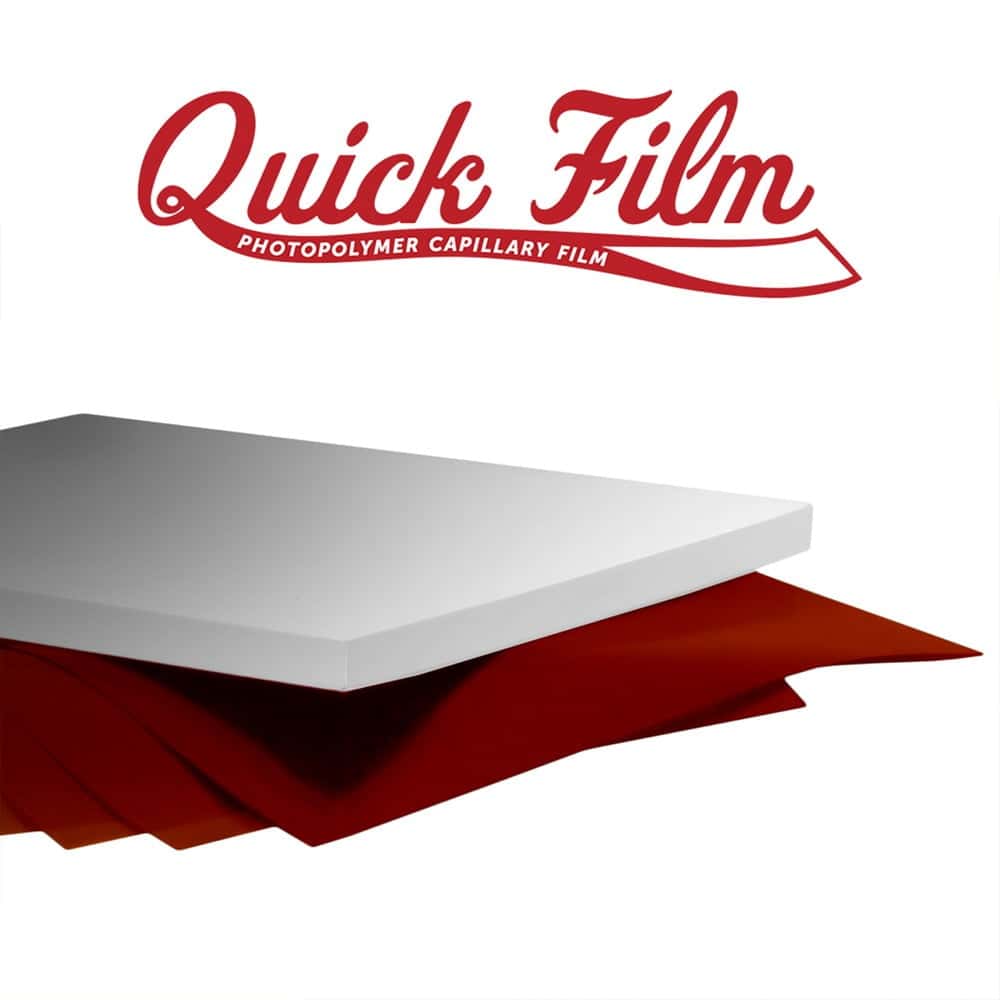

Chromaline Quick Film Photopolymer Capillary Film is Chromaline’s pure photopolymer capillary film — engineered for textile screen printers who want fast exposure, immediate press readiness, and the option to skip the bonding emulsion step entirely. At 40 microns thick, it’s engineered specifically for textile screen printing with plastisol inks, halftone reproductions, fine detail work, fast-turnaround production environments, and any workflow where exposure speed and minimal preparation time matter. Pre-sensitized pure photopolymer chemistry means no mixing or measuring — open the package, cut to size, and apply to your wet mesh. Drop ships direct from Chromaline’s South Carolina warehouse (allow 2-3 extra business days for processing and shipping). Browse all Chromaline capillary films in our capillary film category.
$109.27
Description
Fast to Press, No Bonding Emulsion Required
Chromaline Quick Film is Chromaline’s pure photopolymer capillary film — engineered for textile screen printers who want fast exposure, immediate press readiness, and the option to skip the bonding emulsion step entirely. At 40 microns thick, it’s engineered specifically for textile screen printing with plastisol inks, halftone reproductions, fine detail work, fast-turnaround production environments, and any workflow where exposure speed and minimal preparation time matter. Pre-sensitized pure photopolymer chemistry — open the package, cut to size, apply to your wet mesh. Drop ships direct from Chromaline’s South Carolina warehouse.
What Is Chromaline Quick Film?
Capillary film is pre-sensitized photopolymer emulsion supplied as a dry sheet. Instead of coating your screen with liquid emulsion (and waiting hours for multiple coats to dry while fighting orange peel), you apply the film to a wet mesh, squeegee it down, and the capillary action of the wet threads draws the film into the mesh. The result: a perfectly uniform stencil thickness in minutes instead of hours.
Chromaline Quick Film is Chromaline’s pure photopolymer capillary film — engineered for textile screen printers who want fast exposure, immediate press readiness, and the option to skip the bonding emulsion step entirely. The 40-micron stencil thickness is specifically calibrated for textile screen printing with plastisol inks — different thicknesses in the ProCap and Chromaline capillary film lineup are engineered for different LPI halftone ranges and ink deposit requirements.
Where the ProCap line uses diazo chemistry (slower exposure, plastisol + solvent compatibility), Quick Film uses pure photopolymer (faster exposure, plastisol only). The trade-off is intentional: textile screen printers running plastisol exclusively benefit from the faster exposure throughput, while Quick Film’s standalone capability eliminates the bonding emulsion step entirely. Optional lamination with any Chromaline textile emulsion adds durability for very long print runs.
Where Chromaline Quick Film Fits in the Chromaline Capillary Film Lineup
Chromaline makes capillary films across a wide thickness range — from 15 microns for ultra-fine detail up to 700 microns for extreme high-density 3D effects. Pick the thickness that matches your design’s LPI/halftone requirements and your ink type. Click any thickness to view that product:
Stand-alone capable — works without bonding emulsion (optional lamination for added durability) — and exposes faster than diazo films for higher daily screen throughput.
What Chromaline Quick Film Is Used For
Chromaline Quick Film’s 40-micron thickness is calibrated for these primary applications. If your work matches any of the below, this is the right capillary film:
Watch: Quick Film Application
Official Chromaline demonstration of the Quick Film application process — from wet mesh prep through squeegee-down, drying, exposure, and washout. The visual reference shows exactly what proper film-to-mesh capillary contact looks like in real time, and how the red film behaves differently from diazo capillary films during application.
Quick Film’s pure photopolymer chemistry behaves slightly differently from diazo ProCap films during application — the red color, the faster exposure, and the standalone-capable workflow. The video shows the practical handling tips that aren’t obvious from the technical data sheet.
Step-by-Step: Applying Chromaline Quick Film to Your Screen
The standard roll-down method below works for Chromaline Quick Film. Larger production shops sometimes use spray-gun methods for lighter water application, but the roll-down approach is the proven workflow. Total active time: 10-15 minutes plus drying.
Start with a properly degreased, fully dry mesh. Quick Film works well on coarse to thin mesh — match your mesh count to your design’s detail requirements.
Open Quick Film only under yellow safelight or low-wattage tungsten bulbs. AVOID daylight, fluorescent, quartz/halogen, and cool-white LED — these will pre-expose the film. Cut about 1″ larger than your image area.
Spray or wipe the mesh side with clean filtered water until uniformly wet — not dripping, not dry. This is the capillary action that draws Quick Film into the threads.
With the red film side DOWN (toward the wet mesh) and the Mylar carrier UP, lay the film flat. Smooth any wrinkles by hand before squeegeeing.
Use a soft squeegee to work from the center outward. Light pressure — the capillary action pulls the film in; you’re just guiding it. Several light passes work better than one heavy pass.
Lay the screen flat to dry. Quick Film dries relatively fast — typically 1-2 hours for standard mesh thicknesses. Drying position doesn’t matter (any orientation works).
Quick Film can be used standalone, OR for very long print runs you can coat the print side with any Chromaline textile emulsion (Hydro-X, CP-Tex, etc.) for added durability. This step is OPTIONAL with Quick Film — unlike Super PHAT which requires it.
Pure photopolymer chemistry means faster exposure than diazo films. Start at roughly 50% of your typical diazo capillary film exposure time and test. Wash out with gentle water spray. Quick Film produces clean, pinhole-free stencils when exposed correctly.
Pro Tips for Chromaline Quick Film
Distilled from Chromaline’s technical documentation, shop experience, and customer feedback. Save yourself the trial-and-error:
Quick Film exposes faster than diazo ProCap variants. If you’re switching from ProCap to Quick Film, start your exposure time at roughly 50% of your typical ProCap exposure and step-test from there. Most shops save 30-50% in exposure time per screen.
For typical textile production (under ~2000 impressions per stencil), standalone Quick Film works fine. For runs over 5000 impressions, laminate with a Chromaline textile emulsion (Hydro-X Blue, CP-Tex) for added durability — it adds 10 minutes of work but doubles stencil life.
Quick Film’s red color isn’t decorative — it makes the film visible on the mesh during application. Use this when positioning the film: you can see exactly where it sits, making registration with your design’s intended position more precise.
Pure photopolymer formulations break down in water-based and discharge inks. If you switch a job from plastisol to water-based, switch capillary films too — use ProCap with UDC-ACE emulsion bonding, or Super PHAT with UDC-ACE for high-density water-based effects.
Quick Film is engineered to be pinhole-free, but that only works if your starting mesh is properly degreased and contaminant-free. Take an extra 30 seconds with degreaser and a fresh wipedown — you’ll avoid touchup work later.
Quick Film can be plotter-cut for precise design transfer when traditional exposure isn’t ideal. Useful for jobs where you need to cut multiple identical stencils quickly, or where the design includes very tight tolerances that benefit from cutting rather than photographic exposure.
Exposure Unit Requirements
All Chromaline capillary films need proper UV exposure to cure correctly. Underexposure causes the image area to wash out during development — leaving you with no usable stencil. Here’s what works:
- Metal Halide units (3-7KW typical) — the industry-standard exposure source
- LED UV exposure units — modern shop standard, fast cure times
- High-power mercury vapor lamps
- Used with yellow mesh for best edge definition on detail work
- Fluorescent / BLB exposure units — usually too weak for thick films
- Sunlight exposure — uneven, unpredictable
- Standard household UV lamps — not enough power
- Reptile bulbs & hobbyist UV — won’t fully cure
Capillary Film vs Liquid Emulsion — When to Use Which
Both have their place. For high-detail, halftone, and consistency-critical work, capillary film like Chromaline Quick Film produces better results. For everyday standard plastisol work in mid-LPI range, liquid emulsion remains the cost-effective choice. Here’s the honest comparison:
| Factor | ★ Chromaline Quick Film (Capillary Film) | Liquid Emulsion |
|---|---|---|
| Thickness Consistency | ★ Uniform across entire screen (factory-cast) | Variable — depends on operator coating technique |
| Edge Definition | ★ Sharper edges, especially at high LPI | Good with skill, but coating variability shows |
| Setup Time Per Screen | ★ Faster — one application, single dry | Multiple coats + dry between each |
| Cost Per Screen | Higher per-screen for consumable cost | ★ Lower per-screen consumable cost |
| Learning Curve | ★ Easier — uniform results regardless of operator | Coating skill required for consistent results |
| Best Application | ★ High-detail, halftones, consistency-critical | Standard plastisol work, larger format screens |
Stock Chromaline Hydro-X liquid emulsion for everyday standard plastisol work AND Chromaline Quick Film for high-detail / halftone / fine-line screens. Each tool for its right job — forcing one to do the other’s work costs you time and quality.
Shipping & Drop-Ship Notice
Chromaline Quick Film ships directly from Chromaline’s South Carolina distribution warehouse — NOT from our San Antonio facility. Please allow 2-3 extra business days for processing before standard shipping transit time. Most US destinations receive shipment in 4-7 business days total via standard ground.
The drop-ship arrangement means you get fresh, factory-direct inventory with no double-handling. FREE shipping applies on RCS orders over $200 (combined with other items as needed). Need it faster? Contact us — expedited shipping options may be available for an additional fee.
Other Chromaline Capillary Films
If Chromaline Quick Film isn’t quite the right thickness for your work, Chromaline makes capillary films across the full thickness range. Browse the full capillary film category or jump to a specific product:
Technical Specifications
Product Identification
| Specification | Value |
|---|---|
| Product Name | Chromaline Quick Film Photopolymer Capillary Film |
| Manufacturer | Chromaline Screen Print Products |
| Category | Pre-sensitized pure photopolymer capillary film |
| Color | Red film |
| Country of Origin | USA |
| Shipping Origin | Drop ships from Chromaline South Carolina warehouse |
Physical Specifications
| Property | Value |
|---|---|
| Film Thickness | 40 microns (0.040 mm) |
| Chemistry Type | Pure photopolymer (faster cure) |
| Ink Compatibility | Plastisol inks ONLY (not for solvent or water-based) |
| Recommended LPI Range | Halftone-capable |
| Recommended Mesh Range | Compatible with coarse to thin mesh |
| Bonding Emulsion | Optional — Can be used standalone OR laminated with any Chromaline textile emulsion |
| Exposure Source | Metal halide or LED UV (fluorescent units typically insufficient) |
| Exposure Speed | ★ FAST exposure (faster than diazo ProCap) |
| Recommended Mesh Color | Yellow mesh (especially for halftone work) or white mesh for solid color |
| Safelight Handling | Yellow safelight or low-wattage tungsten only |
Available Sizes
| Size Option |
|---|
| 15″ × 17″ sheets, 50 sheets per box |
Storage & Handling
| Detail | Value |
|---|---|
| Unopened Shelf Life | 2 years at room temperature, sealed |
| Storage Position | Flat in sealed container, cool, dry, dark area |
| Coated Screen Shelf Life | Use within 1 month — store in completely dark cabinet |
| Temperature Range | Room temperature (60-80°F ideal) |
| Light Sensitivity | High — avoid all daylight, fluorescent, halogen, cool-white LED |
Documents & Resources
Technical Sheets / Safety Data Sheets / Documents
Documents & Resources
FREQUENTLY ASKED QUESTIONS
Frequently Asked Questions
Reviews
Only logged in customers who have purchased this product may leave a review.
You May Also Like
Related products
-

Chromaline ProCap 38 Diazo Capillary Film – Precision Meets Durability
Price range: $114.16 through $178.25 -
Chromaline ProCap 25 Diazo Capillary Film – Precision Meets Durability
Price range: $102.65 through $152.15 -
Chromaline ProCap 30 Diazo Capillary Film – Precision Meets Durability
Price range: $108.12 through $168.16 -
Chromaline ProCap 18 Diazo Capillary Film – Precision Meets Durability
Price range: $78.76 through $118.08

Reviews