Albatross AlbaChem VLR Vinyl Letter Removing Solvent
Albatross
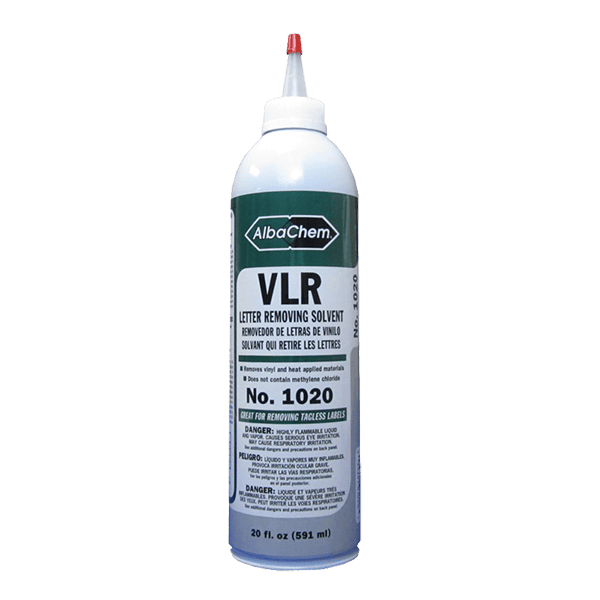
AlbaChem® VLR Vinyl Letter Removing Solvent (Item 1020, 20 fl. oz) — the industry-standard solvent for removing heat transfer vinyl, DTF transfers, and adhesive residues from cotton garments. Save misprinted shirts, fix tagless label errors, and reclaim production seconds. Fast-drying, residue-free, contains no chlorinated solvents or California Prop 65 ingredients. The precision Yorker spout puts the solvent exactly where you need it — no overspray, no waste. Ships UPS Ground from San Antonio, TX with FREE SHIPPING on orders over $200.
$19.99
Description
The Industry-Standard HTV Remover Since the 1990s
The industry-standard solvent for removing heat transfer vinyl letters, DTF transfers, and adhesive residues from cotton garments. Save misprinted shirts, fix tagless label errors, and reclaim production seconds — fast-drying, no stains, no chlorinated solvents.
Why Decorators Trust AlbaChem VLR
The Yorker-style spout puts solvent exactly where you need it — no overspray, no waste, no soaking the surrounding fabric. A small puddle directly on the back of the HTV is all you need.
VLR evaporates completely within 1-2 minutes, leaving no stain, no oily film, no chemical residue. The garment is ready to re-press immediately.
Formulated without methylene chloride, perchloroethylene, or other chlorinated solvents that were common in older vinyl removers. Safer for your shop, safer for the environment.
Contains no Prop 65 listed ingredients — sellable and usable in all 50 US states without restrictions.
Designed for the heat-activated adhesives in HTV, DTF, EasyPSV, and tagless transfers. Penetrates the adhesive bond from the back side of the fabric for clean release.
Manufactured by Albatross USA, Inc. (Long Island City, NY) — the same company that supplied the textile industry’s degreasers and cleaners for decades. Used by professional decorators since the 1990s.
Packaged as Limited Quantity (49 CFR 173.150) — ships standard UPS Ground without hazmat surcharges within the continental US.
Cited as the trusted vinyl letter remover by Stahls’, ScreenPrinting.com (Ryonet), HeatPressNation, Heat Transfer Warehouse, and every other major US decorator supply distributor.
What’s in the Bottle
Single 20-ounce HDPE bottle with a Yorker-type precision-pour spout. The Yorker spout has a small opening that controls flow for accurate application — a major upgrade vs cap-and-pour bottles.
Factory-sealed cap ensures the solvent hasn’t evaporated or been tampered with in transit. Always check the seal before first use.
Each lot is QC tested by Albatross before release. Item No. 1020 has been in continuous production for over 20 years.
Downloadable from this product page. Required reading before use. View the VLR SDS here.
Application instructions, package data, and shipping classifications. View the VLR TDS here.
See VLR In Action — Official Demonstration
Official Albatross USA demonstration showing VLR removing heat-pressed vinyl from multiple fabric types. Watch the technique — apply through the back, wait 10-15 seconds, stretch and peel.
Step-by-Step: How to Use VLR
Removing a misprinted HTV design takes about 60-90 seconds per garment once you have your workflow down. The key is applying VLR through the back of the fabric so the solvent reaches the adhesive from below.
VLR is highly flammable and produces vapors. Open windows, run a fan, or work near a ventilation hood. Keep open flames and sparks away. Don’t use near a heat press in operation.
Apply a small drop to an inside seam or hem. Wait 30 seconds, then rub with a white rag. Check for fabric weakening, color transfer, or damage before proceeding.
Lay the shirt flat on a clean work surface, inside-out. The adhesive side of the HTV (now facing up) is what VLR needs to penetrate. This is the most important step — applying from the front side rarely works as cleanly.
Using the Yorker spout, apply a small puddle of VLR directly onto the back side of the unwanted HTV — through the fabric. The solvent will soak through the cotton and reach the HTV adhesive from the underside.
Let the solvent penetrate the adhesive layer. For thicker HTV (Glitter, StripFlock, Brick) or larger designs, wait 30 seconds for the solvent to fully break down the adhesive.
Flip the garment right-side-out. Gently stretch the fabric near the HTV — this cracks the adhesive bond. Peel the HTV off in one piece if possible. For tight detail, use a plastic scraper or the back of a credit card.
Apply VLR to a clean white rag and rub the front side of the garment to dissolve any remaining adhesive. Repeat the front-rub if needed.
Hang the garment to air-dry for 5-10 minutes. The solvent evaporates completely, leaving no stain or residue. Inspect for any remaining adhesive — repeat the process if needed. Garment is ready to re-press.
What VLR Removes (and What It Doesn’t)
VLR is engineered to dissolve heat-applied adhesives — heat transfer vinyl, DTF, and decal vinyl glue. It does NOT remove dyes, plastisol ink, or anything bonded to polyester at the fiber level. Here’s the honest compatibility breakdown based on Albatross’s specs and decorator field experience:
| Material Type | VLR Effectiveness | Notes |
|---|---|---|
| Siser EasyWeed & standard HTV | Excellent | Primary use case. Dissolves the HTV adhesive layer and lifts cleanly within seconds. |
| Siser Glitter, Holographic, StripFlock | Excellent | Works on thicker specialty HTV. May need 2-3 applications for heavier glitter. |
| Siser EasyPSV & permanent decal vinyl | Excellent | Removes adhesive vinyl from cotton garments. Less effective on hard surfaces — use Vinyl Liftoff for hard surfaces. |
| DTF Transfers | Very good | Works on DTF, though AlbaChem DFR is purpose-built for DTF with low-odor formula. Both work. |
| Screen print adhesive residue | Excellent | Cleans pallet adhesive transferred to garments, plus screen tape adhesive residue. |
| Tagless label misprints | Excellent | The original use case from Albatross — removes misprinted tagless labels cleanly. |
| EasySubli printed on cotton | Good | Works on EasySubli HTV. User reports successful removal of large EasySubli designs. |
| Heat-applied transfer paper | Good | Most heat-applied transfers respond to VLR. Test first. |
| Plastisol screen print ink | Not effective | VLR does not remove cured plastisol. Use a screen print spot remover instead. |
| Discharge ink prints | Not effective | Discharge dyes the fabric — no solvent removes them. Reclaim with bleach & rewash. |
| Sublimation prints | Not effective | Sublimation dye bonds to polyester at molecular level — no chemical removal possible. |
| Embroidery | Not applicable | Embroidery requires mechanical removal with a stitch eraser tool. |
Fabric Compatibility Chart
VLR is formulated for cotton and cotton-blend garments. It can damage synthetic fibers, particularly polyester, rayon, and acetate. Always test on an inconspicuous area (inside seam, hem) before treating a customer’s garment. When in doubt, use AlbaChem DFR — it’s lower-odor and slightly more polyester-tolerant.
| Fabric Type | VLR Use | Notes |
|---|---|---|
| 100% Cotton | Safe | VLR’s primary intended use. Test first on dyed cottons to confirm colorfastness. |
| Cotton/poly blends (50/50, 60/40) | Safe with caution | Generally safe. Test inconspicuous area first. Avoid extended contact on polyester-heavy blends. |
| Tri-blend (cotton/poly/rayon) | Use caution | Rayon content reacts to solvent. Apply quickly and rinse — don’t let solvent dwell. |
| 100% Polyester | NOT RECOMMENDED | Solvent may weaken polyester fibers, especially under heat or extended contact. |
| Performance fabrics & spandex | NOT RECOMMENDED | Spandex/elastane degrades on solvent contact. Use DFR (low-odor) at your own risk. |
| 100% Rayon & viscose | NOT RECOMMENDED | Rayon fibers can dissolve or weaken — solvent damages the fabric structure. |
| Acetate & triacetate | NOT RECOMMENDED | Acetate dissolves in many organic solvents. Will likely ruin the garment. |
| Nylon | Test first | Some nylon fabrics tolerate VLR, others discolor. Always test inconspicuous area first. |
| Linen & hemp | Generally safe | Natural fibers tolerate VLR well. Test for colorfastness first. |
| Denim | Safe | Denim is heavy cotton — VLR works well. May leave a temporary wet spot until it evaporates. |
For any garment you don’t recognize, apply a small drop to an inside seam, wait 30 seconds, then rub with a white rag. If the fabric weakens, discolors, or transfers color to the rag, do not use VLR on that garment. The cost of one ruined customer shirt is more than the cost of a new bottle of VLR.
Who Uses VLR — Common Production Scenarios
VLR has been the industry-standard vinyl letter remover for over two decades. Albatross designed it for tagless label printers in the 1990s, and the apparel decoration market adopted it as the de facto solution for HTV reclamation. If you do any of this work, VLR belongs in your shop:
VLR vs DFR vs Vinyl Liftoff — Which AlbaChem Remover Do You Need?
AlbaChem makes three garment removers. They look similar but each is engineered for a specific material. Picking the right one saves you time and prevents fabric damage.
| Specification | ★ AlbaChem VLR (This Product — Item 1020) | AlbaChem DFR DTF Remover (Item 2020) | AlbaChem Vinyl Liftoff Hard-Surface Remover |
|---|---|---|---|
| Primary Use | HTV / vinyl letters on garments | DTF transfers on garments | Vinyl on glass, metal, plastic, painted surfaces |
| Best Substrate | 100% cotton garments | Cotton, blends, some polyester (test) | Hard non-porous surfaces (NOT fabric) |
| Odor Level | Strong (use ventilation) | Low-odor formula | Moderate |
| Drying Time | Fast (1-2 minutes) | Fast (rinse with water) | Fast |
| Cleanup | Evaporates — no rinse needed | Water soluble — rinse with water | Wipe with clean rag |
| Hazmat Classification | Flammable Liquid (Limited Qty Exempt) | Lower hazard rating | Flammable |
| Chlorinated Solvents | None | None | None |
| Container | 20 oz Yorker spout bottle | 20 oz Yorker spout bottle | Various sizes (aerosol & liquid) |
| When to Pick This One | HTV misprints, vinyl letter mistakes, tagless label errors | DTF-specific shops, polyester-heavy production, low-odor environments | Removing decals from car windows, sign panels, equipment |
VLR is the fastest tool for cotton HTV mistakes (which are most decorators’ #1 reclamation use case). DFR is the low-odor option for shops doing DTF production where ventilation is limited. They’re complementary, not redundant. Browse all AlbaChem remover fluids.
The Math: How Many Shirts Does One Bottle Save?
A 20 oz bottle of VLR contains roughly 590 mL of solvent. A typical HTV reclamation job uses about 5-10 mL per garment (one small puddle through the back, plus a residue cleanup pass). Conservatively, one bottle reclaims 60-100 misprinted garments.
| Scenario | Cost of Mistake Without VLR | Cost With VLR |
|---|---|---|
| Misspelled name on a $25 customer shirt | $25 shirt + reprint = ~$50 total | ~$0.25 VLR + 90 seconds labor |
| Crooked HTV on a team uniform | $15 garment + delayed delivery + brand reputation | ~$0.25 + re-press in 5 minutes |
| Box of 50 misprinted tagless tees | $200-$400 in blank cost written off | ~$15 VLR (less than 1 bottle) + 75 minutes |
| Wrong-size logo on 12 polos | $15 × 12 = $180 in seconds | ~$3 VLR + 20 minutes labor |
| Bottom line | A single 20 oz bottle of VLR pays for itself the first time you save one $25 customer shirt. After that, it’s pure margin recovered. | |
The faster you catch an error, the easier the fix. A crooked HTV that’s been on a garment for 10 minutes peels off in seconds with VLR. The same garment a week later (after washing) takes 2-3 applications. Decorators who keep VLR at the press recover seconds in real time — instead of letting misprints pile up in a “reject” bin to deal with later.
Safety, Handling & Storage
VLR is a flammable industrial solvent. It’s safe when used as directed, but it demands respect. Read the full Safety Data Sheet (SDS) and Technical Data Sheet (TDS) before first use.
- Flammable Liquid Cat. 2 — highly flammable liquid & vapor
- Eye Irritation Cat. 2A — causes serious eye irritation
- STOT-SE Cat. 3 — may cause drowsiness or dizziness
- Vapors heavier than air — keep low & ventilated
- Use only in a well-ventilated area
- Safety glasses or splash goggles
- Nitrile gloves recommended (avoid latex)
- No open flames, sparks, or hot surfaces nearby
- Keep clear of operating heat press
- Store in original Yorker bottle, cap tight
- Cool, dry, well-ventilated area (40-95°F ideal)
- Away from ignition sources & oxidizers
- Keep out of direct sunlight
- Shelf life: 24+ months unopened
- Eye: Rinse with water for several minutes, remove contacts, continue rinsing
- Skin: Wash with soap and water, remove contaminated clothing
- Inhalation: Move to fresh air immediately
- Fire: Use dry chemical extinguisher only — do NOT use water
VLR contains no chlorinated solvents (no methylene chloride, no perchloroethylene, no trichloroethylene), and no California Prop 65 listed ingredients. The 20 oz container ships under the Limited Quantity Exemption of 49 CFR 173.150 — no hazmat shipping surcharge for ground shipments within the continental United States.
Pair VLR With the Right Accessories
VLR is a single-purpose tool — but a complete reclamation station also needs a few support items. Most decorators keep these alongside their VLR bottle:
Technical Documentation
Technical Specifications
Product Identification
| Specification | Value |
|---|---|
| Product Name | AlbaChem® VLR Vinyl Letter Removing Solvent |
| Manufacturer | Albatross USA, Inc. (Long Island City, NY) |
| Manufacturer Item Number | 1020 |
| RCS SKU | ALB-1020 VLR |
| Product Category | Textile cleaning solvent / HTV reclamation chemical |
| Country of Manufacture | United States (made in USA) |
Physical & Chemical Properties
| Property | Value |
|---|---|
| Form | Liquid solvent |
| Appearance | Clear, colorless liquid |
| Odor | Characteristic solvent odor — distinct, sharp |
| Drying Time | Fast (~1-2 minutes evaporation at room temp) |
| Residue After Evaporation | None — leaves no stain on fabric |
| Solubility | Organic solvent blend (not water-soluble) |
| Contains Chlorinated Solvents? | No — no methylene chloride, no PCE, no TCE |
| California Proposition 65 | Contains no Prop 65 listed ingredients |
| Ingredient Disclosure | Trade secret (Albatross proprietary blend) — full SDS classifications below |
Hazard Classifications (GHS)
| Classification | Description |
|---|---|
| Flammability | Flammable Liquid Category 2 — highly flammable liquid and vapor |
| Eye Hazard | Eye Irritation Category 2A — causes serious eye irritation |
| Inhalation Hazard | STOT-SE Category 3 — may cause drowsiness or dizziness |
| Skin Hazard | No specific classification — wash exposed skin with soap and water |
| Environmental | No specific classification — follow local regulations for disposal |
| Carcinogenicity | Not classified as a carcinogen |
Packaging & Shipping
| Detail | Value |
|---|---|
| Container Size | 20 fl. oz (0.59 L / 591 mL) |
| Container Type | HDPE bottle with Yorker-style precision-pour spout |
| Case Pack | 12 bottles per case (case pricing available — contact us) |
| Case Weight | 20.5 lbs (9.3 kg) |
| DOT Shipping Classification | Flammable Liquid, n.o.s. — under Limited Quantity Exemption (49 CFR 173.150) |
| Hazmat Surcharge? | No — ships UPS Ground within continental US without hazmat fees |
| Air Shipping? | Not eligible for air freight (flammable liquid restriction) |
| International Shipping? | Contact us — international hazmat shipping varies by destination country |
Storage & Shelf Life
| Detail | Value |
|---|---|
| Storage Temperature | 40°F – 95°F / 5°C – 35°C ideal |
| Shelf Life (unopened) | 24+ months in original sealed bottle |
| Shelf Life (opened) | 12 months — keep cap tight to prevent evaporation |
| Storage Location | Cool, dry, well-ventilated area away from ignition sources and oxidizers |
| Direct Sunlight | Avoid — keep bottle in shade or in original carton |
| Freezing Tolerance | Avoid freezing — solvent properties may change after freeze/thaw cycles |
Compatibility Summary
| Item | Compatibility |
|---|---|
| Compatible Materials Removed | Heat transfer vinyl (all major brands), DTF transfers, EasyPSV decal vinyl on garments, screen print adhesive residue, tagless label misprints |
| Compatible Fabrics | 100% cotton, denim, linen, hemp, cotton-blend (with caution on poly content) |
| NOT Recommended For | 100% polyester, rayon, viscose, acetate, spandex, performance synthetics — may weaken or damage fibers |
| Cannot Remove | Cured plastisol ink, discharge ink, sublimation dye, embroidery (use appropriate tools for these) |
Technical Documentation
| Document | Link |
|---|---|
| Technical Data Sheet | Download VLR TDS (PDF) |
| Safety Data Sheet | Download VLR SDS (PDF) |
Technical Sheets / Safety Data Sheets / Documents
FREQUENTLY ASKED QUESTIONS
Frequently Asked Questions
Reviews
Only logged in customers who have purchased this product may leave a review.
You May Also Like
Related products
-

Graphtec CE8000-130 Plus 50” Plotter – Quiet Performance for Wide-Format Cutting – FREE SHIPPING
$4,895.00 -
Siser EasyWeed® 15” Passion Pink Heat Transfer Vinyl – Premium Passion Pink HTV for Cricut, Silhouette & Custom T-Shirts
Price range: $42.99 through $367.99 -
Gold Twinkle 20″ HTV – Siser Glitter Vinyl
Price range: $65.99 through $564.99 -
Navy Glitter HTV – Siser Twinkle 20″ Vinyl
Price range: $65.99 through $564.99


Reviews