Murakami Diazo Sensitizer – 4 Gram Packet Diazo Sensitizer for Screen Printing Emulsions

Murakami
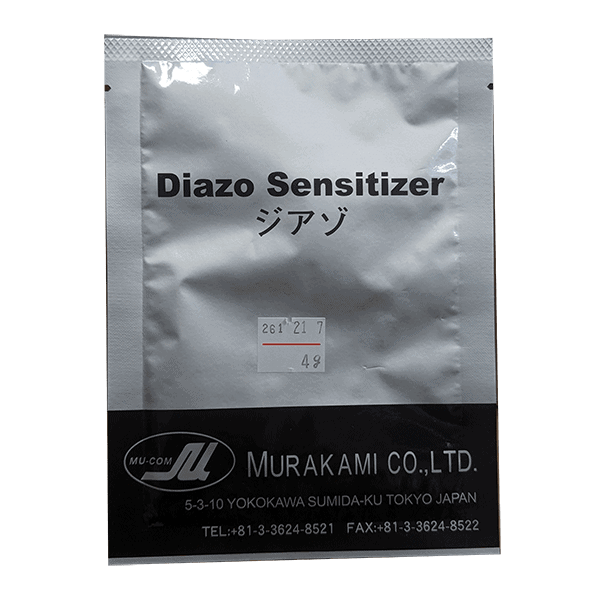
The Murakami Diazo Sensitizer is a powdered diazo packet for screen printing emulsions. Two use cases: (1) as a strength-boosting additive for pure photopolymer (PVA-SBQ) emulsions — adding 4g of diazo to a gallon of photopolymer improves water resistance and stencil durability for water-based and discharge ink work, and (2) as the primary sensitizer for diazo and dual-cure emulsions (this is the packet that ships with new Murakami diazo/dual-cure emulsion containers). Available in 4-gram packets (strengthens a gallon of photopolymer or sensitizes a quart of pure diazo) and 16-gram packets (sensitizes a gallon of dual-cure emulsion). Compatible with Murakami emulsions AND comparable emulsions from Chromaline, Saati, Ulano, Easiway, KIWO, CCI, and other major brands.

Available in 4g & 16g Packets
4g strengthens a gallon of photopolymer emulsion (or sensitizes a quart of pure diazo). 16g sensitizes a gallon of dual-cure emulsion. Pick the size that matches your emulsion type.
Works With Diazo, Dual-Cure & Photopolymer
Primary sensitizer for diazo and dual-cure emulsions (Murakami SP-1400, SP-9500, WSR, Photocure Pro, plus comparable diazo/dual-cure from other brands). Also adds strength to photopolymer (SBQ) emulsions for tougher water-based and discharge stencils.
Improves Water Resistance
Adds diazo chemistry to compatible emulsions to improve stencil durability against water-based, discharge, and HSA ink chemistry on long production runs. Effectively turns a pure photopolymer into a quasi-dual-cure.
Wide Exposure Latitude
Diazo chemistry is more forgiving of light source variation, coating thickness, and exposure-time error than pure photopolymer alone — easier to dial in consistently.
Easy Mixing
Dissolves easily in cold or room-temperature distilled water, then mixes thoroughly into the emulsion. Let stand (overnight ideal) before use to release bubbles.
Genuine Murakami Quality
Manufactured by Murakami Screen, the company that pioneered modern photopolymer emulsion chemistry over 30 years ago. Same diazo packet included in new Murakami emulsion containers.
Ships from RCS San Antonio, TX · Same-day shipping when ordered by 3:30 PM CT · FREE shipping on orders over $200

Price range: $6.99 through $17.99

Description

Murakami Diazo Sensitizer

Powdered Diazo Packet for Diazo, Dual-Cure & Photopolymer Screen Printing Emulsions · Available in 4g & 16g

Diazo sensitizer is the light-sensitive chemistry that powers diazo and dual-cure emulsions — and it can also be added to pure photopolymer (PVA-SBQ) emulsions to add water resistance and stencil durability. The Murakami Diazo Sensitizer ships in two packet sizes: 4 grams (strengthens a gallon of photopolymer emulsion for water-based and discharge work, or sensitizes a quart of pure diazo) and 16 grams (sensitizes a gallon of dual-cure emulsion — the standard dual-cure dose). Manufactured by Murakami Screen, the same diazo formulation included with new Murakami emulsion containers.

4g + 16g packet sizes
Diazo + dual-cure compatible
Photopolymer strength booster
Cross-brand compatible

What Is Diazo Sensitizer and Why Does Emulsion Need It?

Screen printing emulsion comes in three main chemistry types: diazo (uses diazo sensitizer for UV-light reactivity), photopolymer / PVA-SBQ (uses a self-contained pre-sensitized polymer chemistry, no separate diazo needed), and dual-cure (combines both chemistries for the benefits of each).

Diazo and dual-cure emulsions ship in two parts: the emulsion base in a container, and a separate small packet of diazo sensitizer powder. The two are kept separate because the diazo chemistry has a shorter shelf life once mixed into the emulsion. Shipping them separately gives you 1+ year of unsensitized shelf life vs the 2-3 weeks of sensitized pot life after mixing.

When you open a new container of diazo or dual-cure emulsion, the first-use step is to mix the included diazo packet with a small amount of distilled water, then pour the dissolved diazo solution into the emulsion and stir thoroughly. After a 2-hour minimum settle (overnight is better) to let bubbles release, the emulsion is ready for normal scoop-coater application. Once sensitized, that emulsion has approximately 2-3 weeks of usable life at room temperature (1 week for some specialty formulations like Murakami Photocure WSR).

Why would I need a replacement diazo packet?
Three main reasons. One: you’re strengthening photopolymer emulsion for water-based or discharge ink work — this is the most common reason shops order the 4g packet, since pure photopolymer (SBQ) emulsions don’t ship with diazo (the SBQ is pre-sensitized on its own). Two: the original packet was lost, damaged, or already mixed (you bought a partial emulsion container from someone else, or you mixed the original diazo into emulsion that’s now past its sensitized pot life and needs to be re-sensitized from a fresh batch). Three: you’re sensitizing emulsion in smaller portions than the original packet was sized for — e.g., you bought a gallon but only want to sensitize a quart at a time so the rest stays unsensitized longer.

Which Size: 4 Gram or 16 Gram?

Diazo packets are sized for typical emulsion sensitizing volumes. The right size for your job depends on how much emulsion you’re sensitizing at one time:

4 Gram Packet
Strengthens 1 gallon of photopolymer emulsion · OR sensitizes 1 quart of pure diazo emulsion
  • Most common use: Adding 4g of diazo to a gallon of pure photopolymer (SBQ) emulsion for added stencil strength when printing water-based and discharge inks. This is the standard ratio most shops use to convert a pure photopolymer into a quasi-dual-cure for tougher long-run performance.
  • Sensitizing 1 quart of pure diazo emulsion (the standard size for quart-size diazo containers)
  • Small-shop or hobby use where emulsion is sensitized or strengthened in small batches
  • Test batches when evaluating diazo compatibility with a new emulsion
  • Schools, training programs, and instructional setups
16 Gram Packet
Sensitizes 1 gallon of dual-cure emulsion (the standard dual-cure dose)
  • Most common use: Sensitizing a gallon of dual-cure emulsion like Murakami SP-9500, Photocure WSR, or Photocure Pro — dual-cure emulsions need more diazo than pure diazo emulsions because the higher diazo content is what gives dual-cure its added durability and exposure latitude.
  • Standard size that ships with new gallon-size dual-cure emulsion containers
  • Production shops sensitizing full gallons of dual-cure at one time
  • 4× the volume of a 4g packet (more economical per-gram when you know you’ll use a full gallon within the 2-3 week sensitized pot life)
⚠ Sensitized emulsion has a limited shelf life
Once you mix diazo into emulsion, that emulsion has approximately 2-3 weeks of usable life at room temperature (1 week for some specialty formulations like Murakami Photocure WSR). Refrigeration extends usable life. For photopolymer strength boosting with the 4g packet: the SBQ chemistry already gives photopolymer a 1+ year shelf life, but once you add the diazo, that gallon now has the 2-3 week pot life window. Only add diazo to as much photopolymer as you can use in that window. For dual-cure sensitizing with the 16g packet: a gallon of sensitized dual-cure should be used within 2-3 weeks at room temperature (1 week for WSR specifically).

Compatibility: Murakami Diazo Works With Most Emulsions

Diazo sensitizer chemistry is fairly standardized across the screen-printing emulsion industry. The Murakami diazo packet is the same chemistry used in all Murakami diazo and dual-cure emulsions, and it works as a sensitizer (or as a strength-boosting additive) for most direct emulsions across the major brands.

There are two distinct use cases:

  • Strength-boosting additive for pure photopolymer (PVA-SBQ) emulsions — adding a 4g packet to a gallon of photopolymer emulsion improves water resistance, discharge ink durability, and stencil toughness on long production runs. This is the most common use of the 4g packet. Effectively converts a pure SBQ emulsion into a quasi-dual-cure stencil for water-based and discharge ink work.
  • Primary sensitizer for diazo and dual-cure emulsions — this is the diazo that ships with the emulsion originally. Use the 4g packet for quart batches of pure diazo emulsion. Use the 16g packet for gallon batches of dual-cure emulsion (dual-cure emulsions need more diazo than pure diazo emulsions because the higher diazo content gives dual-cure its added durability and exposure latitude).

Every emulsion manufacturer formulates slightly differently, so always test compatibility on a single screen first before committing to a large batch. The TDS (Technical Data Sheet) of the emulsion you’re working with may include specific diazo addition recommendations.

Murakami Diazo & Dual-Cure Emulsions (Designed-In Match)
This is the diazo packet that ships in Murakami diazo and dual-cure emulsion containers from the factory — full compatibility with SP-1400, SP-9500, Photocure WSR, and Photocure Pro. Use the diazo-to-water ratio specified in each emulsion’s TDS.
Murakami Photopolymer Emulsions (Strength Booster)
Add a 4g packet to a gallon of pure photopolymer (PVA-SBQ) emulsion to add water resistance and stencil durability for water-based and discharge ink work — effectively turning the SBQ into a quasi-dual-cure for tougher long-run performance. Works with Photocure BLU, T9 Pink/Violet, Aquasol HV/HVP, Aquasol HS3, Photocure SR, and TXR. This is the most common use of the 4g packet.
Diazo & Dual-Cure Emulsions From Other Brands
Murakami diazo works as a general-purpose sensitizer for many comparable diazo and dual-cure direct emulsions from manufacturers like Chromaline, Saati, Ulano, Easiway, KIWO, CCI, and others. Test compatibility on one screen first before committing to a large batch.
When in Doubt, Call Us
If you’re not sure whether to use diazo as a primary sensitizer or as a strength booster — or whether Murakami diazo is the right choice for a specific brand’s emulsion — call River City Supply at (512) 454-0505. We’ve been distributing screen-printing emulsion since 2008 and can help you pick the right diazo size and use case.

How to Mix Diazo Sensitizer Into Emulsion

Diazo mixing is straightforward, but a few details matter for stencil quality. The exact diazo-to-water ratio depends on your emulsion’s TDS (always check it first), but the general procedure is the same across most diazo and dual-cure emulsions:

1
Work Under Yellow Safelight
Once the diazo is mixed into emulsion, the emulsion becomes fully light-sensitive. Set up your mixing station under yellow safelights and avoid exposure to sunlight, fluorescent, or incandescent lights during and after mixing.
2
Dissolve Diazo in Distilled Water
Open the diazo packet and add the volume of cold or room-temperature distilled water specified in your emulsion’s TDS. Do NOT use warm water — it can damage the diazo chemistry. Cap the bottle and shake until fully dissolved (cloudy/yellow with no visible particles). Distilled water only — minerals in tap water can interfere with diazo chemistry.
3
Pour Diazo Solution Into Emulsion
Pour the entire diazo solution into the emulsion container and stir thoroughly with a clean stir stick until the diazo is fully blended into the emulsion. Mix slowly to avoid whipping in air bubbles. The emulsion color should be uniform with no streaks or visible diazo concentration.
4
Let Stand 2 Hours Minimum (Overnight Better)
Per typical TDS instructions, let the sensitized emulsion stand for at least 2 hours (overnight is better) before using. This allows air bubbles introduced during mixing to rise out of the emulsion. Coating immediately after stirring traps bubbles in the stencil and causes pinholes. The wait is worth it.
5
Label the Container With Mix Date
Write the date on the container with a permanent marker. Sensitized emulsion has a 2-3 week pot life at room temperature (varies by emulsion brand — check the TDS). Knowing the mix date prevents using stale emulsion that won’t expose correctly. Refrigerated storage extends usable life.
✓ Pro tip: 4 grams per gallon of photopolymer = tougher water-based & discharge stencils
If you print water-based or discharge inks and find your pure photopolymer (SBQ) stencils breaking down on long runs, add a 4g diazo packet to each gallon of photopolymer emulsion before coating. The added diazo gives you the durability of a dual-cure stencil without switching emulsion brands. The pre-sensitized SBQ chemistry still handles light-sensitivity, so the emulsion stays ready-to-use — the diazo just adds water resistance on top. Most shops doing serious water-based or discharge work do this as standard practice.

What Diazo Sensitizer Actually Does for Your Stencil

Beyond just “making emulsion light-sensitive,” diazo adds specific performance properties to the cured stencil:

Water Resistance
Diazo improves the cured stencil’s resistance to water-based ink chemistry. Critical for water-based and discharge ink printing where pure photopolymer alone breaks down on long runs.
Solvent & Ink Chemistry Resistance
Diazo chemistry holds up better against aggressive press wash solvents and the chemistry in UV inks, solvent inks, HSA (high solid acrylic) inks, and some plastisol formulations.
Wider Exposure Latitude
Diazo and dual-cure emulsions are more forgiving of variations in exposure time, light source intensity, coating thickness, and bulb age — easier to dial in consistently across batches without precise process control.
On-Press Durability
Diazo-sensitized stencils handle long automated press runs better than pure photopolymer for many ink types — less stencil breakdown means fewer rejected prints and longer screen reuse cycles.
Easy Reclaiming
Most diazo and dual-cure emulsions reclaim cleanly with standard screen-stripping chemistry — the diazo doesn’t lock the stencil into the mesh permanently. Important for shops that reclaim screens frequently.
Long Unsensitized Shelf Life
The reason diazo ships separately: keeping it apart from the emulsion gives 1+ year of shelf life on the unsensitized emulsion. Mix only what you’ll use in 2-3 weeks (the sensitized pot life window).

Compatible Murakami Emulsions

The Murakami diazo packet is included with new containers of Murakami diazo and dual-cure emulsions. You’d order this replacement packet separately when (a) you’re strengthening pure photopolymer emulsion for water-based or discharge work (the most common reason), (b) the original packet was lost or damaged, (c) you bought a partial container, or (d) you’re sensitizing in smaller portions than the original packet was sized for:

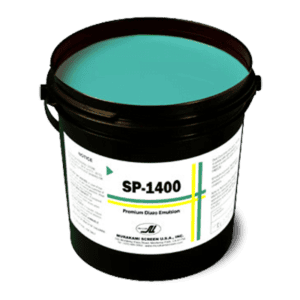
Murakami SP-1400

Traditional diazo emulsion — blue, 42% solids. For plastisol, discharge, HSA, and water-based textile printing.

View SP-1400 →

Murakami SP-9500

All-purpose dual-cure emulsion — green, 36% solids. For UV, solvent, plastisol, and graphic/industrial printing.

View SP-9500 →

Murakami Photocure WSR

Solvent-resistant dual-cure — blue, 44% solids, 17,000 mPa·s. For water-based, discharge, HSA, and plastisol textile printing.

View Photocure WSR →

Murakami Photocure Pro

Dual-cure textile emulsion — the original Murakami dual-cure that established the category 30+ years ago.

View Photocure Pro →

Using a non-Murakami emulsion?
Murakami diazo works as a general-purpose sensitizer for many comparable diazo and dual-cure direct emulsions from manufacturers like Chromaline, Saati, Ulano, Easiway, KIWO, CCI, and others. Always test on a single screen first before committing to a large batch — every emulsion brand formulates differently. Browse all emulsion options →
FREE SHIPPING ON ORDERS OVER $200
Murakami Diazo Sensitizer ships from San Antonio, TX

Questions about compatibility with your specific emulsion brand, sensitizing volumes, or which packet size to order? Call River City Supply — we’ve been distributing Murakami emulsion chemistry since 2008 and we can help you pick the right diazo size and confirm compatibility before you order.

Call (512) 454-0505

Technical Specifications

Product Identification

SpecificationValue
Product NameMurakami Diazo Sensitizer
ManufacturerMurakami Screen USA, Inc.
DistributorRiver City Supply (San Antonio, TX)
Available Sizes4 gram packet · 16 gram packet
SKU (4g)MUR Diazo-4G
SKU (16g)MUR Diazo-16G
FormPowdered diazo sensitizer (dissolves in cold distilled water before mixing into emulsion)
CategoryScreen-printing emulsion chemistry / sensitizer
StorageCool, dry area in original sealed packet, away from UV light. Unmixed packet shelf life is approximately 1 year at room temperature.
Mixing MediumCold or room-temperature distilled water (NOT warm water, NOT tap water)

Size Selection & Sensitizing Volume

Packet SizeSensitizes / TreatsBest For
4 gram1 gallon of photopolymer (as strength booster) · OR 1 quart of pure diazo emulsionMost common use: adding 4g to a gallon of pure photopolymer (SBQ) emulsion to strengthen the stencil for water-based and discharge ink printing. Also used as primary sensitizer for quart-size pure diazo emulsion containers.
16 gram1 gallon of dual-cure emulsion (the standard dual-cure dose)Standard size for sensitizing gallon-size dual-cure emulsion containers (Murakami SP-9500, Photocure WSR, Photocure Pro, and comparable dual-cure emulsions). Dual-cure emulsions need more diazo than pure diazo emulsions — the higher diazo content is what gives dual-cure its added durability and exposure latitude.

Note: Volumes above reflect typical industry-standard ratios used by most production shops. Always check your specific emulsion’s TDS (Technical Data Sheet) for the exact diazo-to-water and diazo-to-emulsion ratios specified by the emulsion manufacturer.

Compatibility Matrix

Emulsion TypeUse This Diazo?Notes
Murakami Diazo Emulsions (SP-1400)◎ Designed MatchThis is the diazo packet that ships in the emulsion container from the factory. Full compatibility — required as the primary sensitizer.
Murakami Dual-Cure Emulsions (SP-9500, WSR, Photocure Pro)◎ Designed MatchThis is the diazo packet that ships in the emulsion container from the factory. Required as the primary sensitizer. Use the diazo-to-water ratio in each emulsion’s TDS.
Murakami Photopolymer / SBQ Emulsions (Photocure BLU, T9, Aquasol HV/HVP/HS3, Photocure SR, TXR)◎ Strength BoosterPhotopolymer (SBQ) emulsions ship pre-sensitized so diazo isn’t required. Adding a 4g packet to a quart of photopolymer adds water resistance and stencil durability — effectively turning the SBQ into a quasi-dual-cure for tougher long-run performance on water-based and discharge work.
Diazo & Dual-Cure Emulsions From Other Brands○ Test FirstDiazo chemistry is fairly standardized; Murakami diazo works as a sensitizer for many comparable diazo/dual-cure emulsions (Chromaline, Saati, Ulano, Easiway, KIWO, CCI, etc.). Test on one screen first before committing a large batch.
Photopolymer Emulsions From Other Brands○ Test FirstAdding diazo as a strength booster to photopolymer emulsions from other brands works similarly to Murakami photopolymer emulsions, but every manufacturer formulates differently. Test on one screen first before committing.
Capillary film (CapFilm, SuperPHAT, etc.)× Do Not UseCapillary films are pre-sensitized solid sheets that adhere to the mesh with water alone — no diazo addition is required or compatible.

Rating legend: ◎ Designed Match = the exact diazo formulation that ships in the emulsion container as required sensitizer. ◎ Strength Booster = optional addition to pre-sensitized photopolymer emulsions to improve water resistance and durability. ○ Test First = compatible chemistry; test a single screen before committing to a full batch. × Do Not Use = chemistry is incompatible.

Shelf Life & Storage

ConditionShelf Life
Sealed diazo packet (room temp)Approximately 1 year stored in original sealed packet, cool dry area, away from UV light
Sensitized emulsion (mixed with diazo)Typically 2-3 weeks at room temperature; some specialty emulsions (e.g. Murakami Photocure WSR) only 1 week. Refrigeration extends usable life. Always check the emulsion’s TDS.
Coated screens (sensitized, unexposed)Up to 1 month at 59-77°F (15-25°C), 30-50% relative humidity, total darkness
Exposed/cured stencilsIndefinite — exposed and cured stencils are stable until reclaimed

Technical Sheets / Safety Data Sheets / Documents

The Murakami Diazo Sensitizer packet is a chemistry consumable and doesn’t have a standalone TDS document — the relevant technical specifications (diazo-to-water ratio, mixing procedure, sensitized pot life) are documented in each compatible emulsion’s TDS. SDS (Safety Data Sheet) information is available on request through Murakami Screen USA. Use the links below to navigate to the compatible emulsion product pages for line-specific documentation.

Compatible Murakami Emulsion Pages (with TDS & SDS)

Each Murakami diazo and dual-cure emulsion product page hosts its own TDS and SDS documents. Navigate to the emulsion you’re sensitizing for the exact diazo-to-water ratio and mixing procedure that emulsion’s TDS specifies.

Emulsion Troubleshooting & Related Pages

Having trouble sensitizing emulsion correctly, getting pinholes, washing out, or matching exposure? Our emulsion troubleshooting guide covers the most common issues across coating, exposure, washout, and on-press stages.

Need the SDS for Murakami Diazo Sensitizer? SDS available on request — call (512) 454-0505 or email [email protected] and we’ll send the current Murakami SDS for the diazo sensitizer.

FREQUENTLY ASKED QUESTIONS

What is diazo sensitizer and what does it do?
Diazo sensitizer is the light-sensitive chemistry that powers diazo and dual-cure screen printing emulsions. It’s a powder that ships in a small packet. When dissolved in water and mixed into emulsion, the diazo makes the emulsion light-sensitive (so it can be exposed by UV light) AND adds water resistance, solvent resistance, and exposure latitude to the cured stencil. Pure photopolymer (PVA-SBQ) emulsions don’t use diazo — they ship pre-sensitized with a different chemistry.
Will this work with my non-Murakami emulsion?
Probably, with testing. Diazo chemistry is fairly standardized across the screen-printing industry — Murakami diazo works as a primary sensitizer for many comparable diazo and dual-cure emulsions from other manufacturers (Chromaline, Saati, Ulano, Easiway, KIWO, CCI, and others). It can also be added to pure photopolymer (PVA-SBQ) emulsions from other brands as a strength-boosting additive to improve water resistance on long water-based or discharge runs. Every manufacturer formulates slightly differently, so always test compatibility on a single screen first before committing to a large emulsion batch.
How do I know if my emulsion needs diazo or not?
Check the emulsion’s label or TDS. Three signs your emulsion requires diazo to work at all: (1) the container ships with a separate small packet of powder — that’s the diazo, (2) the label says “diazo” or “dual-cure,” (3) the instructions tell you to “mix the sensitizer” before using. If your emulsion is labeled “photopolymer,” “PVA-SBQ,” or “pre-sensitized” — it doesn’t need diazo to be light-sensitive (the SBQ chemistry handles that), but you can still add a 4g diazo packet to a quart of photopolymer emulsion as a strength booster to improve water resistance and durability on long water-based or discharge runs.
Which size do I need: 4 gram or 16 gram?
It depends on what you’re using diazo for. Use the 4-gram packet for adding strength to a gallon of pure photopolymer (PVA-SBQ) emulsion — this is the most common use of the 4g packet, particularly for shops printing water-based or discharge inks. The 4g packet also sensitizes a quart of pure diazo emulsion. Use the 16-gram packet for sensitizing a gallon of dual-cure emulsion (Murakami SP-9500, Photocure WSR, Photocure Pro, and comparable dual-cure emulsions from other brands). Dual-cure emulsions need more diazo than pure diazo emulsions — that’s what gives them their added durability and exposure latitude. Always check the diazo-to-water and diazo-to-emulsion ratios in your specific emulsion’s TDS — some are dosed differently.
Can I add diazo to a photopolymer (SBQ) emulsion to make it stronger?
Yes — this is actually the most common use of the 4g diazo packet. Most shops add 4g of diazo to a gallon of pure photopolymer (PVA-SBQ) emulsion before coating, which improves the cured stencil’s water resistance and durability on long production runs of water-based and discharge inks. The photopolymer chemistry still handles light-sensitivity (so the emulsion remains pre-sensitized and ready to use after the diazo is mixed in), but the added diazo gives you the durability benefits of a dual-cure stencil. Works with Murakami Photocure BLU, T9 Pink/Violet, Aquasol HV/HVP, Aquasol HS3, Photocure SR, TXR, and comparable photopolymer emulsions from other brands. Test on one screen first before committing to a large batch.
How do I mix diazo into emulsion correctly?
Five-step process: (1) work under yellow safelights, (2) dissolve the diazo powder in the volume of cold or room-temperature distilled water specified in your emulsion’s TDS — NOT warm water, NOT tap water, (3) pour the dissolved diazo solution into the emulsion and stir thoroughly until uniformly blended, (4) let stand at least 2 hours (overnight better) for air bubbles to rise out, (5) label the container with the mix date so you know when the sensitized pot life expires. The full step-by-step is in the Description tab above.
Why distilled water and not tap water?
Tap water contains minerals, chlorine, and other dissolved substances that can interfere with the diazo chemistry and produce inconsistent stencil performance. Distilled water is mineral-free and pH-neutral, so the diazo dissolves cleanly and the emulsion behaves predictably. Most shops keep a gallon of distilled water in the screen room specifically for diazo mixing — it’s inexpensive insurance against bad batches.
Why not warm water?
Warm or hot water can damage the diazo chemistry before it gets into the emulsion. Cold or room-temperature water (under ~75°F / 24°C) keeps the diazo stable during dissolution. If your distilled water is room-temperature from a shelf, you’re fine; just don’t run hot tap water or heat the bottle.
How long does sensitized emulsion last?
Typically 2-3 weeks at room temperature for most diazo and dual-cure emulsions, though specialty emulsions can be shorter (Murakami Photocure WSR is only 1 week). Refrigeration at ~40°F (4°C) extends usable life by several weeks. Always check the specific emulsion’s TDS for its sensitized pot life and label the container with the mix date so you know when it expires.
Can I sensitize only part of my emulsion container?
Yes — this is a useful strategy for shops that use emulsion slowly. If you’ve got a gallon of pure diazo emulsion and don’t think you’ll use all of it within the 2-3 week sensitized pot life, transfer 1 quart to a separate sensitizing container and mix one 4g diazo packet into that quart instead of dosing the full gallon. The unsensitized portion stays in its original container with 1+ year shelf life. Same approach works for the 16g packet and dual-cure emulsions if you split a gallon into quart portions and dose proportionally. Total usable emulsion life is significantly longer than sensitizing the full container at once.
Does my new emulsion already include a diazo packet?
Most new Murakami diazo and dual-cure emulsion containers ship with a diazo packet pre-included in the box. The standard 4g packet ships with quart-size pure diazo containers; the 16g packet ships with gallon-size dual-cure containers. You’d order this Murakami Diazo Sensitizer separately when (1) the original packet was lost or damaged, (2) you bought a partial emulsion container without the packet, (3) you’re strengthening photopolymer emulsion (which doesn’t ship with diazo since it’s pre-sensitized), or (4) you’re using bulk unsensitized emulsion that didn’t include diazo.
Does diazo add water resistance to the stencil?
Yes. Adding diazo to compatible emulsion improves the cured stencil’s resistance to water-based and discharge ink chemistry, which is why dual-cure emulsions (diazo + photopolymer) are often preferred over pure photopolymer for long-run water-based and discharge printing. Diazo also improves solvent and aggressive-ink chemistry resistance for graphic, UV, and industrial work. For maximum durability on water-based runs, pair sensitized emulsion with Murakami MS Hardener applied after exposure.
Can I use Murakami diazo to re-sensitize old sensitized emulsion?
No — once sensitized, the emulsion chemistry is set, and adding more diazo to an already-sensitized batch doesn’t refresh it. If your sensitized emulsion is past its 2-3 week pot life, dispose of it per local regulations and sensitize a fresh batch of unsensitized emulsion with a fresh diazo packet.
Is shipping really same-day?
Yes — the Murakami Diazo Sensitizer ships from RCS’s San Antonio, TX warehouse when in stock. Orders placed before 3:30 PM Central Time on a business day typically ship the same day. Some replacement-packet orders may ship direct from Murakami’s facility (which adds transit time) if our local stock is out; we’ll notify you at the time of order if that applies. FREE shipping on orders over $200.
How long does the sealed diazo packet last on the shelf?
Approximately 1 year in the sealed original packet, stored in a cool dry area away from UV light. Diazo powder is more stable than sensitized liquid emulsion because it’s not yet in solution. Keep packets sealed until use — once opened and exposed to humidity, the powder absorbs moisture and degrades faster.
Where can I get the SDS for this product?
SDS available on request — call River City Supply at (512) 454-0505 or email [email protected] and we’ll send the current Murakami SDS for the diazo sensitizer chemistry. For ink-system-specific SDS (covering the diazo as it appears in a finished sensitized emulsion), see the corresponding emulsion product page’s Documents tab.
Need Help Choosing the Right Diazo Size or Confirming Compatibility?

Call us — we’ll help you identify your emulsion type, pick the right packet size, and confirm Murakami diazo is the right sensitizer for your specific emulsion brand. Distributing Murakami screen-printing chemistry since 2008.

(512) 454-0505

Reviews

Reviews

    Only logged in customers who have purchased this product may leave a review.

    You May Also Like

    Additional Options