Murakami Aquasol HS3 Emulsion – High-Durability, Water-Resistant Screen Printing Emulsion – for Thick Print Applications

Murakami

Murakami Aquasol HS3 is a SBQ-Type one-pot water-resistant emulsion engineered specifically for thick E.O.M. (Emulsion Over Mesh) printing. Per Murakami’s TDS, HS3 carries the highest solids content of any emulsion in the Murakami lineup at 49%, with a very high viscosity of 33,000 mPa·s — built for building thick stencils (140-400µm EOM) for water-based textile, flag printing, and other high-deposit applications. Higher printing durability than conventional emulsion. Compatible with LED 405nm and metal halide exposure systems. Plastisol-compatible with specific mineral-spirit, kerosene, turpentine, or orange-oil ink cleaners only (avoid toluene, acetone, ethyl acetate).

Highest Solids in the Murakami Lineup: 49%
Per Murakami TDS, HS3 has the highest solids content of any Murakami emulsion. The high solids build thick stencils efficiently — fewer coats needed to reach 200-400µm EOM than with standard 40-42% solids emulsions.
Built for Thick EOM Printing
Per Murakami TDS — specifically engineered for thick E.O.M. (Emulsion Over Mesh) printing. Standard production thicknesses include 140µm, 200µm, 340µm, and 400µm depending on mesh count and coating procedure.
Water Resistant Without Hardener
Per Murakami TDS, HS3 is a water-resistant SBQ emulsion engineered for water-based ink applications including textiles and flags. Higher printing durability than conventional emulsions, without requiring a separate hardener.
Pre-Sensitized & Ready to Use
No diazo mixing required. Open the container, coat, expose, print. SBQ-Type chemistry is ready straight from the container.
High Sensitivity, Short Exposure Times
Per Murakami TDS — high sensitivity allows short exposure times for thick stencils (30-40 sec for 140-200µm, 60-85 sec for 340-400µm on metal halide). Efficient productivity even on high-EOM work where exposure times typically balloon.
LED 405nm Compatible
Per Murakami TDS, HS3 exposure data is provided for both 3kW Metal Halide and LED 405nm exposure systems. Works with modern LED screen exposure units.
Same-day shipping · In stock at our San Antonio, TX warehouse · FREE shipping on orders over $200 · Order by 3:30 PM CT

Price range: $34.99 through $4,322.50

Description

Murakami Aquasol HS3 Emulsion

The Highest-Solids Emulsion for Thick EOM Water-Based Printing

Murakami Aquasol HS3 is a SBQ-Type one-pot water-resistant emulsion engineered specifically for thick E.O.M. (Emulsion Over Mesh) printing. Per Murakami’s TDS, HS3 carries the highest solids content of any emulsion in the Murakami lineup at 49%, with a very high viscosity of 33,000 mPa·s — built for building thick stencils (140-400µm EOM) for water-based textile, flag printing, and other high-deposit applications. Higher printing durability than conventional emulsion. Compatible with LED 405nm and metal halide exposure systems. Plastisol-compatible with specific mineral-spirit, kerosene, turpentine, or orange-oil ink cleaners only (avoid toluene, acetone, ethyl acetate).

SBQ-Type one-pot (water-resistant)
49% solids, blue color
Pre-sensitized — ready to use

Key Features & Benefits

Highest Solids in the Murakami Lineup: 49%
Per Murakami TDS, HS3 has the highest solids content of any Murakami emulsion. The high solids build thick stencils efficiently — fewer coats needed to reach 200-400µm EOM than with standard 40-42% solids emulsions.
Built for Thick EOM Printing
Per Murakami TDS — specifically engineered for thick E.O.M. (Emulsion Over Mesh) printing. Standard production thicknesses include 140µm, 200µm, 340µm, and 400µm depending on mesh count and coating procedure.
Water Resistant Without Hardener
Per Murakami TDS, HS3 is a water-resistant SBQ emulsion engineered for water-based ink applications including textiles and flags. Higher printing durability than conventional emulsions, without requiring a separate hardener.
Pre-Sensitized & Ready to Use
No diazo mixing required. Open the container, coat, expose, print. SBQ-Type chemistry is ready straight from the container.
High Sensitivity, Short Exposure Times
Per Murakami TDS — high sensitivity allows short exposure times for thick stencils (30-40 sec for 140-200µm, 60-85 sec for 340-400µm on metal halide). Efficient productivity even on high-EOM work where exposure times typically balloon.
LED 405nm Compatible
Per Murakami TDS, HS3 exposure data is provided for both 3kW Metal Halide and LED 405nm exposure systems. Works with modern LED screen exposure units.
Higher Printing Durability
Per Murakami TDS — higher printing durability than conventional emulsions, which matters when running long water-based or flag printing runs where stencil breakdown causes rejects.
Coats Smoothly Despite High Viscosity
Per Murakami TDS, the high-solids formulation is designed for easy coating of thicker, flat surfaces. Use a dull-edge coater for the recommended coating procedure.

The Full Murakami Emulsion Lineup at River City Supply

Murakami makes ten different emulsions for different screen-printing needs. Murakami Aquasol HS3 is one option in the lineup — but other Murakami emulsions may fit specific workflows better. Use this chart to compare:

EmulsionTypeColorSolidsInk CompatibilitySensitizingBest For
Photocure ProDual-cure (diazo + photopolymer)Blue38%Water-based, discharge, plastisol, solvent, UVDiazo packet included — mix at first useVersatility — one emulsion for every ink type
Photocure BLUPVA-SBQ pure photopolymerBlue41%Plastisol, discharge, water-based textilePre-sensitized — ready to useMulti-ink production, blue color preference
Photocure SRPVA-SBQ pure photopolymer (solvent-resistant)Magenta37%UV, solvent, textile (plastisol); also backs capillary filmsPre-sensitized — ready to useSolvent/UV ink work + capillary film backing
T9 PinkPVA-SBQ pure photopolymerPink44%Water-based, discharge, HSA, plastisolPre-sensitized — ready to useMulti-ink, 44% solids, 17,000 mPa·s viscosity
T9 VioletPVA-SBQ pure photopolymerViolet44%Water-based, discharge, HSA, plastisolPre-sensitized — ready to useSame as T9 Pink, violet color preference
TXRPVA-SBQ pure photopolymerPink41%Water-based, discharge, HSA, plastisolPre-sensitized — ready to useVersatility, fast exposure, fine detail
Aquasol HVPVA-SBQ pure photopolymer (high-viscosity)Blue42%Water-based, discharge, plastisolPre-sensitized — ready to useThick stencils, heavy ink deposit, fast exposure
Aquasol HVP PinkPVA-SBQ pure photopolymer (high-viscosity)Pink42%Water-based, discharge, plastisolPre-sensitized — ready to useThick stencils, pink color preference
★ This Product
Aquasol HS3
SBQ-Type one-pot (water-resistant)Blue49%Water-based, discharge, plastisolPre-sensitized — ready to useHighest solids (49%), thick high-EOM water-based prints
SP 1400DiazoBlue42%Plastisol, discharge, HSA, water-based textileDiazo packet — mix at first useTraditional diazo workflow, long stencil life, easy reclaim
Not sure which Murakami emulsion is right for you?
Call (512) 454-0505 and tell us what inks you’re running, your typical print run length, and whether you want pre-sensitized convenience or diazo flexibility. We’ll match you to the right emulsion for your shop’s workflow — not just sell you the most expensive option.

What Murakami Aquasol HS3 Is Used For

Murakami Aquasol HS3 is engineered for shops where pre-sensitized convenience, fast exposure, and reliable multi-ink performance matter. If you’re in one of these categories, this is the right choice:

Thick-Deposit Water-Based Textile Printing
Per Murakami TDS — HS3 is specifically engineered for water-based ink applications such as textiles. The thick stencil (140-400µm EOM) deposits enough water-based ink to achieve high opacity on dark garments in a single hit.
Flag Printing
Per Murakami TDS — flag printing is called out as a specific application. The thick stencil and water-resistance handle large-format water-based flag production.
High-Density Specialty Effects
Puff inks, high-density inks, athletic ink, glitter base, foil base — any work that requires a thick stencil deposit benefits from HS3’s 49% solids and 33,000 mPa·s viscosity, which build EOM efficiently.
Plastisol With Compatible Cleaners
Per Murakami TDS, plastisol ink applications are supported under circumstances where mineral spirits, kerosene, turpentine oil, or orange oil is used as ink cleaner. Avoid using normal solvents (toluene, acetone, ethyl acetate) as ink cleaners with HS3.
LED Exposure Unit Shops
Per Murakami TDS, HS3 exposure data is provided for LED 405nm at 10 mW/cm² (such as M&R Starlight). Shops with LED exposure can use HS3 directly without conversion charts.
Long-Run Water-Based Production
Higher printing durability + water resistance + thick stencil = HS3 is the choice when water-based runs need to go long without stencil breakdown. The water resistance is built into the chemistry, not added via hardener.
High-EOM Graphic & Industrial Work
When graphic or industrial work requires a 200-400µm stencil deposit, HS3 builds that thickness more efficiently than coating multiple passes of a lower-solids emulsion.

Step-by-Step: Coating & Exposing Murakami Aquasol HS3

Murakami Aquasol HS3 is pre-sensitized and ready to use straight out of the container. No diazo mixing required — coat, expose, develop, print.

1
Degrease the Mesh
Apply mesh degreaser to both sides of the screen and work into a lather with a soft brush. Rinse thoroughly with clean water and allow the screen to dry completely before coating. Murakami 801 Screen Degreaser is the recommended chemistry per the TDS. A properly degreased mesh is the foundation of every successful stencil.
2
Set Up Your Coating Station Under Yellow Safelight
Per Murakami TDS — work under yellow safelights. Avoid exposure to sunlight, fluorescent, and incandescent lights. Set the screen on a stable surface at a slight upward angle.
3
Coat the Print Side
Per Murakami TDS — use a clean dry coating trough that has a nick-free surface for smooth coating. Pour an ample amount of Murakami Aquasol HS3 into the scoop coater. Apply one or two coats of emulsion to the print side. Aim for full uniform coverage with no streaks, gaps, or visible mesh through the emulsion.
4
Flip Screen, Coat the Squeegee Side
Per Murakami TDS — rotate the frame 180 degrees and apply one or two coats of emulsion to the squeegee side. Additional coats may be added to the print side if thicker stencils are required.
5
Dry Flat With Print Side Down
Per Murakami TDS — dry the coated screen horizontally with the print side DOWN in a clean light-safe area. Target Up to 104°F (40°C) per TDS and 30-50% relative humidity ideal with good air circulation. A screen drying cabinet with heated airflow holds these conditions reliably.
6
Position Your Film Positive
Place the film positive on the PRINT SIDE of the screen with the emulsion side of the positive in direct contact with the emulsion. Lock down with vacuum (preferred) or weighted glass — no air gaps, no light leaks. Per Murakami TDS, clean the film positives and vacuum frame glass prior to exposure to minimize pinholes.
7
Expose to UV Light
Expose using a metal halide or LED UV exposure unit. Per Murakami TDS, exposure is affected by mesh color, emulsion type, coating thickness, lamp type, and bulb age — see the Technical Specs tab for the TDS exposure data table as a starting point. Run a 21-step Stouffer wedge test on your first screen to dial in your shop’s optimal time.
8
Wash Out the Stencil
Per Murakami TDS — gently spray both sides of the screen with lukewarm water, wait a few seconds to allow emulsion to soften, then wash the print side of the screen until the image is fully open. Rinse both sides thoroughly. Don’t use high-pressure water — it can damage fine detail.
9
Dry the Developed Screen
Allow the developed screen to dry completely before printing. A fan or warm drying cabinet (under 104°F / 40°C) speeds drying. Once dry, you can spot-touch any small pinholes with blockout — Murakami 901 Blockout Red is ideal for this. The screen is now ready for press.

Having an Emulsion Problem? Free Troubleshooting Guide

Every screen-printer runs into emulsion problems eventually — pinholes, washout failures, sawtooth edges, fish eyes, stencils breaking down mid-run. We’ve put together a comprehensive troubleshooting guide organized by symptom so you can find your issue fast and get back to printing.

River City Supply Free Resource
The Complete Screen Printing Emulsion Troubleshooting Guide
19 specific emulsion issues across 5 workflow stages (coating, exposure, washout, on-press, reclaim). Quick diagnostic table at top so you can triage fast. Prevention checklist so you stop the problem from coming back.

View Troubleshooting Guide →

8 Pro Tips for Murakami Aquasol HS3

Distilled from Murakami’s TDS, professional shop experience, and our customer feedback. Save yourself the trial and error:

1
Use a Dull-Edge Coater
Per Murakami TDS, HS3’s high viscosity coats best with a DULL-edge coater (not sharp edge). The dull edge deposits more emulsion per pass, which is exactly what you want for building thick EOM. Standard coating procedure is 2 passes print side, 4-10 passes squeegee side depending on target EOM.
2
Coat Slowly to Prevent Air Bubbles
Per Murakami TDS, coat the emulsion slowly in order to prevent air bubbles. The high 33,000 mPa·s viscosity traps air more easily than standard emulsions; slow steady passes prevent bubble inclusion.
3
Filter Before Returning Emulsion to Container
Per Murakami TDS, filter remaining emulsion with screen mesh before pouring it back into the container. Removes dust, foreign substances, and air bubbles that would cause coating defects on the next batch.
4
Dry Coated Screen Completely Before Exposure
Per Murakami TDS, dry the coated screen completely before exposure. Drying temperature at +40°C (104°F). Thick stencils take longer to dry than standard thicknesses — allow extra time, use good airflow.
5
Plastisol Cleaner Restriction
Per Murakami TDS, HS3 is plastisol-compatible only under specific circumstances: use mineral spirits, kerosene, turpentine oil, or orange oil as ink cleaners. DO NOT use normal solvents like toluene, acetone, or ethyl acetate — they damage HS3’s water-resistant chemistry.
6
Higher EOM = Longer Exposure
Per Murakami TDS, 140-200µm EOM exposes in 30-40 sec; 340-400µm EOM needs 60-85 sec on metal halide or 110-130 sec on LED. Match your exposure time to your stencil thickness. Take a step test to find the optimum for your shop.
7
Run a Step Test to Dial In Exposure
Per Murakami TDS, the published exposure data is for guideline purposes only — take a step test to find the optimum exposure time for your specific exposure unit, mesh, and coating procedure.
8
Keep the Emulsion Cool and UV-Safe
Per Murakami TDS, store emulsion in a cool, UV-light-safe area. Avoid temperature swings and direct sunlight. Heat and light shorten shelf life.

Pair Murakami Aquasol HS3 With Murakami MS Hardener for Extended Runs

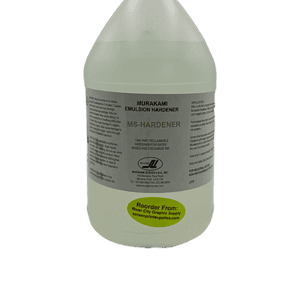
For water-based and discharge work running over a few hundred impressions, the stencil will gradually break down as the aqueous ink chemistry attacks the emulsion. Murakami MS Hardener is a post-exposure treatment that dramatically extends stencil life by cross-linking the cured emulsion for greater water, solvent, and abrasion resistance.

★ Murakami MS Emulsion Reclaimable Hardener

Applied after exposure, development, and blockout using a scoop coater on both sides. Cured in direct sunlight or a 100°F hot box. Compatible with diazo, dual-cure, and SBQ photopolymer emulsions across all major brands — so it works with Murakami Aquasol HS3 and every other Murakami emulsion.

Key benefit: Unlike permanent hardeners, MS Hardener is RECLAIMABLE when proper procedures are followed — meaning you don’t lose your screen inventory to the treatment. Ideal for water-based, discharge, and aggressive plastisol printing.

View MS Hardener →

Note on Hardener A&B: Murakami also sells a two-part Hardener A&B for maximum durability. Per the Murakami TDS, stencils treated with Hardener A&B will NOT be reclaimable. View Hardener A&B →

Storage & Shelf Life

Unsensitized Murakami Aquasol HS3
  • Up to 1 year at room temperature, sealed in original container (per general Murakami SBQ guidance)
  • Store in original container, lid tight
  • Cool, dry, UV-light-safe area
  • Avoid temperature swings
Coated Screens
  • Standard SBQ shelf life — coated screens should be used reasonably promptly after coating, stored in total darkness at 59-77°F (15-25°C), 30-50% relative humidity
  • Total darkness required — no light leaks
  • Cool, dry environment
  • Stack with frames separated
Working Conditions
  • Yellow safelight (per Murakami TDS)
  • AVOID sunlight, fluorescent, incandescent
  • Drying temp: Up to 104°F (40°C) per TDS
  • Humidity: 30-50% relative humidity ideal

Other Murakami Emulsions & Accessories

If Murakami Aquasol HS3 isn’t quite the right fit, here are the other Murakami emulsions we stock — plus the accessories that pair with the Murakami Aquasol HS3 workflow:

Murakami Photocure Pro

Dual-cure flagship. Diazo + photopolymer chemistry, 38% solids, blue. Compatible with water-based, discharge, plastisol, solvent, and UV inks. Diazo packet included.

View product →

Murakami Photocure BLU

Blue PVA-SBQ pure photopolymer at 41% solids. Pre-sensitized, fast exposure, multi-ink (plastisol, discharge, water-based textile with hardener). The textile production workhorse.

View product →

Murakami T9 Pink

Pre-sensitized SBQ photopolymer — no diazo mixing required. Fast exposure (3-5× faster than diazo), pink color for visibility, multi-ink compatibility.

View product →

Murakami T9 Violet

Same chemistry as T9 Pink, violet color. Some printers prefer violet visibility under their specific safelight conditions.

View product →

Murakami TXR Pink

Pre-sensitized PVA-SBQ photopolymer with 41% solids. Fast exposure, fine detail capability, multi-ink compatibility.

View product →

Murakami Aquasol HV

High-viscosity SBQ photopolymer for thicker stencil builds. Blue color, fast exposure. For shops needing heavier ink deposit.

View product →

Murakami Aquasol HVP Pink

High-viscosity SBQ in pink. Same advantages as Aquasol HV with the pink color preference. 42% solids for very heavy stencil builds.

View product →

Murakami SP 1400

Traditional diazo emulsion in blue. 42% solids. For shops wanting the classic diazo workflow with Murakami quality.

View product →

Murakami Photocure SR

Solvent/UV/plastisol photopolymer emulsion. For specialty solvent ink work and UV-curable inks that need an emulsion engineered for those chemistries.

View product →

Murakami MS Hardener

Post-exposure stencil hardener. Works with all Murakami emulsions. Reclaimable when proper procedures are followed. For extended water-based and discharge runs.

View product →

Murakami 901 Blockout Red

Fast-drying screen blockout for masking. Red color for visibility against blue stencils. Essential for touching up pinholes and masking off frame edges.

View product →

FREE SHIPPING ON ORDERS OVER $200
In stock at our San Antonio, TX warehouse

Orders placed before 3:30 PM CT ship same business day. Most US destinations receive in 2-5 business days. Need help choosing the right emulsion or troubleshooting an existing stencil? Call us — we’ve helped hundreds of shops dial in their screen-making process.

Call (512) 454-0505

Technical Specifications

Product Identification

SpecificationValue
Product NameMurakami Aquasol HS3 Emulsion
SKUMUR Aquasol HS3
ManufacturerMurakami Screen USA
CategoryDirect screen printing emulsion (SBQ-Type one-pot (water-resistant))
Chemistry TypeSBQ-Type One Pot (water-resistant)
ColorBlue
Shipping OriginSame-day from RCS San Antonio, TX (orders by 3:30 PM CT)

Physical Specifications

PropertyValue
Solids Content49% (per Murakami TDS)
ViscosityApprox. 33,000 mPa·s at 25°C
SensitizingPre-sensitized — ready to use
Exposure Speed3-5× faster than diazo emulsions (per Murakami TDS)
Surface QualityVirtually pin-hole and fish-eye free (per Murakami TDS)
Hardener CompatibilityCompatible with Murakami MS Hardener (reclaimable) and Hardener A&B (non-reclaimable)

Ink Compatibility

Ink TypeCompatibility & Notes
Water-based textile★ Compatible — pair with Murakami MS Hardener for runs over 200 impressions.
Plastisol (specific ink cleaners only)★ Excellent — ready to use, no special considerations.

Exposure Data (Per Murakami TDS)

Light source for these times: 3kW Metal Halide at 10 mW/cm² or LED 405nm at 10 mW/cm² (e.g., M&R Starlight)

Mesh / ColorEOMExposure Time
PE 31mesh/cm 54Ø White, dull edge200µmMH 30-40s · LED 30-40s
PE 31mesh/cm 100Ø White, dull edge140µmMH 30-40s · LED 30-40s
PE 31mesh/cm 100Ø White, dull edge340µmMH 60-85s · LED 110-130s
PE 27mesh/cm 71Ø White, dull edge200µmMH 30-40s · LED 30-40s
PE 27mesh/cm 71Ø White, dull edge400µmMH 60-85s · LED 110-130s

Note: Per Murakami TDS — exposure is affected by mesh color, emulsion type, coating thickness, lamp type, and bulb age. Use these times as a starting point. Run a 21-step Stouffer wedge test on your first screen to dial in your shop’s optimal exposure.

Available Sizes

SizeBest For
QuartFirst-time users testing Murakami Aquasol HS3; very low-volume shops
1 GallonSmall/hobby shops, casual users, monthly emulsion turnover
5 Gallons★ Most popular — production shops, weekly screen-making cycles
50 GallonsHigh-volume production facilities, contract printers, multi-line shops

Shelf Life Summary

ConditionShelf Life
Emulsion (sealed, room temp)Up to 1 year at room temperature, sealed in original container (per general Murakami SBQ guidance)
Coated screens (unexposed)Standard SBQ shelf life — coated screens should be used reasonably promptly after coating, stored in total darkness at 59-77°F (15-25°C), 30-50% relative humidity
Coated screens (exposed)Indefinite — exposed/cured stencils are stable

Technical Sheets / Safety Data Sheets / Documents

Official manufacturer documentation for Murakami Aquasol HS3 Emulsion. Both documents open in a new tab.

Aquasol HS3 Technical Data Sheet

Murakami’s official TDS for Aquasol HS3 (2020 version). Includes application instructions, exposure data for both 3kW Metal Halide at 10 mW/cm² and LED 405nm at 10 mW/cm², 49% solids and 33,000 mPa·s viscosity specifications, EOM coating procedures for 140-400μm stencil thicknesses.

Aquasol HS3 Technical Data Sheet

Aquasol HS3 Safety Data Sheet

SDS available on request through Murakami Screen USA. Covers chemistry composition, hazard identification, handling, storage, first aid, exposure controls, and disposal.

Request SDS from Murakami Screen USA →

For additional product information, technical bulletins, and the full Murakami emulsion catalog, visit Murakami Screen USA → · Have a question about specifications or application? Call us at (512) 454-0505.

FREQUENTLY ASKED QUESTIONS

Frequently Asked Questions

What does pre-sensitized mean for Murakami Aquasol HS3?
Pre-sensitized means the light-sensitive chemistry is already mixed into the emulsion at the factory. You don’t need to mix a separate diazo packet. Open the container, scoop, coat, expose, print. Compare to dual-cure emulsions like Photocure Pro that ship with a diazo packet you mix in at first use.
Why is Murakami Aquasol HS3 called “PVA-SBQ”?
PVA-SBQ stands for polyvinyl alcohol-styrylpyridinium. PVA is the base polymer; SBQ (styrylpyridinium) is the light-sensitive component that cures under UV. The SBQ-based pure photopolymer category was pioneered by Murakami over 30 years ago and is the foundation of nearly every modern pre-sensitized emulsion on the market.
How does Murakami Aquasol HS3 compare to dual-cure Photocure Pro?
See the comparison chart in the Description tab. Quick version: Murakami Aquasol HS3 is pre-sensitized PVA-SBQ photopolymer (no diazo mixing, faster exposure, but requires hardener for extended water-based or discharge runs). Photocure Pro is dual-cure (mix diazo at first use, broadest ink compatibility including solvent and UV inks). Choose Murakami Aquasol HS3 if you want simpler workflow and stick to textile inks; choose Pro if you need solvent/UV compatibility or want the widest exposure latitude.
How fast does Murakami Aquasol HS3 expose compared to diazo?
Per Murakami’s TDS, PVA-SBQ pure photopolymer emulsions like this one expose 3-5× faster than traditional diazo-based emulsions. The exact exposure time depends on your light source (metal halide vs LED), mesh count, mesh color, coating thickness, and bulb age. See the Technical Specs tab for the TDS exposure data as a starting point, then dial in with a Stouffer wedge test.
Do I need to use a hardener with Murakami Aquasol HS3?
Not always. Per Murakami’s TDS, Murakami Aquasol HS3 is suitable for water-based and discharge inks WHEN HARDENED with Murakami MS Hardener or Hardener A&B. Without hardener, water-based and discharge ink chemistry will eventually break the stencil down on extended runs. For plastisol runs of any length, no hardener is required. For short water-based or discharge runs (under ~200 impressions), you may not need it. For extended water-based or discharge runs, the hardener is essential. View MS Hardener →
What’s the difference between MS Hardener and Hardener A&B?
Both are Murakami stencil hardeners that add water and solvent resistance. MS Hardener is single-part, applied with a scoop coater, and is RECLAIMABLE when proper procedures are followed — meaning you can still strip the stencil after using it. Hardener A&B is a two-part system that delivers maximum durability but is NOT reclaimable per Murakami’s TDS. Choose MS for screens you want to reclaim and reuse; choose A&B for screens you’re planning to retire or for single-use applications. MS Hardener · Hardener A&B
How long does Murakami Aquasol HS3 last in storage?
Unsensitized emulsion has a shelf life of up to 1 year at room temperature, sealed in original container (per general murakami sbq guidance). Coated unexposed screens last up to one month at 59-77°F (15-25°C), 30-50% relative humidity, in total darkness. Exposed (cured) stencils are stable indefinitely. Unlike dual-cure or diazo emulsions, pre-sensitized PVA-SBQ doesn’t have a separate sensitized shelf life since it ships already sensitized.
How thick should my stencil be?
For most textile work, one coat each side of Murakami Aquasol HS3 is sufficient. Per Murakami’s TDS, additional coats may be added to the print side or squeegee side if thicker stencils are required. For very high deposit work (puff plastisol, glitter ink, foil base), consider building up the squeegee side with multiple wet-on-wet coats, or use Chromaline Super PHAT capillary film bonded with Murakami Aquasol HS3 for 100-700µm stencil thickness.
What’s the right drying temperature and humidity?
Per Murakami’s TDS, target Up to 104°F (40°C) per TDS drying temperature at 30-50% relative humidity ideal relative humidity, with good air circulation. A screen drying cabinet with heated airflow holds these conditions reliably. Drying temperatures over 104°F (40°C) can pre-cure the emulsion and cause exposure problems.
How do I reclaim a screen after using Murakami Aquasol HS3?
Per Murakami’s TDS — (1) use Murakami 501, 505, or 507 Screen Cleaner to remove all excess ink from the frame; (2) remove the emulsion with Murakami 601, 605, or a solution of Strip Super-P; (3) rinse thoroughly; (4) use Murakami 701 to remove haze and ghost if required; (5) degrease with Murakami 801, rinse both sides thoroughly, and let dry. View screen cleaning chemicals →
What if my stencil washes out during exposure?
Most common cause: underexposure. Per Murakami’s TDS, exposure depends on mesh color, emulsion type, coating thickness, lamp type, and bulb age. Run a Stouffer wedge test to dial in correct exposure time for your specific shop. Other possible causes: emulsion that’s too thin (add more coats), light source too weak (consider upgrading to metal halide or LED), screen positioned too far from exposure source, or contaminated mesh (re-degrease and recoat). The Emulsion Troubleshooting Guide covers each scenario in detail.
What exposure unit do I need?
Per Murakami’s TDS, exposure data is provided for 3kw metal halide at 10 mw/cm² or led 405nm at 10 mw/cm² (e.g., m&r starlight). LED UV exposure units also work well for PVA-SBQ emulsions like this one. Standard fluorescent exposure units can work but require longer exposure times. The exposure data in the Technical Specs tab is a starting point; a 21-step Stouffer wedge test takes 5 minutes and dials in your specific exposure unit accurately.
Why is the emulsion blue?
The blue color makes the stencil visible during coating (so you can see uneven coverage and fix it), during exposure registration (so you can align film positives accurately), and during reclaim (so you can see when the stencil is fully removed). Pure-clear or near-clear emulsions are harder to work with for these reasons. Murakami offers emulsions in blue, pink, violet, and magenta depending on the formulation.
Can I use this emulsion for water-based printing without a hardener?
Yes for short runs (under ~200 impressions) and for single-job use. Per Murakami’s TDS, Murakami Aquasol HS3 is suitable for water-based and discharge inks when hardened with Murakami Hardener and/or Hardener A&B for extended-run durability. Skip the hardener and the stencil chemistry will gradually break down as the aqueous ink attacks the emulsion. The decision is run length: short runs don’t need it, long runs benefit dramatically from it.
Is shipping really same-day?
Yes — Murakami Aquasol HS3 ships from RCS’s San Antonio, TX warehouse. Orders placed before 3:30 PM Central Time on a business day typically ship the same day. Most US destinations receive shipment in 2-5 business days via standard ground. FREE shipping on orders over $200. Need it faster? Call us at (512) 454-0505 for expedited shipping options.
Questions Before Ordering?

Call us — we’ll help you pick the right Murakami emulsion for your inks and workflow. RCS has supplied screen printers since 2008. We use Murakami emulsions ourselves and can talk through specific issues.

(512) 454-0505

Reviews

Reviews

    Only logged in customers who have purchased this product may leave a review.

    You May Also Like

    Additional Options