ESB Extra Light Ball Point Chrome Needles – DBxK5 Commercial Embroidery Needles | Pack of 100

Triumph
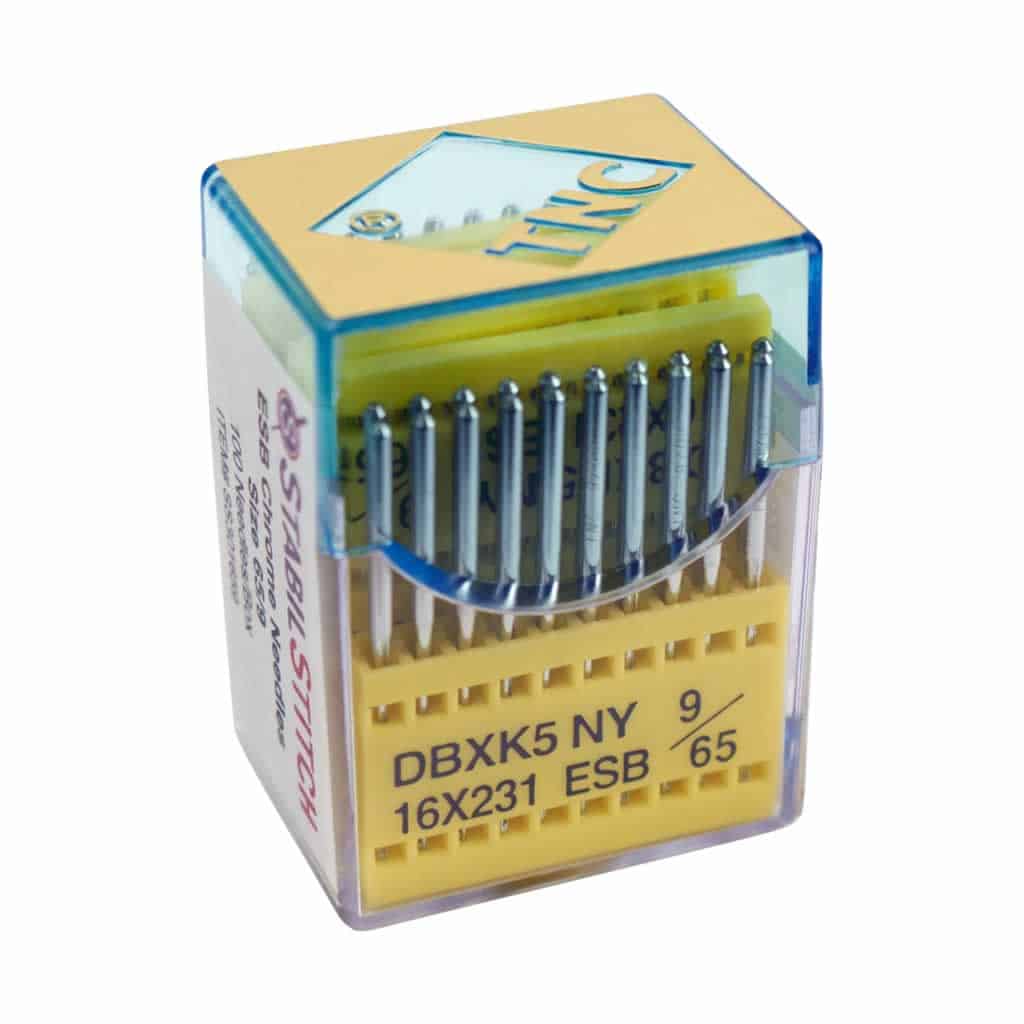
The ESB extra-light ball point is the “universal” embroidery needle — engineered to handle both woven and knit fabrics in a single needle, eliminating the need to swap between sharp and ball point for most production jobs. The extra-light ball gently separates knit fibers (preventing the unraveling that sharp points can cause on jersey), while still performing acceptably on most woven fabrics. The smart choice for shops running mixed garment loads — polos, tees, sweatshirts, and jackets — through a single machine in the same shift.

ESB (Extra Light Ball Point)
Most jobs, most fabrics — woven AND knit without needle changes
DBxK5 System
Universal commercial-machine compatibility (Tajima, Brother, Barudan, SWF, etc.).
5 Sizes Available
65/9, 70/10, 75/11, 80/12, 90/14 — choose at checkout based on fabric weight.
100 per Pack
Production-shop value pack. Triumph chrome plating.
Not sure which point type? See our full needle lineup — Sharp for wovens, SES for knits, ESB universal.
🚚 Same-day shipping before 3:30 PM CT  |  🎁 Free shipping over $200  |  📦 100 needles per pack —

$15.00

Description

UNIVERSAL — WOVEN & KNIT

Triumph ESB Extra Light Ball Point Chrome Needles — Pack of 100

One needle for both woven and knit fabrics — no swapping between point types.

🎯 ESB (Extra Light Ball Point)
⚙️ DBxK5 System
📦 100 per Pack
✨ Triumph Chrome
🏷️ Code: B301659

🎯 ESB (Extra Light Ball Point) Tip

Extra-light ball point tip — barely rounded, just enough to gently separate fibers on knits without compromising performance on most wovens. The “universal” needle of the embroidery world.

🔍 Larger DBxK5 Eye

Engineered with a larger eye than standard sewing needles — allows fluffy embroidery thread to pass through cleanly without fraying or breaking, which is the most common cause of failed stitches.

✨ Smooth Chrome Plating

Chrome coating reduces friction during high-speed stitching, extends needle life, and produces consistent stitch formation across long production runs.

🏭 Universal Commercial Machine Fit

DBxK5 is the industry-standard needle system used by Tajima, Barudan, SWF, Brother, Melco, Ricoma, Happy, Baby Lock, and most other commercial embroidery machines.

Why Choose ESB (Extra Light Ball Point)?

The ESB extra-light ball point is the “universal” embroidery needle — engineered to handle both woven and knit fabrics in a single needle, eliminating the need to swap between sharp and ball point for most production jobs. The extra-light ball gently separates knit fibers (preventing the unraveling that sharp points can cause on jersey), while still performing acceptably on most woven fabrics. The smart choice for shops running mixed garment loads — polos, tees, sweatshirts, and jackets — through a single machine in the same shift.

Best for these jobs:

  • Polo shirts and performance polos (knit + woven mix)
  • T-shirts and cotton tees
  • Hooded sweatshirts and fleece
  • Performance and athletic wear blends
  • Mixed-material multi-garment production runs
  • Production shops wanting to minimize needle changes

Size Breakdown — What Each Size Is Best For

This esb needle ships in 5 sizes. Choose at checkout based on your fabric weight and stitch count. If you’re unsure, 75/11 is the universal default that handles most embroidery jobs.

Size 65/9 — Ultra Fine

Best for:Very lightweight fabrics, fine details, small lettering, monograms
Fabric examples:Thin knits, lightweight performance fabrics, fine thread
Thread:60 wt or finer thread
Why this size:Minimizes fabric damage and needle holes on delicate garments — the most gentle option

Size 70/10 — Fine

Best for:Lightweight to medium fabrics with light stitch counts
Fabric examples:T-shirts, light polos, smooth knits
Thread:60 wt or standard 40 wt thread
Why this size:Cleaner detail than larger needles with minimal fabric stress

Size 75/11 — Standard / Most PopularMost Popular

Best for:Medium-weight fabrics — the universal default size
Fabric examples:Polo shirts, performance wear, caps (with backing)
Thread:Standard 40 wt embroidery thread
Why this size:The go-to size for most embroidery jobs — excellent balance of penetration and stitch quality. Start here if you’re unsure

Size 80/12 — Heavy Duty

Best for:Thicker fabrics and higher stitch counts
Fabric examples:Jackets, fleece, structured caps
Thread:40 wt embroidery thread
Why this size:Stronger needle resists deflection and breakage on dense materials

Size 90/14 — Extra Heavy

Best for:Heavy fabrics and very dense embroidery designs
Fabric examples:Heavy jackets, canvas, thick twill, large fill designs
Thread:40 wt embroidery thread
Why this size:Maximum strength for the most demanding embroidery jobs — heavy canvas, thick twill, large fill designs
💡 Sizing convention: Embroidery needles use a dual notation — the metric size (65, 70, 75, 80, 90) divided by the Singer/imperial size (9, 10, 11, 12, 14). Higher number = larger needle = stronger but more visible holes. Always size to your fabric, not your design — when in doubt, choose smaller.

Sharp vs. Ball Point — Which Should You Use?

We stock three needle point types, and choosing the right one is just as important as choosing the right size. The wrong point can damage knit garments or produce poor stitch quality on woven goods.

Needle Point TypeBest ForAvoid OnSizes
Sharp PointWoven fabrics — twill, denim, canvas, hats, jackets, button-up shirtsNot for knits — sharp tip can cut yarn loops and cause unraveling4 sizes
ESB (Extra Light Ball Point) — this productMost jobs, most fabrics — woven AND knit without needle changesExtreme cases — very heavy woven (use Sharp), or very loose/stretchy knit (use SES)5 sizes
SES (Light Ball Point)Knit fabrics — jerseys, t-shirts, fine knits, performance fabrics, stretch materialsNot ideal for heavy woven — ball point can deflect on twill and canvas5 sizes
💡 Quick rule of thumb: If you embroider mostly woven goods (caps, jackets, button-ups), buy Sharp. If you embroider mostly knits (tees, polos, performance wear), buy SES. If you mix both daily and want to minimize needle changes, buy ESB as your everyday needle.

When to Change Your Needle

⏱️ Every 6–8 Hours of Run Time
Industry rule of thumb: change needles after roughly 6–8 hours of continuous embroidery time. Sooner if you’re running dense designs, heavy thread, or high-stitch-count jobs.
🚨 Immediately on Damage
Replace immediately on any thread break, needle bend, or skipped stitches that don’t resolve with re-threading. A bent or burred needle damages thread and fabric.
🔄 When You Change Fabric Type
Swap needles when moving between very different fabric weights or point-type requirements (sharp ↔ ball point). Don’t carry over a needle worn in on canvas to a fine knit job.
📅 Before Critical Production Jobs
Always start a major production run, customer-priority job, or color-matched specialty thread job with fresh needles. Cheap insurance against costly fabric ruins.

Compatible With All Major Commercial Machines

The DBxK5 needle system is the industry standard for commercial embroidery machines. We carry products for many of the top brands in the embroidery industry:

Tajima
Industrial & commercial
Brother
PR series & commercial
Baby Lock
Multi-needle & single
Melco
Multi-head commercial
Barudan
BEKS & BEKY series
Ricoma
EM & MT-series
SWF
Korean commercial
Happy
HCH & HCS series
Janome MB
MB-4 & MB-7
Toyota
Commercial systems

Complete Your Embroidery Setup

Needles are one piece of the embroidery puzzle. Stock the rest of your shop from one vendor:

🧵 Exquisite 1000m Thread
100+ colors of 40 wt polyester on convenient 1000m spools. The everyday production thread.

Shop 1000m →

🧵 Exquisite 5000m Cones
Commercial 5000m cones for high-volume shops — fewer cone changes per shift.

Shop 5000m →

✨ KingStar Metallic Thread
15 vibrant metallic colors for high-impact decorative embroidery and accent stitching.

Shop Metallic →

🎯 Pre-Wound Bobbins
Save winding time — pre-wound bobbins in standard sizes for commercial machines.

Shop Bobbins →

🧢 Cap Backing
Tear-away stabilizer for finished cap embroidery — 3.0 oz and 3.5 oz weights, sheets and rolls.

Shop Cap Backing →

📐 Tear-Away Backing
For tees, polos, hoodies, and other flat embroidery — pairs perfectly with ball point needles.

Shop Tear-Away →

✂️ Cutaway Backing
For stretch fabrics and high-density designs — permanent support that doesn’t tear.

Shop Cutaway →

💨 Spray Adhesives
Temporary spray adhesive for hooping caps, odd-shaped pieces, and tricky garments.

Shop Aerosols →

👕 Blank Apparel
Wholesale blank apparel — tees, polos, caps, jackets — for embroidery decorators.

Shop Apparel →

Why Order from River City Supply?

🚚
Same-Day Shipping
Orders before 3:30 PM CT ship same-day from San Antonio, TX.
🧵
One Stop for the Whole Shop
Needles, thread, bobbins, backing — one vendor for the entire embroidery setup.
📞
Real Embroidery Help
Not sure which point or size? Call us — we sell to embroidery shops every day.
17+ Years in Business
Founded 2008 — serving screen printers & embroiderers nationwide.

Technical Specifications

Triumph ESB Extra Light Ball Point Chrome Needles — Technical Specifications

SpecificationDetail
Product NameTriumph ESB Extra Light Ball Point Chrome Needles
Product CodeB301659
BrandTriumph
Needle SystemDBxK5 (industry-standard commercial embroidery system)
Point TypeESB (Extra Light Ball Point)
Tip GeometryExtra-light ball point tip — barely rounded, just enough to gently separate fibers on knits without compromising performance on most wovens. The “universal” needle of the embroidery world.
PlatingChrome — smooth surface, reduced friction, extended life
Eye SizeEnlarged for embroidery thread (one size larger than standard sewing needles)
Shank TypeRound shank — standard DBxK5 commercial machine fit
Available Sizes65/9, 70/10, 75/11, 80/12, 90/14
Sizing SystemDual notation: metric (Nm) / Singer (No.)
Pack Quantity100 needles per pack
Best For Fabric TypeMost jobs, most fabrics — woven AND knit without needle changes
Avoid OnExtreme cases — very heavy woven (use Sharp), or very loose/stretchy knit (use SES)
Machine CompatibilityTajima, Brother, Barudan, SWF, Melco, Ricoma, Happy, Baby Lock, Janome MB, Toyota, and other commercial DBxK5 systems
Recommended Thread40 wt polyester or rayon embroidery thread (60 wt for fine detail)
Recommended Replacement CycleEvery 6–8 hours of run time, or immediately on damage/skipped stitches
StorageCool, dry location away from humidity

Properties are typical for the Triumph DBxK5 needle system. Confirm critical specifications with our team before specifying for a demanding application.

Technical Sheets / Safety Data Sheets / Documents

Documents & Specifications

Need a spec sheet or compatibility chart for the Triumph ESB Extra Light Ball Point Chrome Needles? Request the current Triumph documentation and we’ll send the latest revision for your records.

📄
Product Code B301659 — Spec Sheet
Technical data, machine compatibility chart, and size guide
ℹ️ Build a Complete Embroidery Setup
Pair these needles with Exquisite thread, pre-wound bobbins, and the right embroidery backing for your job. Browse our complete embroidery supplies category.
Questions about needle specs or bulk pricing?

FREQUENTLY ASKED QUESTIONS

Frequently Asked Questions

What does “DBxK5” mean?

DBxK5 is the needle system designation — an industry-standard specification for commercial embroidery needles. Designed for use in industrial embroidery machines such as Tajima, Barudan, SWF, Brother, Melco, and most other multi-head commercial systems. The defining feature: a larger eye than a standard sewing needle, which lets the fluffy embroidery thread pass through without fraying or breaking. The K5 also has special geometry that resists deflection at high embroidery speeds.

Why use ESB instead of just having both Sharp and SES?

Production efficiency. The ESB extra-light ball point is engineered as a “universal” needle that handles both woven and knit fabrics adequately for most jobs — which means a multi-head machine doesn’t need needle swaps between every garment type that comes through the shop. The trade-off: ESB isn’t the absolute best at either extreme. If your shop runs almost exclusively woven goods (caps, jackets), Sharp Point will give crisper detail. If your shop runs almost exclusively knits (tees, performance wear), SES will be gentler on the fabric. For everything else — most shops — ESB is the right everyday needle.

What does the 75/11 size designation mean?

Embroidery needles use a dual size system. The first number (65, 70, 75, 80, 90) is the metric size — the needle blade diameter in hundredths of a millimeter. The second number (9, 10, 11, 12, 14) is the Singer/Imperial number, an older parallel system. A 75/11 is a 0.75mm needle. Higher number = larger needle = stronger but more visible holes. Size to your fabric, not your design.

Which size should I start with?

75/11 is the universal default — it handles the widest range of fabrics and stitch counts. If you’re new to commercial embroidery or unsure about your specific fabric, start there. Move down to 65/9 or 70/10 for very fine detail or delicate fabrics; move up to 80/12 or 90/14 (where available) for heavier fabrics or higher stitch densities.

Why does this needle have a bigger eye than a regular sewing needle?

Embroidery thread is fundamentally different from sewing thread — it’s “fluffier” with less tensile strength, optimized for sheen and stitch appearance rather than seam strength. A standard sewing needle eye is too small for embroidery thread to pass cleanly, which causes fraying, thread breaks, and skipped stitches. DBxK5 needles have a larger eye (without an increased blade diameter) that lets embroidery thread pass smoothly while keeping the hole in the fabric small.

How often should I change needles?

Every 6–8 hours of continuous run time is the industry rule of thumb, or sooner for dense designs and high-stitch-count jobs. Replace immediately if you experience thread breaks, skipped stitches that don’t resolve with re-threading, or any visible bend in the needle. Also swap fresh needles before starting major production runs or specialty thread jobs where a ruined garment would be costly.

Will these work in my embroidery machine?

If your machine uses the DBxK5 system (the industry standard for multi-head commercial machines), yes — these will fit. Confirmed compatible with Tajima, Brother (PR series and commercial), Barudan, SWF, Melco, Ricoma, Happy, Baby Lock, Janome MB, Toyota, and most other commercial multi-needle systems. If you have a less common machine, check your manual for the needle system spec, or call us at (512) 454-0505 to confirm.

What thread should I use with these needles?

Standard 40 wt polyester embroidery thread is the universal choice. Use a finer 60 wt thread with the smaller 65/9 needle if you’re running tiny lettering or fine detail work. For high-volume production runs, the same thread on 5000m cones means fewer changeovers per shift. Metallic threads work but typically require a larger needle (try 80/12) and slower speeds to prevent breaks.

Are these the same as titanium needles?

No — these are chrome-plated steel needles, the standard production embroidery needle. Titanium-coated needles are a step up in price and durability — they last 3–5× longer than chrome, especially on dense designs or sticky fabrics that build up adhesive residue. For most production shops, chrome needles delivered at $15 per 100-pack are the cost-effective everyday choice; titanium becomes worth it on high-volume runs or with materials that wear needles quickly.

How should I store unused needles?

Store the pack in a cool, dry location away from humidity. Chrome plating resists rust under normal shop conditions, but prolonged moisture exposure can pit the surface. Keep needles in their original packaging until needed — both for organization (so you don’t mix sizes) and protection from accidental damage.
Need help picking the right needle?

Reviews

Reviews

    Only logged in customers who have purchased this product may leave a review.
    You May Also Like

    Additional Options