
Inktek PCPC10650 Marine Pigment Concentrate – Mix Custom Plastisol Colors
Inktek
Inktek PCPC10650 Marine Pigment Concentrate is one of 15 intermixable concentrates in the Inktek PC Color Mixing System — a plastisol color mixing system for producing accurate Pantone® color simulations. Classic navy/marine blue — most-used blue in team and collegiate printing. Never used straight from the container — always weighed and blended into a plastisol mixing base at formula-specified ratios before printing. Ideal for high-production, wet-on-wet printing. Delivers a matte finish with excellent crock resistance. CPSIA compliant, phthalate-free.
Price range: $190.52 through $778.68
Description
Inktek Marine PC — Pantone-Accurate Plastisol Color Mixing
The Inktek PC system produces thousands of Pantone® color simulations from 15 intermixable concentrates. PCPC10650 Marine is one of the core concentrates — weigh it by grams, blend into your preferred plastisol mixing base, and you have a formula you can reproduce exactly every time a client reorders.
Pigment concentrates are mixed into a plastisol mixing base — never used straight from the container. The concentrate provides color; the base provides the plastisol carrier, opacity, and printability.
Use formula software with your Pantone® Coated guide for the exact grams of each concentrate per pound of mixing base. The result: a Pantone-matched color reproducible identically on every reorder.
The full Inktek PC system gives you 15 concentrates — 7 standard colors, 1 white, 1 black, and 5 fluorescent — that blend with each other and any plastisol mixing base for thousands of color combinations.
Inks produced with the Inktek PC system are designed for high-speed wet-on-wet printing on automatic presses — excellent crock resistance, build-up resistant, matte finish.
Mixed inks meet rigorous dry and wet crocking standards — important for team sports, athletic wear, and any application where rubbing abrasion is a concern.
Inktek PC concentrates are CPSIA compliant, phthalate-free, and formulated without restricted substances — suitable for children’s apparel and licensed brand programs.
Inktek Pigment Concentrates are raw pigments — not screen printing inks. They must be combined with a plastisol mixing base in formula-specified ratios before they can be printed. Do NOT attempt to print pigment concentrate directly from the container. Printing unmixed concentrate will produce poor results, waste expensive pigment, and can damage screens and equipment.
- Get your formula — enter your target Pantone code in your formula software to get the exact gram weights of each concentrate
- Weigh on a gram scale — measure the exact grams specified for each concentrate into a clean mixing container
- Add a plastisol mixing base — blend the concentrate(s) into the appropriate Inktek plastisol mixing base
- Mix thoroughly — use a drill mixer for 60-90 seconds until fully combined
- Now you can print — the mixed ink is ready to go to press
Questions about mixing? Call us at (512) 454-0505 or email [email protected] — we’re happy to help.
How to Use Inktek PC Pigment Concentrates
Open your Pantone Formula Guide. Enter the target Pantone code in your formula software. The software returns the exact grams of each concentrate per pound of mixing base.
Tare your gram scale. Weigh the specified grams of each concentrate directly into a clean container with the plastisol mixing base. Mix thoroughly with a drill mixer for 60-90 seconds.
Mixed ink is ready to print. Cure at 320F (160C). Log your formula, batch weight, and date for exact color reproduction on future reorders.
How Much Concentrate Do I Need?
| Color Type | Typical Range | Notes |
|---|---|---|
| Extra White / Tints | 20–80g | Higher for opaque whites; lower for pastel tints |
| Standard Colors (yellow, orange, green) | 15–50g | Varies significantly by target hue |
| Black | 5–25g | Very concentrated — a little goes a long way |
| Deep colors (maroon, marine, violet) | 20–60g | Often requires higher concentrations |
| Fluorescent colors | 10–40g | Bright at lower doses over white underbase |
The table above gives rough order-of-magnitude guidance. The actual amount depends entirely on your target Pantone color. Use your formula software to get the exact gram weights per 1 lb of base for your specific color target.
Rule of thumb for ordering: 1 quart of concentrate typically mixes 20–50 lbs of finished ink depending on the color formula. For high-volume Pantone color production, concentrates are far more cost-efficient than pre-mixed inks.
Call us at (512) 454-0505 if you need help estimating quantities for a specific job.
Pigment concentrates must be blended with a plastisol mixing base before printing. Choose your base based on fabric, finish, and opacity requirements. The most common options: General Purpose Clear Base for standard production, Opaque Base for darker fabric coverage, and Soft-Hand Base for premium apparel. All are compatible with all 15 Inktek PC concentrates.
Best Use Cases
The primary use case. Open your Pantone Solid Coated book, find your target PMS code, look up the formula, and blend. Accurate, repeatable, client-approved color every time.
Mix exact brand colors for licensed apparel programs, sports teams, and corporate clients who specify strict color accuracy requirements.
The PC system is designed for automatic presses running wet-on-wet. Mixed inks resist build-up and deliver consistent results through long production runs.
Blend multiple concentrates to create intermediate colors. The 15 concentrates cover the full color wheel for virtually unlimited custom color capability.
Complete Inktek PC Pigment Concentrate System — All 15 Colors
15 intermixable concentrates. Mixed with a plastisol mixing base at formula-specified ratios. Click any image or color name to visit its product page. ★ = current product.
| Image | Name | SKU | Type | Pantone Sim. |
|---|---|---|---|---|
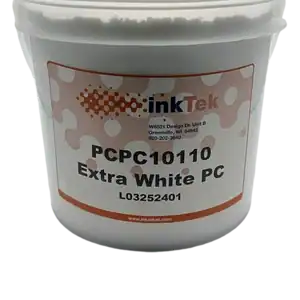 | Extra White | PCPC10110 | STD | White |
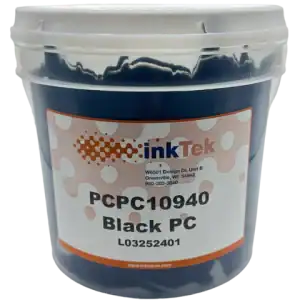 | Black | PCPC10940 | STD | 419 C |
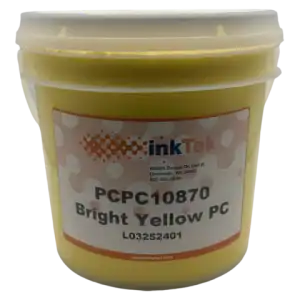 | Bright Yellow | PCPC10870 | STD | 109 C |
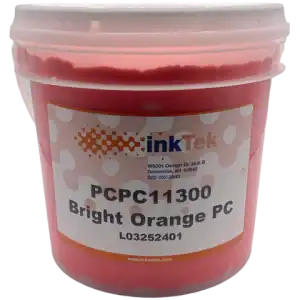 | Bright Orange | PCPC11300 | STD | 151 C |
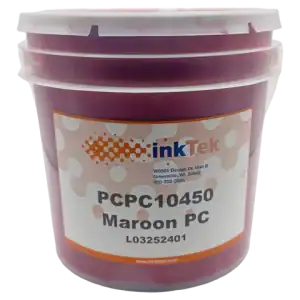 | Maroon | PCPC10450 | STD | 202 C |
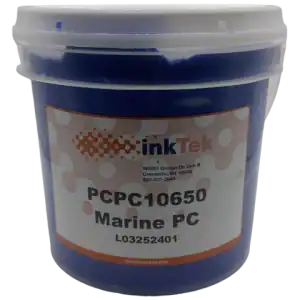 | Marine ★ | PCPC10650 | STD | 295 C |
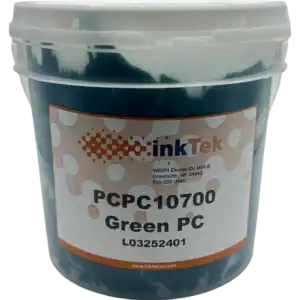 | Green | PCPC10700 | STD | 350 C |
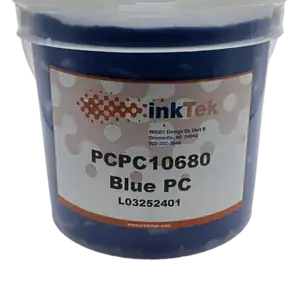 | Blue | PCPC10680 | STD | 286 C |
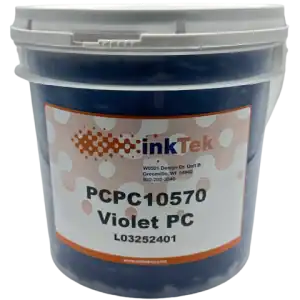 | Violet | PCPC10760 | STD | 267 C |
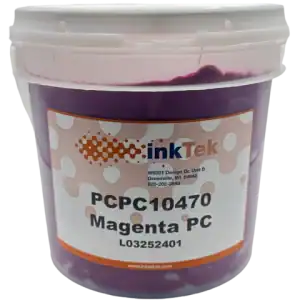 | Magenta | PCPC10300 | STD | Rhodamine Red C |
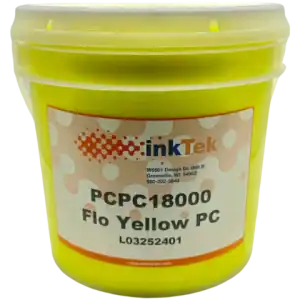 | Flo Yellow | PCPC18000 | FLO | 396 C |
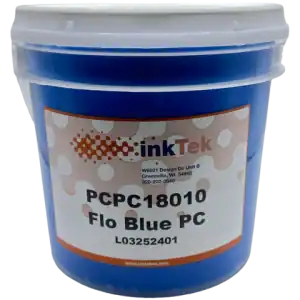 | Flo Blue | PCPC18010 | FLO | 2728 C |
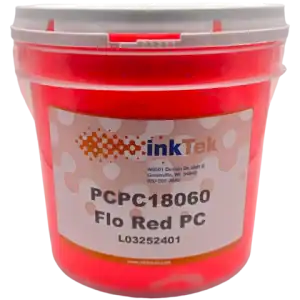 | Flo Red | PCPC18060 | FLO | 032 C |
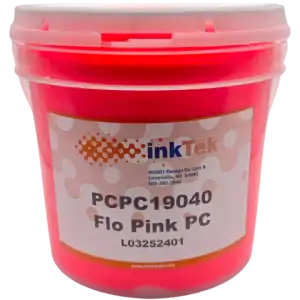 | Flo Pink | PCPC19040 | FLO | Pink C |
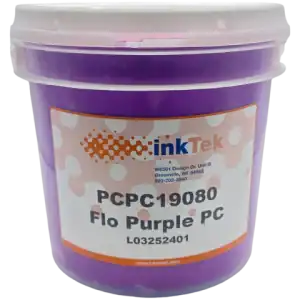 | Flo Purple | PCPC19080 | FLO | 2592 C |
Prefer a finished ink system instead of mixing concentrates? The Inktek LBX System is a complete low-cure plastisol mixing system with 15 inter-mixable finished inks — no separate base required. Higher cost per unit but faster to mix and use on press. PC concentrates offer lower cost and more flexibility; LBX offers speed and simplicity.
Pro Tips for Best Results
Pigment concentrates must be blended into a plastisol mixing base at the formula-specified ratio before printing. Printing concentrate alone produces poor results and wastes expensive pigment.
Weigh every component by grams, not volume. Visual approximation causes color drift across batches. A gram scale is non-negotiable for repeatable Pantone-matched results.
Use a high-speed drill mixer after adding concentrate to the base. Incomplete mixing produces streaks and color inconsistency on press.
Verify cure with a donut probe on the ink surface, not just the tunnel temperature. Always wash-test a sample before production runs.
When printing on polyester or blends, use a low-bleed white or blocker base first to prevent dye migration into your mixed PC colors.
Technical Specifications
Inktek PCPC10650 Marine Pigment Concentrate — Technical Specifications
| Specification | Value / Detail |
|---|---|
| SKU | PCPC10650 |
| System | Inktek PC 15-Concentrate Color Mixing System |
| Color Name | Marine |
| Type | Standard Pigment Concentrate |
| Pantone® Simulation | 295 C (simulation — slight variation is normal) |
| IMPORTANT | Must be mixed with a plastisol mixing base before printing — not a ready-to-use ink |
| Finish | Matte (when mixed with a plastisol mixing base) |
| Cure Temperature | 320F (160C) — standard plastisol cure |
| Gel Temperature | 155–165F |
| Mesh Range | 110–305/in (43–120 t/cm) |
| Screen Tension | 25–35 N/cm² |
| Fabric Compatibility | 100% Cotton, cotton/poly blends, select synthetics |
| Polyester | Use a low-bleed white or blocker base to prevent dye migration |
| Wet-on-Wet | Yes — formulated for wet-on-wet production |
| Crock Resistance | Excellent — dry and wet crocking |
| Lightfastness | Good — standard lightfast pigments. |
| Usage Method | Always blended with a plastisol mixing base — never printed alone |
| Weight Measurement | Mix by weight (grams) — never by volume |
| CPSIA Compliance | Compliant |
| Phthalate | Phthalate-free, non-phthalate |
| Storage | 65–90F (18–32C). Avoid direct sunlight. 1 year shelf life from manufacture. |
| Recommended Mesh | 110–305/inch (43–120 t/cm) — standard plastisol mesh range |
| Screen Tension | 25–35 N/cm² |
| Squeegee Durometer | 60–75 shore for most applications. 70/90/70 triple durometer for fine detail. |
| Squeegee Angle | 10–15° off vertical |
| Squeegee Stroke Speed | Medium to fast |
| Flood Stroke | Light flood before first pull — fills mesh evenly |
| Wet-on-Wet | Suitable — ink is designed for wet-on-wet production |
| Flash Temperature | 160–180F (71–82C) for intermediate flashing |
| Gel Temperature | 155–165F — ink surface should not transfer to next screen |
| Cure Temperature | 320F (160C) — full fusion required for wash fastness |
| Cure Dwell Time | 60–90 seconds at cure temp minimum; verify with wash test |
| Underbase on Dark Garments | Required — use an opaque white underbase, flash, then print PC colors on top |
| Dye Migration (Polyester) | Use a low-bleed white or blocker base before PC colors on polyester |
Technical Sheets / Safety Data Sheets / Documents
FREQUENTLY ASKED QUESTIONS
{"@context":"https://schema.org","@type":"FAQPage","mainEntity":[{"@type":"Question","name":"⚠ Can I print this pigment concentrate directly from the container?","acceptedAnswer":{"@type":"Answer","text":"No. Inktek Marine Pigment Concentrate (PCPC10650) is NOT a ready-to-use screen printing ink. It is a raw pigment concentrate that must be weighed and blended into a plastisol mixing base at formula-specified ratios before it can be printed. Printing concentrate alone from the container will produce unusable results and waste expensive pigment."}},{"@type":"Question","name":"What is Inktek PCPC10650 Marine Pigment Concentrate and how do I use it?","acceptedAnswer":{"@type":"Answer","text":"Inktek PCPC10650 Marine is one of 15 intermixable pigment concentrates in the Inktek PC Color Mixing System. Classic navy/marine blue — most-used blue in team and collegiate printing. To use it: (1) Enter your target Pantone code in your formula software to get exact gram weights, (2) Weigh the specified grams of concentrate(s) on a gram scale, (3) Blend into a plastisol mixing base using a drill mixer for 60-90 seconds, (4) Print at standard settings, cure at 320F."}},{"@type":"Question","name":"What mixing base do I use with Inktek PC concentrates?","acceptedAnswer":{"@type":"Answer","text":"Inktek PC concentrates are compatible with Inktek plastisol mixing bases including general-purpose, opaque, soft-hand, and transfer bases. For polyester printing, use a low-bleed or poly white base to prevent dye migration. Browse compatible bases."}},{"@type":"Question","name":"How accurate is the Pantone color simulation?","acceptedAnswer":{"@type":"Answer","text":"The Inktek PC system produces accurate Pantone® simulations when formulas are followed precisely by weight on a gram scale. Note that plastisol inks on fabric simulate — not match — Pantone colors due to differences in ink film, opacity, substrate, and production method. Always print and approve a color proof on the actual production garment before running full quantities."}},{"@type":"Question","name":"What is the cure temperature for Inktek PC inks?","acceptedAnswer":{"@type":"Answer","text":"Inktek PC mixed inks cure at 320F (160C) as standard. Always verify with a donut probe thermometer on the ink surface — not just the tunnel temperature. Conduct a wash test on every new garment or substrate before committing to full production."}}]}
⚠ Can I print this pigment concentrate directly from the container?
No. Inktek Marine Pigment Concentrate (PCPC10650) is NOT a ready-to-use screen printing ink. It is a raw pigment concentrate that must be weighed and blended into a plastisol mixing base at formula-specified ratios before it can be printed. Printing concentrate alone from the container will produce unusable results and waste expensive pigment.
What is Inktek PCPC10650 Marine Pigment Concentrate and how do I use it?
Inktek PCPC10650 Marine is one of 15 intermixable pigment concentrates in the Inktek PC Color Mixing System. Classic navy/marine blue — most-used blue in team and collegiate printing. To use it: (1) Enter your target Pantone code in your formula software to get exact gram weights, (2) Weigh the specified grams of concentrate(s) on a gram scale, (3) Blend into a plastisol mixing base using a drill mixer for 60-90 seconds, (4) Print at standard settings, cure at 320F.
What mixing base do I use with Inktek PC concentrates?
Inktek PC concentrates are compatible with Inktek plastisol mixing bases including general-purpose, opaque, soft-hand, and transfer bases. For polyester printing, use a low-bleed or poly white base to prevent dye migration. Browse compatible bases.
How accurate is the Pantone color simulation?
The Inktek PC system produces accurate Pantone® simulations when formulas are followed precisely by weight on a gram scale. Note that plastisol inks on fabric simulate — not match — Pantone colors due to differences in ink film, opacity, substrate, and production method. Always print and approve a color proof on the actual production garment before running full quantities.
What is the cure temperature for Inktek PC inks?
Inktek PC mixed inks cure at 320F (160C) as standard. Always verify with a donut probe thermometer on the ink surface — not just the tunnel temperature. Conduct a wash test on every new garment or substrate before committing to full production.
Reviews
Only logged in customers who have purchased this product may leave a review.
You May Also Like
Related products
-

Inktek PCPC10470 Magenta Pigment Concentrate – Mix Custom Plastisol Colors
Price range: $326.96 through $1,354.23 -
Inktek PCPC10680 Blue Pigment Concentrate – Mix Custom Plastisol Colors
Price range: $129.66 through $521.73 -
Inktek PCPC18000 Flo Yellow Pigment Concentrate – Mix Custom Plastisol Colors
Price range: $223.08 through $915.93 -
Inktek PCPC10870 Bright Yellow Pigment Concentrate – Mix Custom Plastisol Colors
Price range: $243.70 through $1,002.87

Reviews